

Quick answer
D2C brand analytics in India tracks customer acquisition cost, retention cohorts, unit economics per order, marketing channel ROAS, and repeat purchase behaviour for brands selling directly through their own website and app. With India's D2C market exceeding $60 billion and funded brands facing profitability pressure, analytics helps D2C companies reduce CAC, improve LTV, optimise ad spend, and build sustainable unit economics beyond marketplace-dependent growth.
India's D2C ecosystem has exploded, with over 800+ funded D2C brands across beauty, food, fashion, health, and home categories. However, the post-2022 funding slowdown has forced a shift from growth-at-all-costs to profitability-focused operations. Analytics is the foundation of this pivot — D2C brands that track unit economics rigorously survive, while those that don't run out of runway.
Why D2C Analytics Matters in India
Indian D2C brands face unique analytical challenges:
- High CAC environment: Digital advertising costs in India have risen 40–60% over 3 years — Meta and Google CPMs are increasing while organic reach declines
- Marketplace dependence: Many "D2C" brands generate 50–70% of revenue from Amazon and Flipkart, not their own website — true D2C economics are hard to achieve
- Low repeat rates: Most Indian D2C brands see 15–25% repeat purchase rates, making customer retention the biggest lever for profitability
- COD burden: 30–50% of D2C website orders are COD, with higher RTO (Return to Origin) rates than prepaid orders
- Price-sensitive market: Indian consumers comparison-shop across channels, making pricing and discount strategy data-critical
Core D2C Metrics Indian Brands Track
Unit Economics
- Average Order Value (AOV): Revenue per order — Indian D2C AOVs typically range from ₹500–₹2,500 depending on category
- Contribution Margin (CM) per order: Revenue minus COGS, packaging, shipping, payment gateway fees, and returns — the true per-order profitability
- CM1 and CM2 breakdown: CM1 = revenue minus COGS; CM2 = CM1 minus fulfilment costs (shipping, packaging, COD charges)
- Blended CAC: Total marketing spend / new customers acquired
- LTV-to-CAC ratio: Must be >3x for sustainable D2C — many Indian brands operate at 1.5–2.5x
- Payback period: Months required to recover CAC from customer purchases — target is under 6 months
Customer Acquisition Metrics
- Channel-wise CAC: Meta Ads, Google Ads, influencer marketing, affiliate, organic — each tracked separately
- ROAS by channel: Revenue generated per rupee of ad spend
- CPC and CPM trends: Meta CPMs in India range ₹50–₹200 depending on category and targeting
- New customer percentage: Percentage of orders from first-time buyers
- Assisted conversions: Attribution across touchpoints — a customer might see an Instagram ad, search on Google, then buy through a WhatsApp link
Retention and Cohort Metrics
- Month 1, 3, 6, 12 retention rates: Percentage of acquired customers who make another purchase within each timeframe
- Cohort revenue curves: Revenue generated by each acquisition cohort over time — reveals whether your business is building compounding value
- Repeat purchase rate: Percentage of customers with 2+ orders — the single most important D2C health metric
- Time between purchases: Average days between first and second order — shorter is better
- Reactivation rate: Percentage of churned customers (no purchase in 6+ months) who return after re-engagement campaigns
Product Analytics
- SKU-wise contribution margin: Not all products are created equal — some drive acquisition (low margin, high volume), others drive profit
- Bundle performance: Combo and subscription bundle conversion rates and margin impact
- First-order product mix: Which products do new customers buy? This determines initial brand experience
- Cross-sell and upsell rate: Percentage of orders that include recommended products
- Return rate by SKU: Identifies product-market fit issues at the SKU level
Marketing Performance
- Blended ROAS: Total revenue / total marketing spend — Indian D2C brands target 3–5x blended ROAS
- Meta Ads performance: Campaign, ad set, and creative-level ROAS, CTR, and conversion rate
- Google Ads performance: Brand vs non-brand search ROAS, shopping ads performance
- Influencer ROI: Revenue attributed to influencer campaigns (tracked via UTMs, discount codes, or landing pages)
- Email and WhatsApp marketing ROI: Revenue from retention channels vs cost — these should be the highest-ROI channels for repeat purchases
D2C Analytics Dashboards
Founder/CEO Dashboard
- Revenue trend: daily, MTD, and vs same period last year
- New customers vs repeat customers (revenue and orders)
- Blended CAC and LTV-to-CAC ratio
- Contribution margin per order trend
- Cash burn rate and runway
Marketing Head Dashboard
- Channel-wise spend, ROAS, and CAC
- Creative performance (top 5 and bottom 5 creatives by ROAS)
- Campaign budget pacing
- Audience segment performance
- Organic vs paid revenue split
Retention/CRM Dashboard
- Cohort retention matrix (acquisition month vs retention month)
- Repeat purchase rate trend
- Email and WhatsApp campaign performance (open rate, click rate, revenue per send)
- Churn risk segments (customers past expected repurchase window)
- Loyalty program metrics (if applicable)
Operations Dashboard
- Orders by fulfilment status (processing, shipped, delivered, RTO)
- COD vs prepaid split and RTO rates
- Shipping partner performance (TAT, delivery success rate)
- Inventory levels vs sales velocity
- Return rate analysis by reason
Data Sources for Indian D2C Analytics
- E-commerce platform: Shopify (dominant in Indian D2C), WooCommerce, custom builds
- Ad platforms: Meta Ads Manager, Google Ads, Taboost/OutBrain for content marketing
- Email/WhatsApp: Klaviyo, WebEngage, MoEngage, Wati — retention marketing platforms
- Analytics: Google Analytics 4, Mixpanel, Amplitude — website and app behaviour
- Payment: Razorpay, Cashfree — transaction data and COD reconciliation
- Shipping: Shiprocket, Delhivery, BlueDart — fulfilment and delivery data
- CRM: HubSpot, Zoho CRM, or built-in Shopify customer data
Challenges in Indian D2C Analytics
Attribution Complexity
Indian D2C customer journeys are multi-touch: Instagram discovery → Google search → WhatsApp enquiry → website purchase. With iOS privacy changes limiting tracking, attribution is increasingly difficult. Most Indian D2C brands use a mix of UTM tracking, discount code attribution, and post-purchase surveys.
Marketplace vs D2C Website Data Silos
Brands selling on Amazon, Flipkart, AND their own website have fragmented customer data. A customer on Amazon is Amazon's customer — the brand gets limited data. Unifying cross-channel customer analytics is a major challenge.
COD and RTO Impact on Unit Economics
COD orders that result in RTO (Return to Origin) are the biggest unit economics killer for Indian D2C brands. The brand pays forward and reverse shipping, plus handling costs, with zero revenue. Analytics must track RTO rates by pincode, payment method, and order value to identify and mitigate this leakage.
Influencer Attribution
India's D2C ecosystem relies heavily on influencer marketing, but measuring influencer ROI beyond vanity metrics (likes, views) is difficult. Best practice is combining unique discount codes, UTM-tagged links, and time-based attribution windows.
See e-commerce analytics India for marketplace-specific analytics, and trend analysis for retention measurement methodology.
Ready to act on your data?
See how teams use FireAI to ask in plain language and get analytics they can trust.
Explore FireAI workflows
Go from this topic into product features and solution paths that match what you read here.
Topic hub
Industry Analytics In India
Comparison pages and implementation guidance for industry-specific BI, dashboards, and analytics use cases in India.
Explore hubFrequently asked questions
What is a good LTV-to-CAC ratio for Indian D2C brands?
A healthy LTV-to-CAC ratio for Indian D2C brands is 3x or higher — meaning the lifetime value of a customer should be at least 3 times the cost of acquiring them. Many Indian D2C brands operate at 1.5–2.5x, which is unsustainable long-term. Improving this ratio requires either reducing CAC (better targeting, organic growth) or increasing LTV (better retention, cross-selling, subscription models).
How do Indian D2C brands reduce Customer Acquisition Cost?
Indian D2C brands reduce CAC through better creative testing (data-driven ad creative iteration), audience segmentation (lookalike audiences based on high-LTV customers), organic growth channels (SEO, content marketing, community building), referral programs, and shifting spend from awareness to retargeting. Building brand recall through consistent social media presence reduces dependence on paid acquisition over time.
Which analytics tools do Indian D2C brands typically use?
Indian D2C brands typically use Shopify Analytics for basic e-commerce metrics, Google Analytics 4 for website behaviour, Meta Ads Manager and Google Ads for marketing analytics, and platforms like WebEngage or MoEngage for retention analytics. For unified dashboards combining all data sources, brands use BI tools like FireAI, Looker Studio, or custom data stacks built on tools like Segment and Amplitude.
Related in this topic
Best BI Tools for E-Commerce Analytics in India (2026)
Compare the best business intelligence tools for Indian e-commerce businesses. Review features for order analytics, seller performance, returns, inventory, and customer behaviour across FireAI, Power BI, Zoho Analytics, and others.
7 Best BI Tools in India (2026)
Compare the best business intelligence tools for Indian businesses in 2026. See pricing features and which BI platform fits SMBs mid-market and enterprise.
E-commerce Analytics in India: Marketplace, CAC & LTV
E-commerce analytics in India covers marketplace seller performance, customer acquisition cost, LTV, and unit economics. Learn key metrics for Indian e-commerce businesses.
Trend Analysis: Definition, Methods & Examples (With Formulas)
Trend analysis spots patterns in sales, revenue and demand over time. Learn 6 methods (moving averages, regression, time-series), formulas, and real business examples.
From the blog

Top 7 Marketing Metrics to Track in 2026 and How AI Simplifies Them
In 2026, track these 7 critical marketing metrics — CLV, CAC, ROAS, Conversion Rate, Engagement, Brand Awareness, and ROI — to prove real business impact instead of vanity stats.
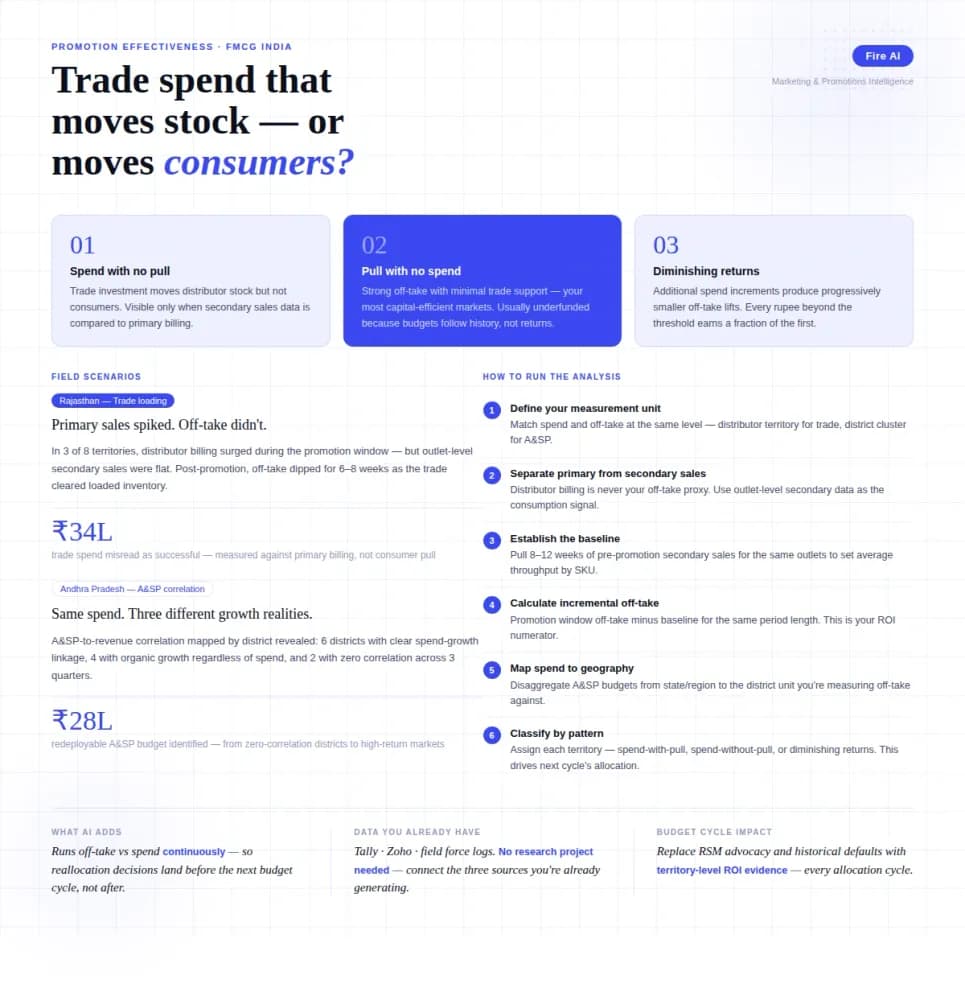
Measuring Promotion Effectiveness: A Data-Driven Guide for FMCG Marketers
FMCG brands in India spend 15–25% of gross revenue on trade promotions and A&SP (advertising and sales promotion) every year. Most can tell you how much they spent. Very few can tell you what it returned. The problem isn't a lack of data — it's that the data lives in disconnected places. Trade spend sits in finance. Off-take data lives with the distributor or field team. A&SP budgets are tracked in a marketing spreadsheet. No single view ties promotional investment to consumer pull at the outlet level. The result is a budget cycle where last year's spend allocation becomes next year's default, because no one has the numbers to argue for something different. This guide walks through how FMCG marketing and trade teams can build a promotion effectiveness framework that actually connects spend to outcome — not just channel-level assumptions.

What is a KPI dashboard and why does every Indian business need one?
Still piecing together your business numbers from WhatsApp messages and old Excel files? Here is why a KPI dashboard changes everything for Indian businesses.