

Quick answer
Healthcare analytics in India tracks bed occupancy, OPD-to-IPD conversion, ARPOB, revenue cycle efficiency, and clinical outcomes. In a $372 billion sector with 5–10% revenue leakage at most hospitals, tools like FireAI connect HIS and Tally data to deliver real-time operational dashboards — helping hospitals reduce claim rejections and improve patient throughput without IT teams.
India's healthcare sector is projected to reach $372 billion by 2027, driven by hospital chain expansion, health insurance growth, government schemes like Ayushman Bharat, and increasing health awareness. Analytics is becoming essential for hospitals to manage operations efficiently, reduce costs, and deliver better patient outcomes at scale.
Why Healthcare Analytics Matters in India
Indian healthcare has unique analytics requirements:
- Mixed payer models: Patients pay through insurance (cashless and reimbursement), government schemes (Ayushman Bharat, state schemes), and out-of-pocket — each requiring different billing and collection workflows
- High OPD volumes: Indian hospitals handle significantly higher patient volumes than Western counterparts — a 300-bed hospital may see 1,000+ OPD patients daily
- Doctor productivity: With a doctor-to-patient ratio of 1:1,400 (vs WHO recommended 1:1,000), maximising doctor productivity is critical
- Revenue leakage: Studies estimate 5–10% revenue leakage in Indian hospitals due to billing errors, undercoding, and process gaps
- NABH accreditation: India's hospital quality standard requires systematic data tracking across clinical and operational parameters
Core Healthcare Metrics for Indian Hospitals
Patient Flow Metrics
- OPD footfall: Daily outpatient registrations and consultations
- OPD-to-IPD conversion rate: Percentage of outpatients who are admitted — typically 8–15% for multi-specialty hospitals
- Average length of stay (ALOS): Days per admission — lower ALOS with maintained outcomes indicates efficiency
- Bed occupancy rate: Target is 75–85% for optimal operations — too high means capacity strain, too low means underutilisation
- Patient wait time: Registration-to-consultation time for OPD, and admission-to-bed-assignment time for IPD
- Discharge TAT: Time from doctor's discharge order to actual patient exit — a major patient satisfaction driver
Revenue and Financial Metrics
- Average Revenue Per Occupied Bed (ARPOB): The headline revenue metric for Indian hospitals — ranges from ₹30,000–₹80,000/day for corporate hospital chains
- Revenue per patient (OPD and IPD separately): Tracks monetisation efficiency
- Payer mix: Cash vs insurance vs government scheme contribution — affects revenue realisation and collection cycles
- Billing-to-collection ratio: Especially important for insurance and government scheme patients where claim rejection rates can be high
- TPA/insurance claim rejection rate: Percentage of claims rejected by TPAs — target is below 5%
- Revenue cycle days: Average time from service delivery to payment collection
Clinical Outcome Metrics
- Mortality rate: Tracked by department and procedure, risk-adjusted
- Surgical site infection rate: Key quality indicator tracked for NABH
- Readmission rate within 30 days: Indicates quality of initial treatment
- Hospital-acquired infection rate: Critical for ICU and surgical departments
- Antibiotic usage patterns: WHO recommends tracking to combat antimicrobial resistance
Operational Efficiency Metrics
- OT (Operation Theatre) utilisation: Percentage of available OT hours actually used for surgeries
- Lab and radiology TAT: Time from sample collection/test order to report delivery
- Pharmacy revenue as % of total: Typically 15–25% for Indian hospitals
- Emergency department wait-to-treatment time: Critical quality metric
- Staff-to-patient ratio by department: Nurse-to-patient ratio is particularly important
Healthcare Analytics Dashboards
Hospital CEO Dashboard
- Revenue trend: daily, MTD, and YTD vs budget
- Bed occupancy and ALOS across departments
- Payer mix trend
- Patient satisfaction scores (NPS/CSAT from feedback)
- Key clinical outcomes summary
Operations Head Dashboard
- Real-time bed status board (occupied, vacant, blocked for cleaning, under maintenance)
- OPD patient flow: registrations, consultations completed, pending
- OT schedule utilisation and cancellation rate
- Discharge pending list with reasons for delay
- Staff attendance and shift coverage
Revenue Cycle Dashboard
- Daily billing summary by department
- Insurance claim submission and approval pipeline
- Claim rejection analysis (reasons, TPA-wise, department-wise)
- Outstanding receivables ageing (0–30, 30–60, 60–90, 90+ days)
- Ayushman Bharat claim status tracker
Clinical Dashboard
- Department-wise patient volume and outcomes
- Infection rate tracking (surgical site, catheter-related, ventilator-associated)
- Antibiotic stewardship metrics
- NABH indicator compliance status
- Critical value alerts from lab results
Data Sources in Indian Healthcare
- HIS/HMS (Hospital Information System): HMIS by C-DAC, Aarogya (NIC), or commercial systems like MocDoc, Practo Ray, eHospital — core patient and billing data
- LIS (Lab Information System): Lab test orders, results, and TAT data
- RIS/PACS: Radiology information and imaging systems
- EMR/EHR: Clinical documentation — adoption is growing but inconsistent across Indian hospitals
- Insurance/TPA portals: Vidal Health, Medi Assist, ICICI Lombard — claim submission and settlement data
- Ayushman Bharat portal: PM-JAY claims and beneficiary data
Key Challenges in Indian Healthcare Analytics
Fragmented IT Systems
Most Indian hospitals run separate systems for registration, billing, lab, pharmacy, and clinical records. True analytics requires integrating these disparate systems, which is a significant IT challenge.
Paper-Based Clinical Records
Despite growing digitisation, many Indian hospitals still use paper-based clinical documentation, limiting clinical analytics. Hospitals moving to EMR unlock significant analytics value.
Insurance Claim Analytics
With India's health insurance market growing rapidly, hospitals need analytics to reduce claim rejection rates, optimise pre-authorisation workflows, and track TPA-wise settlement patterns. Ayushman Bharat adds another payer layer with its own claim processes.
Multi-Location Analytics
Hospital chains like Apollo, Fortis, Max, and Narayana Health need to consolidate analytics across 20–100+ facilities, each potentially running different HIS versions.
How FireAI Helps Indian Healthcare Businesses
FireAI connects fragmented hospital data into unified operational dashboards:
- Tally + HIS integration: Link Tally (billing, vendor payments, P&L) with HIS platforms like MocDoc, Practo Ray, or eHospital. A 200-bed hospital in Hyderabad connected Tally + MocDoc to FireAI and identified ₹28 lakh/month in revenue leakage from unbilled procedures
- 700+ connectors: Pull data from LIS, PACS, pharmacy systems, TPA portals, and Ayushman Bharat claim portals into one dashboard
- Ask in Hindi or English: A hospital administrator can type "इस महीने किस department में सबसे ज़्यादा claim reject हुए?" and get instant analysis — no SQL, no IT team
- ₹4,999/month flat pricing: The entire hospital team — CEO, operations head, billing manager, department heads — accesses dashboards for one flat price. No per-user fees that inflate costs as you add more staff
- Pre-built healthcare dashboards: Bed occupancy tracker, revenue cycle monitor, OPD patient flow, TPA claim pipeline, and NABH indicator compliance — live in days
- Zero-code alerts: Get notified when bed occupancy crosses 90%, when claim rejection rate exceeds 5%, or when discharge TAT exceeds 4 hours
Healthcare KPIs You Can Track from Day One
| KPI | Source | Indian Benchmark |
|---|---|---|
| Bed occupancy rate | HIS | 75–85% optimal |
| ARPOB | Tally + HIS | ₹30,000–₹80,000/day |
| OPD-to-IPD conversion | HIS | 8–15% multi-specialty |
| TPA claim rejection rate | TPA portals | <5% target |
| Revenue cycle days | Tally | <45 days target |
Real Indian Healthcare Scenario
A 150-bed multi-specialty hospital in Jaipur with ₹60 crore annual revenue was losing ₹35 lakh/month to TPA claim rejections and billing gaps. After connecting Tally + MocDoc HIS to FireAI, the billing team got daily claim pipeline dashboards. Within 3 months: claim rejection rate dropped from 12% to 4%, and revenue cycle days reduced from 68 to 42 — recovering ₹2.1 crore annually.
See operations dashboard for general operational analytics guidance.
Ready to act on your data?
See how teams use FireAI to ask in plain language and get analytics they can trust.
Explore FireAI workflows
Go from this topic into product features and solution paths that match what you read here.
Topic hub
Industry Analytics In India
Comparison pages and implementation guidance for industry-specific BI, dashboards, and analytics use cases in India.
Explore hubFrequently asked questions
What are the most important KPIs for Indian hospitals?
The most important KPIs are bed occupancy rate (75–85% optimal), ARPOB (₹30,000–₹80,000/day for corporate chains), OPD-to-IPD conversion (8–15%), revenue cycle days (<45 target), and TPA claim rejection rate (<5%). FireAI tracks all of these by connecting HIS and Tally data automatically.
How do Indian hospitals reduce revenue leakage using analytics?
Analytics identifies unbilled procedures, undercoded diagnoses, pharmacy billing gaps, and TPA claim rejections. FireAI connects Tally (billing) with HIS (clinical events) to flag these gaps automatically — typically recovering 3–8% of additional revenue, worth ₹50 lakh–₹4 crore annually for a 200-bed hospital.
What is the best affordable analytics tool for Indian hospitals?
FireAI offers native Tally integration, 700+ connectors for HIS/LIS/TPA portals, Hindi/English NLQ queries, and flat pricing at ₹4,999/month. Unlike Power BI (₹844/user), the entire hospital team accesses dashboards for one price — making analytics accessible for 50–200 bed hospitals that cannot afford enterprise BI.
How can small hospitals in India track Ayushman Bharat claim analytics?
FireAI connects to Tally (billing) and the PM-JAY claim portal to track claim submission rates, approval timelines, rejection reasons, and settlement amounts. This helps small hospitals reduce Ayushman Bharat claim rejection rates from the typical 15–20% to under 5%, recovering ₹5–15 lakh/month in stuck claims.
How does hospital analytics help with NABH accreditation in India?
NABH requires systematic tracking of clinical indicators (infection rates, mortality, readmissions) and operational metrics (OT utilisation, patient wait times). FireAI dashboards auto-track these from HIS data, generating audit-ready reports that simplify NABH accreditation preparation and ongoing compliance monitoring.
Related in this topic
7 Best BI Tools in India (2026)
Compare the best business intelligence tools for Indian businesses in 2026. See pricing features and which BI platform fits SMBs mid-market and enterprise.
What is an Operations Dashboard? Key Metrics
An operations dashboard is a real-time visual display of operational KPIs — production, logistics, fulfillment, and service metrics — that helps operations teams manage daily performance. Learn what an operations dashboard includes and how to build one.
What is a KPI Dashboard? Definition and Examples
A KPI dashboard is a visual display of key performance indicators that gives business leaders an at-a-glance view of performance against goals. Learn what KPI dashboards include, how to build one, and see examples across sales, finance, and operations.
Tally Analytics: Turn Tally Data into Dashboards & Reports
Get AI-powered analytics and dashboards from Tally Prime data without SQL. FireAI connects to Tally for live GST, sales, inventory, and P&L—no spreadsheet exports.
From the blog

AI-Powered Analytics: From Data Overload to Decision Intelligence
The Analytics Crisis: What We’re Seeing Across Indian Businesses Across India’s mid-market segment — companies between ₹50Cr and ₹500Cr in revenue — we’re witnessing a silent crisis. Not of revenue or growth, but of **analytics inefficiency**.
Tally Analytics Dashboards for Indian Businesses
80% of Indian SMBs use Tally. Fewer than 5% have dashboards. Learn how to build real-time P&L, cash flow, and receivables analytics from your Tally Prime data.
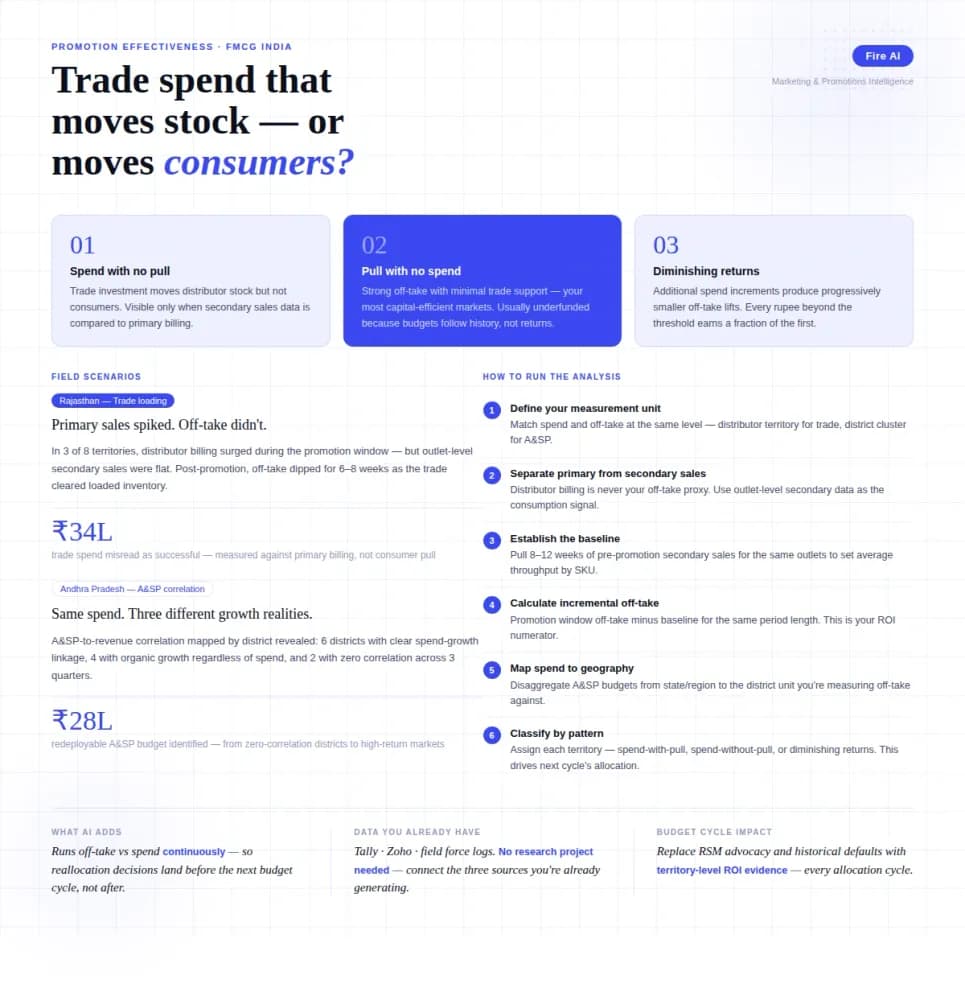
Measuring Promotion Effectiveness: A Data-Driven Guide for FMCG Marketers
FMCG brands in India spend 15–25% of gross revenue on trade promotions and A&SP (advertising and sales promotion) every year. Most can tell you how much they spent. Very few can tell you what it returned. The problem isn't a lack of data — it's that the data lives in disconnected places. Trade spend sits in finance. Off-take data lives with the distributor or field team. A&SP budgets are tracked in a marketing spreadsheet. No single view ties promotional investment to consumer pull at the outlet level. The result is a budget cycle where last year's spend allocation becomes next year's default, because no one has the numbers to argue for something different. This guide walks through how FMCG marketing and trade teams can build a promotion effectiveness framework that actually connects spend to outcome — not just channel-level assumptions.