

Quick answer
Yes, AI can detect financial fraud. AI systems analyse transaction patterns, flag statistical anomalies, identify unusual expense patterns, and detect inconsistencies in financial data that are too subtle for manual review. Machine learning models trained on historical transaction data identify fraudulent or suspicious activity in real time with significantly higher coverage than periodic manual audits.
Yes — AI is now one of the most effective tools for detecting financial fraud, and it catches patterns that human auditors routinely miss.
Traditional audit approaches check samples of transactions — perhaps 5–10% of all entries. AI can review 100% of transactions continuously, in real time, flagging anomalies the moment they occur rather than weeks later during a periodic review.
How AI Detects Financial Fraud
Pattern Recognition
AI models learn the "normal" pattern of financial activity in your business:
- Typical transaction amounts by vendor, employee, and account
- Normal transaction timing patterns
- Expected approval workflows
- Usual payment methods and frequencies
Any transaction that deviates significantly from these established patterns is flagged for review.
Anomaly Detection
Anomaly detection algorithms identify statistical outliers:
- An expense claim 10x higher than an employee's usual amount
- A vendor payment on a weekend when all normal payments occur on weekdays
- A new vendor created and paid within the same day
- Multiple near-identical expenses just below an approval threshold (splitting)
Network Analysis
AI can analyse relationships between entities — identifying when:
- A vendor's bank account matches a suspended employee's account
- Multiple vendors share the same address or phone number
- An approver consistently approves their own team's expense claims without secondary review
Specific Fraud Pattern Recognition
AI models are trained to recognise specific known fraud patterns:
- Expense splitting: Multiple claims just below approval thresholds
- Ghost employees: Payroll entries for non-existent employees
- Vendor fraud: Inflated invoices or duplicate payments
- Kickback patterns: A specific employee consistently approving a particular vendor above market price
- Data manipulation: Entries edited after approval or just before period close
AI Fraud Detection vs Traditional Audit
| Aspect | Traditional Audit | AI Fraud Detection |
|---|---|---|
| Coverage | 5–10% sample | 100% of transactions |
| Frequency | Periodic (quarterly/annual) | Continuous, real-time |
| Detection timing | Months after the fact | Often same day |
| Pattern recognition | Human judgment | Statistical + ML models |
| False positives | High (many manual exceptions) | Tunable, reduced over time |
| Scalability | Limited by auditor hours | Scales with transaction volume |
Types of Financial Fraud AI Can Detect
Accounts Payable Fraud
- Duplicate invoices paid twice
- Fictitious vendors and inflated invoices
- Invoice amounts altered after approval
- Payment to employee-owned vendors (conflict of interest)
Expense Fraud
- Personal expenses claimed as business expenses
- Inflated expense claims with falsified receipts
- Claims for non-existent travel or entertainment
- Multiple employees claiming the same expense
Payroll Fraud
- Ghost employees added to payroll
- Salary rate manipulation
- Unauthorised advance payments
- Overtime inflation
Revenue Fraud
- Fictitious revenue entries (window dressing)
- Early/late revenue recognition manipulation
- Discounts or credits applied without authorisation
AI Financial Fraud Detection for Indian Businesses
For Indian businesses, key fraud risks include:
- Vendor master manipulation — new vendors added without proper verification
- Tally entry manipulation — entries backdated or edited post-approval
- GST fraud — claiming input credits on non-existent purchases
- Cash transaction irregularities — unrecorded cash receipts or payments
AI analytics tools that connect to Tally can flag:
- Entries posted outside business hours
- Unusual patterns in cash receipts vs sales vouchers
- Vendor payments without corresponding purchase vouchers
- Entries made by users with no business reason to access certain voucher types
Limitations of AI Fraud Detection
AI fraud detection is powerful but not infallible:
- Collusion: Multiple parties working together can evade individual-level anomaly detection
- False positives: AI flags anomalies that may have legitimate explanations — human review is still needed to investigate
- Novel fraud schemes: AI models trained on historical patterns may miss entirely new fraud types
- Data quality dependency: If the source data is manipulated at the source, AI analytics on that data is compromised
A robust fraud prevention strategy combines AI detection with strong data quality controls, access controls, and periodic human audit.
Ready to act on your data?
See how teams use FireAI to ask in plain language and get analytics they can trust.
Explore FireAI workflows
Go from this topic into product features and solution paths that match what you read here.
Topic hub
AI Analytics
Guides on natural language querying, AI-powered analytics, forecasting, anomaly detection, and automated insights.
Explore hubFrequently asked questions
How does AI detect fraud in financial transactions?
AI learns the normal patterns of financial transactions — typical amounts, timing, vendors, and workflows. It then applies anomaly detection algorithms to flag deviations from these patterns: unusual transaction amounts, atypical timing, suspicious vendor relationships, or known fraud patterns like expense splitting.
Can AI detect fraud in Tally accounting entries?
Yes. AI analytics tools can monitor Tally entries for anomalies — entries posted outside business hours, unusual vendor payment patterns, backdated vouchers, or discrepancies between purchase and payment vouchers. This provides continuous oversight that a periodic manual audit cannot match.
Is AI fraud detection accurate?
AI fraud detection achieves high recall (catches most real fraud) but produces some false positives (legitimate transactions flagged as suspicious). The ratio improves over time as models learn the specific patterns of your business. AI is most valuable as a first-line filter that prioritises cases for human review, not as a replacement for human judgment.
Can AI replace auditors for fraud detection?
No — AI augments auditors rather than replacing them. AI provides 100% transaction coverage and flags anomalies continuously. Human auditors investigate flagged items, apply business context and judgment, and handle complex cases. The combination is more effective than either alone.
Related in this topic
What Is Diagnostic Analytics? Definition, Examples & Techniques
Diagnostic analytics answers WHY something happened — not just what. Learn the definition, 5 key techniques (root cause analysis, drill-down, correlation), and real business examples.
Can AI Analyze Financial Statements Automatically?
Learn how AI can analyze financial statements through automated processing, pattern recognition, risk assessment, and predictive analytics. Discover AI capabilities in financial analysis, accounting automation, and business intelligence.
What is Agentic Analytics? AI Agents for BI
Agentic analytics uses autonomous AI agents to proactively analyze data, surface insights, trigger alerts, and take actions without human prompting. Learn how agentic AI differs from traditional BI, and what it means for business decision-making.
Why Is Data Quality Important for Analytics?
Discover why data quality is crucial for effective analytics. Learn about accurate insights, reliable decisions, cost reduction, and how poor data quality undermines business intelligence and decision-making processes.
From the blog
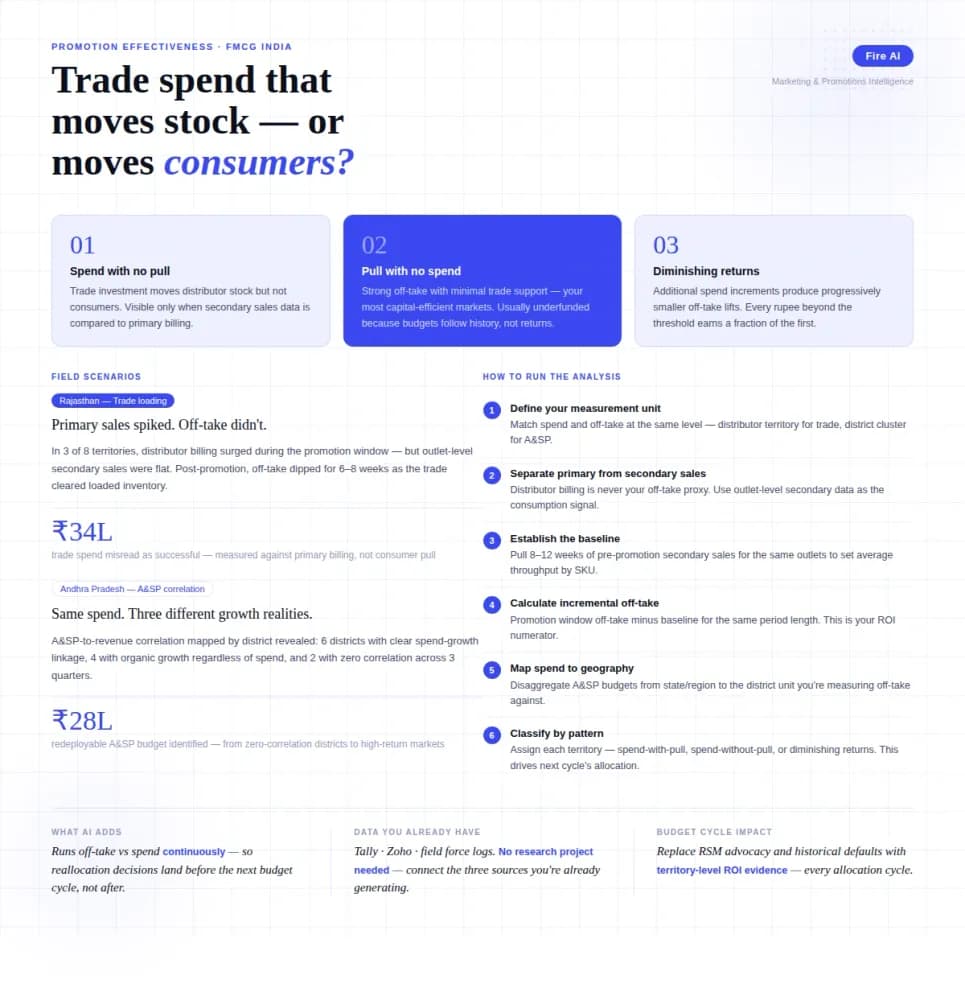
Measuring Promotion Effectiveness: A Data-Driven Guide for FMCG Marketers
FMCG brands in India spend 15–25% of gross revenue on trade promotions and A&SP (advertising and sales promotion) every year. Most can tell you how much they spent. Very few can tell you what it returned. The problem isn't a lack of data — it's that the data lives in disconnected places. Trade spend sits in finance. Off-take data lives with the distributor or field team. A&SP budgets are tracked in a marketing spreadsheet. No single view ties promotional investment to consumer pull at the outlet level. The result is a budget cycle where last year's spend allocation becomes next year's default, because no one has the numbers to argue for something different. This guide walks through how FMCG marketing and trade teams can build a promotion effectiveness framework that actually connects spend to outcome — not just channel-level assumptions.
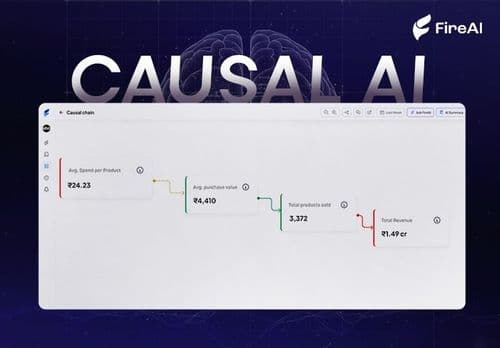
Causal AI Explained: Uncovering the “Why” in Data with Machine Learning
Causal AI reveals not just what will happen, but why — and exactly what changes if you act differently. It turns predictions into high-ROI decisions by uncovering true cause-and-effect in your data.
Building a Data-Driven Culture: How Leaders Can Drive AI Adoption in Their Organization
AI adoption doesn’t fail because of technology—it fails because of culture. This piece shows how leaders can turn AI into real business impact by embedding data-driven decision-making into everyday leadership behavior and organizational DNA.