

Quick answer
Yes. AI can predict customer churn for D2C brands by learning patterns in order timing, basket size, category mix, and repeat rates before customers fully lapse. Models score risk from transactional and engagement signals so retention teams act early. FireAI ties Shopify and marketplace order history to churn-risk views and plain-language questions without manual spreadsheet scoring.
Yes. For many direct-to-consumer brands, churn shows up first in order behavior long before a customer deletes an account or unsubscribes. AI helps by turning those weak signals into ranked risk scores, segments for campaigns, and monitored dashboards instead of one-off exports each month.
This page covers which behavioral signals matter for D2C, how predictive models usually work, limits you should expect, and how platforms like FireAI operationalize churn prediction from order data. For definitions, formulas, and leading indicators, start with what is customer churn analysis. For retention workflows and segmentation in Indian D2C, see D2C e-commerce customer use cases.
Behavioral signals AI uses before churn is obvious
Churn prediction for D2C is mostly about sequence and drift in purchase behavior, plus optional engagement signals if you connect them.
| Signal type | Examples | Why it helps |
|---|---|---|
| Recency | Days since last order vs that customer's own median | Catches silent lapses before hard churn rules fire |
| Frequency | Orders per quarter vs prior periods | Surfaces slowing habit before revenue drops sharply |
| Monetary | AOV trend, category shift away from hero SKUs | Separates bargain hunters from fading core buyers |
| Channel / promo mix | Rising dependency on discounts or single marketplace | Highlights fragile margin customers |
Subscription-like brands may add payment failures or pause events; marketplace-heavy sellers often blend Amazon / Flipkart repeat gaps with own-site data when both sync cleanly.
These signals overlap with RFM analysis and cohort retention curves. AI adds relative ranking: who is cooling fastest compared with similar customers, not only absolute thresholds.
How predictive models usually work (without mystique)
Production churn models are typically supervised learning on tabular history: each customer-row gets labels such as “no purchase in the next 90 days” or “30-day revenue drop beyond X%,” then algorithms learn weights over recency, frequency, monetary features, and engineered deltas.
Common patterns teams use:
- Gradient-boosted trees or logistic models on rolling windows of orders (strong baseline when data volume is moderate).
- Rules plus model scores for transparency (“must be inactive 45 days AND declining AOV”) alongside a propensity score for prioritization.
- Cohort-aware evaluation so you do not mistake seasonality (festive spikes) for model accuracy.
Accuracy is never perfect. The goal is usually better prioritization: whom to email, whom to offer a win-back, whom to exclude from expensive acquisition lookalikes. Pair scores with revenue impact so finance trusts the cutoffs.
How FireAI helps D2C teams predict churn from orders
FireAI is built to connect ecommerce and accounting sources Indian teams already run (Shopify, marketplace reports, Tally where finance ties back) and to surface dashboards and conversational analytics without forcing every marketer to maintain feature tables in Excel.
Typical workflows
- Unify order history by customer across channels where data allows, so gaps and basket trends reflect real behavior.
- Monitor at-risk segments with thresholds or scores that stay visible week to week, not only after month-end closes.
- Ask plain-language questions (for example, “Which Mumbai cohorts acquired last Diwali have the fastest lengthening purchase gaps?”) to validate hypotheses before campaigns ship.
- Align retention with finance using the same definitions as customer churn analysis and broader D2C analytics.
AI here supports earlier, consistent prioritization. Creative copy, offer design, and CX judgment still sit with your team.
When AI churn prediction falls short
- Thin history: New brands, frequent SKU catalog resets, or noisy customer IDs limit what any model can learn.
- Sparse engagement data: If only orders sync and marketing touchpoints stay siloed, the model sees part of the story (often enough for D2C, but not the full journey).
- One-off shocks: Supply outages or platform policy changes can spike churn that history-based models miss until you add scenario tags.
Summary: AI can predict customer churn for D2C brands when purchase history is consistent, definitions of “churn” are stable, and teams use scores to prioritize retention work. Deepen the playbook with customer churn analysis and D2C customer use cases.
Ready to act on your data?
See how teams use FireAI to ask in plain language and get analytics they can trust.
Explore FireAI workflows
Go from this topic into product features and solution paths that match what you read here.
Topic hub
BI Fundamentals
Foundational guides on business intelligence, analytics architecture, self-service BI, and core data concepts.
Explore hubFrequently asked questions
Can AI predict churn without CRM or email engagement data?
How accurate are AI churn predictions?
Does churn prediction replace RFM or cohort reports?
How does FireAI use order data for churn risk?
Related in this topic
What Is Customer Churn Analysis? Metrics & Prediction
Customer churn analysis measures when and why customers stop buying, tracks leading indicators, and powers retention programs.
What Is Cohort Analysis? Retention & Revenue Cohorts
Cohort analysis tracks groups of customers from a shared start date to measure retention and revenue over time. See key metrics and practical uses.
What Is RFM Analysis? Recency, Frequency & Monetary Scoring
RFM analysis scores customers by recency, frequency and monetary value. Learn scoring methods, segmentation examples and business applications.
D2C Analytics India: What Top Brands Actually Track
D2C analytics in India covers customer acquisition, retention, unit economics and attribution. Learn the key KPIs and dashboard applications.
From the blog
Data-Driven Customer Success: How Real-Time Metrics Reduce Churn
Discover how data-driven customer success teams use real-time metrics, causal analytics, and tools like FireAI to predict churn before it happens and turn insights into retention.
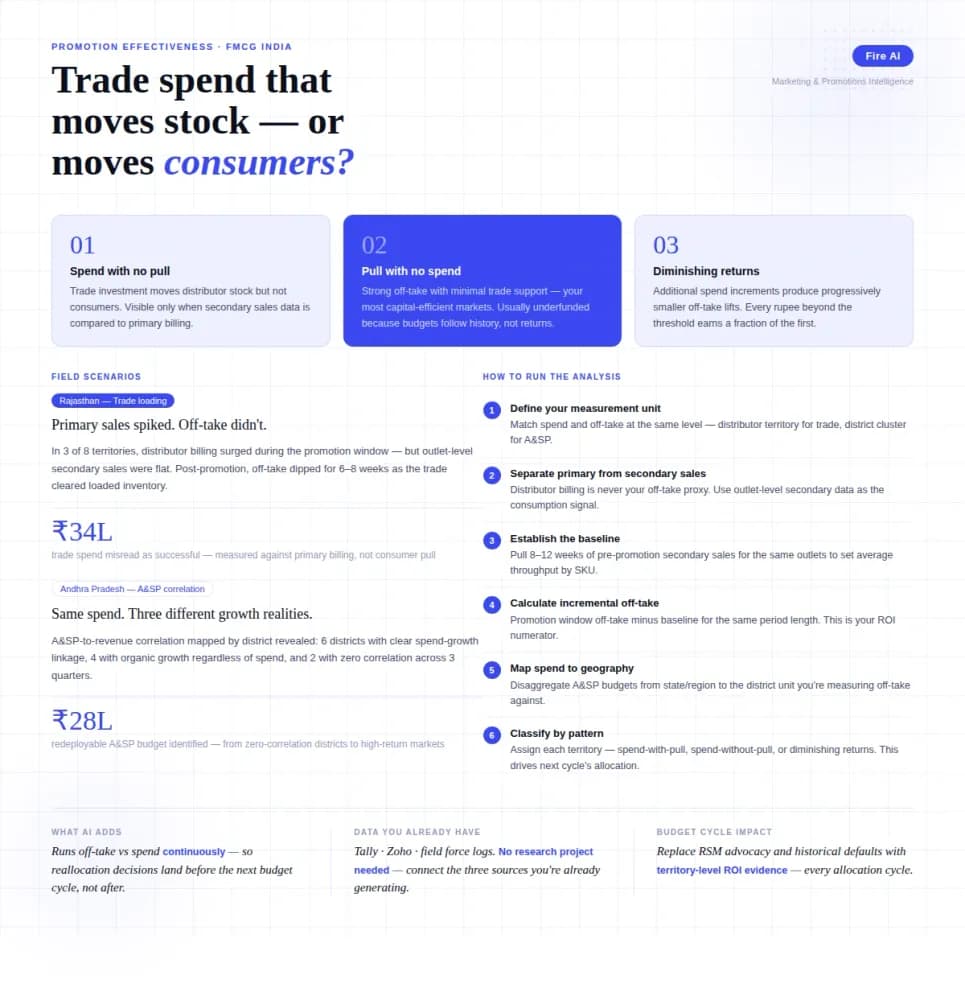
Measuring Promotion Effectiveness: A Data-Driven Guide for FMCG Marketers
FMCG brands in India spend 15–25% of gross revenue on trade promotions and A&SP (advertising and sales promotion) every year. Most can tell you how much they spent. Very few can tell you what it returned. The problem isn't a lack of data — it's that the data lives in disconnected places. Trade spend sits in finance. Off-take data lives with the distributor or field team. A&SP budgets are tracked in a marketing spreadsheet. No single view ties promotional investment to consumer pull at the outlet level. The result is a budget cycle where last year's spend allocation becomes next year's default, because no one has the numbers to argue for something different. This guide walks through how FMCG marketing and trade teams can build a promotion effectiveness framework that actually connects spend to outcome — not just channel-level assumptions.

How AI-Powered Analytics Can Transform India’s Arbitration Bottleneck?
AI-powered analytics can transform India's arbitration system by automating case classification, predicting timelines, and optimizing arbitrator allocation to cut delays.