

Quick answer
Yes, AI can track pharma field force productivity by combining GPS or check-in signals, CRM visit logs, and prescription or secondary sales outcomes into unified dashboards. Machine learning highlights territory gaps, low-engagement doctors, and unusual visit patterns relative to peers. That gives sales leadership measurable MR productivity beyond manual Excel rollups, when data quality and consent rules are respected.
Yes, AI can track pharmaceutical field force productivity when your organisation connects visit behaviour, call reporting, and downstream prescription or sales signals in one analytics layer. It does not replace compliance, ethics, or fair HR policy, but it can turn fragmented MR data into consistent KPIs, benchmarks, and early warnings that Excel rollups rarely catch in time.
Indian pharma teams already capture huge volumes of calls, samples, and territory plans. The gap is usually integration and interpretation: CRM says one thing, distributor secondary another, and leadership still debates which MR is truly productive. AI helps by scoring patterns, ranking territories fairly, and surfacing outliers. For context on the full analytics stack, see pharma analytics in India and pharma sales use cases.
What “tracking productivity” means for pharma MRs
Productivity is not only “number of visits.” Meaningful MR analytics typically blends:
- Coverage and frequency — doctors, chemists, and institutions reached versus plan
- Call quality proxies — detail aid usage, sample movement, or structured call notes where available
- Outcome linkage — prescription trends, SKU focus, or secondary sales in the MR’s geography (with appropriate lag and data rules)
- Travel and time use — planned versus actual routes when GPS or check-in data is approved and compliant
AI adds value when these streams are joined and compared at territory and peer level, not when each system stays in its own silo.
GPS tracking, call logging, and compliance
GPS and mobile check-ins can show whether field days align with planned beats and flag systematic gaps (for example, clusters of doctors never visited). In India, implementation must follow company policy, consent, and applicable labour and privacy norms. AI should support transparency: reps and managers should understand what is measured and why.
Call logging from CRM or SFA remains the backbone: calls per day, missed calls, joint working, and campaign execution. Natural language processing can help structure free-text visit notes into themes (competitor mentions, stock issues, patient feedback) when volumes are large, so managers see patterns without reading every entry.
Together, GPS and logs answer “was the field effort structured and executed?” Prescription and sales data answer “did the market respond?”
Prescription correlation and outcome analytics
Prescription (Rx) intelligence and secondary sales are the lagging indicators most sales heads care about. AI can:
- Correlate visit intensity and messaging cadence with Rx or stockist offtake at doctor or patch level, with sensible time lags
- Detect anomalies such as territories with high activity but flat Rx, or the opposite (risk of compliance or data issues)
- Segment HCP engagement (by specialty, class, or institution type) so coaching is specific
Correlation is not causation. Strong analytics teams treat AI output as hypothesis generation for medical and sales leadership, not as automatic performance punishment.
How FireAI fits: CRM, Rx, and conversational analytics
FireAI is built to connect the systems you already run and make MR productivity visible without weekly manual merges:
- CRM / SFA exports or APIs for calls, samples, and territory master
- Prescription or syndicated data feeds where your organisation has rights to use them
- Distributor or secondary sales from ERP or data partners, aligned to geography
- Optional location signals where your policy allows them
From there, teams get dashboards and alerts on coverage, call effectiveness proxies, and outcome trends. Natural language questions help regional managers ask, for example, which territories dropped visit frequency last month while Rx slowed, without waiting for a central analytics queue.
If you are comparing platforms, best BI tools for pharma in India covers what to require for regulated, multi-source data.
Summary
- AI can track pharma field force productivity by unifying visits, behaviour signals, and Rx or sales outcomes.
- GPS and CRM address execution; Rx and secondary data address market impact; ML highlights peer-relative patterns and risks.
- FireAI helps Indian pharma teams integrate these sources and ask questions in plain language, alongside pharma sales use cases you may already be planning.
Ready to act on your data?
See how teams use FireAI to ask in plain language and get analytics they can trust.
Explore FireAI workflows
Go from this topic into product features and solution paths that match what you read here.
Topic hub
Industry Analytics In India
Comparison pages and implementation guidance for industry-specific BI, dashboards, and analytics use cases in India.
Explore hubFrequently asked questions
Can AI replace manual MR reporting in pharma?
AI can automate consolidation, scoring, and benchmarking from CRM, Rx, and sales data, which cuts manual Excel work. It does not remove the need for managerial judgment, fair performance conversations, or compliance with company policy on data use and field conduct.
What data is needed for AI to track MR productivity accurately?
At minimum, reliable visit or call logs with territory mapping. Stronger models add prescription or secondary sales by geography, product focus, and time lag. Optional GPS or check-in data improves route and coverage insight where permitted. Data quality and consistent master data for doctors and patches matter more than algorithm choice.
How does prescription data get linked to MR visits without wrong conclusions?
Analytics should use agreed geography and doctor keys, sensible lag between visits and Rx changes, and peer or historical baselines. AI should flag anomalies for review, not auto-label causes. Medical and compliance teams should govern how Rx data is used in performance discussions.
How does FireAI help pharma sales leaders with field force analytics?
FireAI connects CRM and commercial data sources, builds MR and territory dashboards, and supports natural language questions so regional heads get answers without a dedicated analyst for every request. It fits alongside existing SFA and BI investments rather than replacing them overnight.
Related in this topic
Pharma Analytics in India: MR Performance & Compliance
Pharma analytics in India covers MR productivity, territory management, prescription tracking, and regulatory compliance. Learn key dashboards for Indian pharmaceutical companies.
Best BI Tools for Pharma in India (2026)
Compare the best BI tools for pharmaceutical analytics in India, including features for supply chain management, inventory planning, regulatory reporting, and demand forecasting. Review pricing, compliance capabilities, and fit for Indian pharma companies.
What Is Field Force Analytics in FMCG? Metrics & Meaning
Field force analytics in FMCG measures how sales teams perform in the field: visits, outlet coverage, orders per call, and productivity. Learn the core metrics and how FireAI builds dashboards from DMS and CRM data.
What Is Cold Chain Analytics in Pharma? Monitoring & Compliance
Cold chain analytics turns temperature logs, batch data, and shipment records into pharma-grade visibility for vaccines and biologics. Learn monitoring, compliance alerts, and how FireAI can unify IoT sensors with ERP and quality data.
From the blog
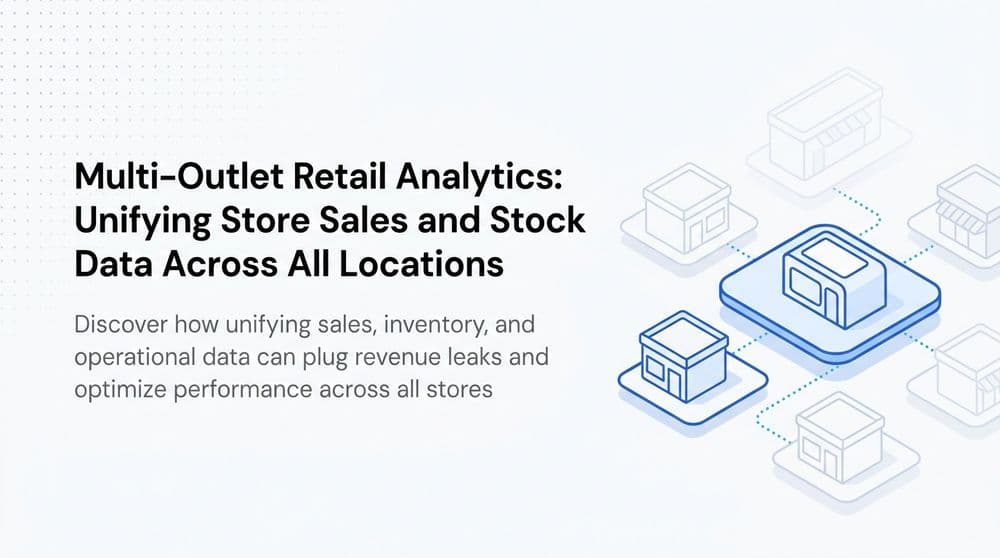
Multi-Outlet Retail Analytics: Track Store Sales
Track sales, stockouts, and staff performance across all stores. Learn how multi-outlet retail analytics can find the root cause of revenue leaks.
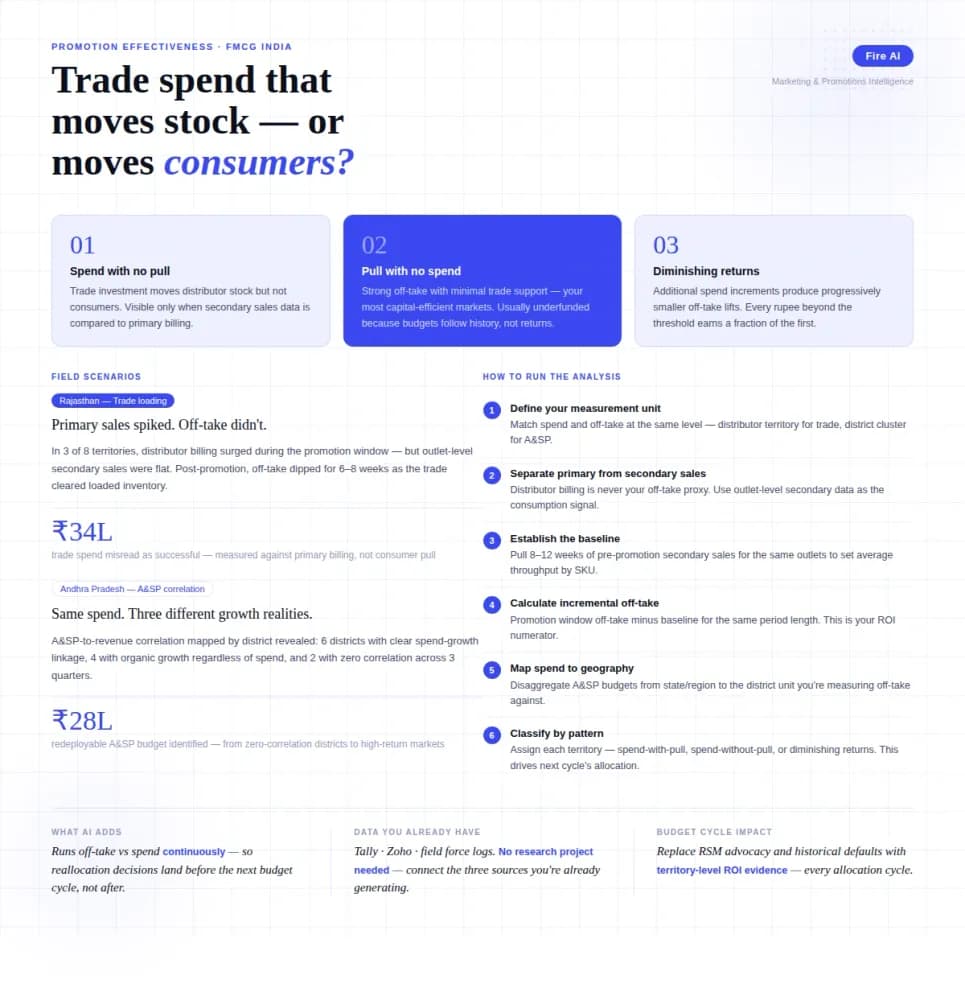
Measuring Promotion Effectiveness: A Data-Driven Guide for FMCG Marketers
FMCG brands in India spend 15–25% of gross revenue on trade promotions and A&SP (advertising and sales promotion) every year. Most can tell you how much they spent. Very few can tell you what it returned. The problem isn't a lack of data — it's that the data lives in disconnected places. Trade spend sits in finance. Off-take data lives with the distributor or field team. A&SP budgets are tracked in a marketing spreadsheet. No single view ties promotional investment to consumer pull at the outlet level. The result is a budget cycle where last year's spend allocation becomes next year's default, because no one has the numbers to argue for something different. This guide walks through how FMCG marketing and trade teams can build a promotion effectiveness framework that actually connects spend to outcome — not just channel-level assumptions.

How AI-Powered Analytics Can Transform India’s Arbitration Bottleneck?
AI-powered analytics can transform India's arbitration system by automating case classification, predicting timelines, and optimizing arbitrator allocation to cut delays.