

Quick answer
Field force analytics in FMCG is the practice of measuring how effectively your sales team works in the field: who they visit, how often, and what each visit produces. Core metrics include visit frequency, outlet coverage, orders per visit, and a field productivity index. It turns route plans and DMS data into comparable performance scores across territories and reps.
Field force analytics is the measurement and comparison of field sales performance for FMCG teams that sell through general trade, modern trade, and institutional channels. It answers whether sales officers, field executives, and supervisors are visiting the right outlets often enough, covering the planned universe, and converting visits into orders.
In Indian FMCG, millions of outlets sit behind long distribution chains. Without analytics, “field effort” is a story; with analytics, it is a set of numbers you can benchmark, coach against, and tie to secondary sales outcomes. This page defines what field force analytics includes and how it differs from a deep tactical read on beat productivity alone.
For HR and incentive design context, see FMCG HR and field force use cases. For a detailed angle on beat-level productivity patterns, see Beat productivity analysis.
What Field Force Analytics Covers
Field force analytics sits at the intersection of route discipline, outlet reach, and selling effectiveness. It typically uses data from beat plans, daily call reports (DCR), GPS or attendance logs, distributor management systems (DMS), and sometimes van sales or secondary billing feeds.
Typical questions it answers:
- Are reps visiting outlets at the frequency the plan expects?
- What share of the target outlet universe is actually being billed or visited?
- How many orders does each visit produce on average?
- How do you rank territories and individuals on a fair productivity index?
This is definitional and metric-focused. A separate narrative on why beats slip, how to redesign routes, or case studies on productivity interventions belongs in long-form content such as the beat productivity blog, not in a short “what is” definition.
Core Metrics in FMCG Field Force Analytics
1. Visit frequency
Visit frequency is how often a rep reaches an outlet within a period (for example, weekly or fortnightly) compared to the planned beat cycle.
- Planned vs actual visits show compliance with the route
- Missed visits may indicate capacity issues, unrealistic beats, or data gaps in reporting
Analytics often breaks frequency down by outlet type, channel, and territory so you do not average away weak pockets.
2. Outlet coverage
Outlet coverage measures how much of your target universe you actually reach with visits or orders. Common views include:
- Numeric distribution and effective coverage (outlets with at least one bill in a period)
- Coverage gap: planned outlets minus reached outlets
- New outlet activation versus dormant outlet counts
For India’s general trade, coverage is rarely 100% in one pass; analytics makes the gap visible by supervisor and by week.
3. Orders per visit (order productivity)
Orders per visit (or productive call rate) is the average number of orders written per call or per day in the field. It reflects whether visits translate into revenue, not just attendance.
- Often paired with lines per call (LPC) to show depth of selling
- Compared alongside average drop size to spot shallow versus deep selling
Low orders per visit with high visit counts may signal display, stock, or credit issues at retail, not laziness alone.
4. Field productivity index
A field productivity index combines multiple signals (visits, coverage, orders, sometimes value or margin) into one comparable score per rep or territory. The exact formula varies by company, but the intent is the same: normalize performance so Mumbai and Indore routes are judged on similar rules.
Indexes support fair incentives, territory redesign, and coaching priorities when raw visit counts would mislead.
How Field Force Analytics Connects to Business Outcomes
Field metrics do not replace secondary sales analytics, but they explain why secondary numbers move:
- Higher coverage and orders per visit usually precede better secondary trends in a territory
- Persistent low compliance may cap scheme effectiveness even when national campaigns look strong
Connecting field analytics to distributor stock, scheme run rates, and outlet-level billing gives brand teams a full picture. For the broader FMCG analytics landscape in India, see FMCG analytics in India.
How FireAI Supports Field Force Analytics
FireAI is built for teams that already have data in Tally, DMS, spreadsheets, or CRM exports but lack a single place to monitor field KPIs.
What you can expect:
- Dashboards for visit compliance, coverage, orders per visit, and productivity index without building everything in Excel
- Natural-language questions in English and Indian languages so regional managers ask “Which territories dropped coverage last week?” without SQL
- Alerts when a territory’s field metrics diverge from its historical baseline, so issues surface before month-end reviews
Field force analytics is ongoing operations work. FireAI reduces the manual stitching between route data and sales outcomes so supervisors spend time on coaching, not reconciliation.
Field Force Analytics vs Beat Productivity Content
- This answer page defines terms and metrics for people searching “what is field force analytics.”
- Beat productivity analysis goes deeper into patterns, interventions, and analysis of beat-level performance.
Use both together: definition here, operational depth on the blog.
Ready to act on your data?
See how teams use FireAI to ask in plain language and get analytics they can trust.
Explore FireAI workflows
Go from this topic into product features and solution paths that match what you read here.
Topic hub
Dashboard And Reporting
Practical content on KPI dashboards, executive reporting, trend analysis, charts, and reporting automation.
Explore hubFrequently asked questions
What is field force analytics in FMCG?
Field force analytics measures how FMCG sales teams perform in the field. It tracks visit frequency against plans, outlet coverage versus target universe, average orders per visit, and often a composite productivity index. The goal is to compare territories and reps fairly and link field effort to secondary sales outcomes.
What metrics matter most for FMCG field force analytics?
Common metrics include planned versus actual visits, outlet coverage or effective distribution, productive call rate, orders per visit, lines per call, average order value, and a weighted productivity index. Companies may add GPS or time-in-market checks depending on policy and data availability.
How is field force analytics different from only tracking secondary sales?
Secondary sales show what reached retailers from distributors. Field force analytics explains whether the sales team’s visits and coverage explain those results. You need both: secondary sales for demand, field metrics for execution and coaching.
Can FireAI build field force dashboards from DMS and Tally data?
Yes. FireAI connects to common FMCG data sources including Tally and DMS exports so teams can monitor visit compliance, coverage, and order productivity in one place. Managers can also ask questions in plain language instead of maintaining manual pivot tables for every review.
Related in this topic
FMCG Analytics in India: Sales & Distribution
FMCG analytics in India covers secondary sales tracking, distributor performance, beat coverage, and retailer segmentation. Learn key metrics for Indian FMCG companies.
What is a Sales Dashboard? Metrics and Examples
A sales dashboard is a visual tool that displays real-time sales performance metrics — revenue, pipeline, win rate, and team performance — on a single screen. Learn what to include in a sales dashboard and how to build one.
What is an HR Analytics Dashboard?
An HR analytics dashboard displays workforce metrics — headcount, attrition, payroll, attendance, and hiring — in one visual interface. Learn what HR dashboards include and how to use them for better people management decisions.
What is Predictive Analytics? Methods and Examples
Predictive analytics uses statistical algorithms and machine learning to forecast future outcomes based on historical data. Learn how predictive modeling works, which methods are used, and how businesses apply it for sales forecasting, risk management, and strategic planning.
From the blog
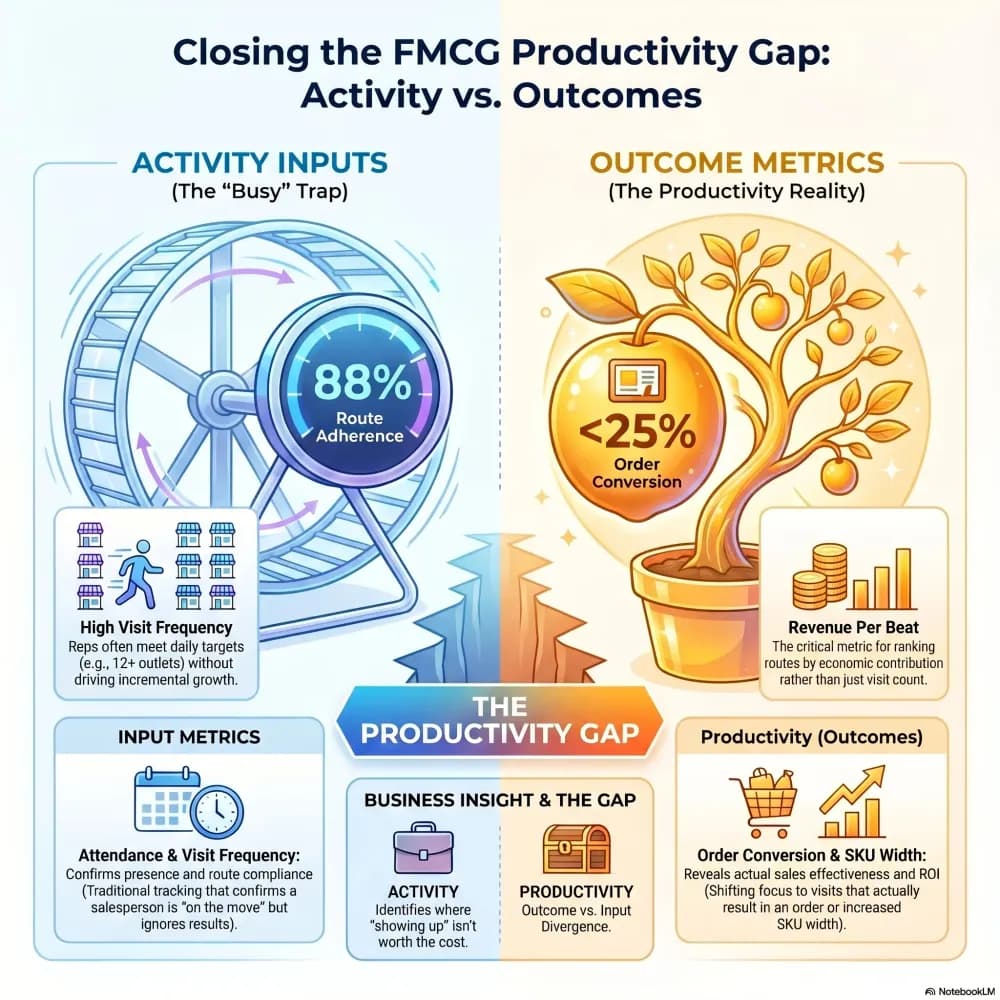
Beat Productivity Analysis: How Top FMCG Brands Optimize Field Force ROI
Your sales team is covering 300 beats a month. But how many of those beats are actually driving orders — and how many are just burning fuel? Here's how the sharpest FMCG brands are figuring that out.
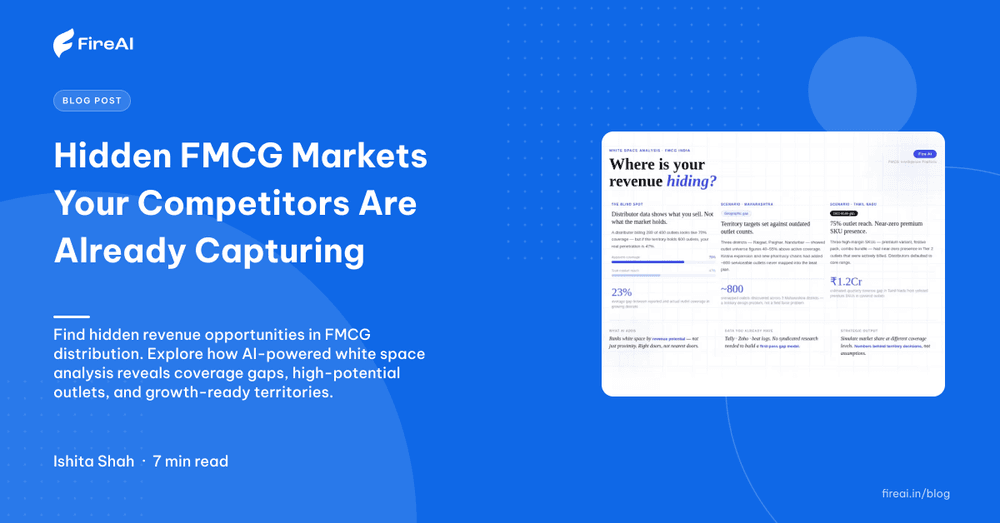
White Space Analysis for FMCG: Finding Untapped Markets with AI
Most FMCG sales leaders assume their coverage gaps are known. They're not — they're estimated. Based on distributor claims, field rep feedback, and the occasional market visit. The outlets you aren't reaching don't appear in your Tally data. The SKUs your distributors aren't pushing don't show up on beat reports. What's missing is, by definition, invisible. That invisibility is expensive.
Multi-Outlet Retail Analytics: Track Store Sales
Track sales, stockouts, and staff performance across all stores. Learn how multi-outlet retail analytics can find the root cause of revenue leaks.