

Quick answer
Restaurants with multiple outlets or heavy delivery should adopt an analytics platform when POS and inventory data outgrow spreadsheets. Without consolidated views you lose margin to food cost variance, misaligned labor, and slow menu fixes. ROI shows in food cost points, scheduling efficiency, and less manual reporting. Invest when daily decisions depend on exports that arrive too late.
Most multi-outlet restaurants, QSRs, and busy cloud kitchens should use an analytics platform once weekly reviews depend on stitched exports and nobody trusts the same food cost number on Monday and Friday. This page is a decision guide for Indian F&B: what you lose without analytics, where ROI usually appears, and when waiting is still reasonable. For the problem framing first, see why restaurants need real-time analytics. For product context, see FireAI for food and beverage and F&B finance use cases.
The cost of no analytics in restaurants
POS, delivery aggregators, inventory, and payroll all produce data. Without a platform that joins them, operators still decide on partial pictures.
What that costs in practice:
- Food cost bleeds quietly when recipe costs, waste, and aggregator commissions are reconciled days later.
- Labor mismatches show up as overtime or understaffing because demand signals from POS and delivery platforms are not in one forecast.
- Menu mistakes persist because popularity and margin live in different tabs, not one engineering-style view.
- Franchise or multi-outlet inconsistency hides weak outlets until a quarterly review.
In India, thin margins, GST compliance, and aggressive delivery promos make that delay expensive. The question is not whether you have data; it is whether leadership sees margin drivers before the month closes.
Food cost savings and labor ROI you can actually measure
A practical ROI stacks platform and setup cost against benefits you can observe in 90 to 180 days.
| Benefit bucket | What to measure | Example levers |
|---|---|---|
| Food cost % | Actual vs theoretical, variance by outlet and SKU | Portion control, supplier swaps, promo discipline |
| Labor % | Sales per labor hour, overtime vs forecast error | Shift templates, demand-linked scheduling |
| Menu mix | Contribution by item, discount impact | Engineering changes, bundles, de-listing dogs |
| Outlet comparison | Same-store food and labor vs peers | Coaching, standard recipes, local buying fixes |
You do not need a perfect model on day one. Teams get value when they can answer in minutes: Which three SKUs drove food variance last week? Which outlet missed labor target on Friday and Saturday? Platforms like FireAI help when you want POS and inventory connected and questions asked in plain language instead of rebuilding pivot tables every morning.
Deeper methodology lives in food cost analytics and how to track food cost percentage.
When investing in a restaurant analytics platform makes sense (and when to wait)
Prioritize investment when:
- You run multiple outlets or a franchise and cannot compare food and labor % on a trusted daily or weekly basis.
- Aggregator share is high and net margin after commissions needs outlet-level truth.
- Central kitchen or commissary supplies stores and you need batch and transfer visibility tied to sales.
- Finance and operations spend serious time reconciling sales, GST, and payouts instead of improving margin.
- You have outgrown static MIS from the POS vendor but still export before every review.
It can wait when:
- You operate a single location, the owner knows every number, and complexity is stable.
- Master data (recipes, SKUs, stores) is not stable enough to trust dashboards yet.
- You only need a short burst of analyst help for a one-time event, not ongoing operational rhythm.
Next steps: compare tools and narrow the use case
If you are ready to shortlist vendors, start with best BI tools for food and beverage in India and align the first dashboards to food cost and labor, then add menu and multi-outlet views as data quality holds. F&B finance use cases maps how those metrics connect to cash and profitability for Indian operators.
Ready to act on your data?
See how teams use FireAI to ask in plain language and get analytics they can trust.
Explore FireAI workflows
Go from this topic into product features and solution paths that match what you read here.
Topic hub
Industry Analytics In India
Comparison pages and implementation guidance for industry-specific BI, dashboards, and analytics use cases in India.
Explore hubFrequently asked questions
Should every restaurant use a full analytics platform?
What is the biggest ROI from restaurant analytics?
How long until a restaurant analytics platform pays off?
Can Indian F&B teams use analytics without a data team?
Related in this topic
Why Restaurants Need Real-Time Analytics in 2026
Restaurants run on perishable stock, shifting footfall, and aggregator-driven demand. Learn why delayed reports fail for F&B, and how live POS, labor, and platform data cuts waste, protects margins, and keeps service smooth.
What Is Food Cost Analytics for Restaurants?
Food cost analytics turns recipes, purchases, and POS sales into food cost percentage, actual vs theoretical usage, and waste signals.
Track Restaurant Food Cost Percentage: Step-by-Step
Practical steps to track restaurant food cost percentage: ingredient master data, recipe costing, actual versus theoretical usage, variance analysis.
Best BI Tools for Food & Beverage in India (2026)
Compare the best BI and analytics platforms for Indian restaurants, QSRs, and F&B chains. See how tools stack up on menu engineering, food cost tracking, outlet benchmarking, and finance dashboards tied to POS and Tally.
From the blog
Calculating ROI on AI Analytics Tools: Are They Worth the Investment?
A practical breakdown of how AI analytics delivers real, measurable ROI across speed, accuracy, forecasting, and decision-making. This guide helps leaders evaluate true impact beyond costs to understand why AI is now a business-critical investment.
Tally Analytics Dashboards for Indian Businesses
80% of Indian SMBs use Tally. Fewer than 5% have dashboards. Learn how to build real-time P&L, cash flow, and receivables analytics from your Tally Prime data.
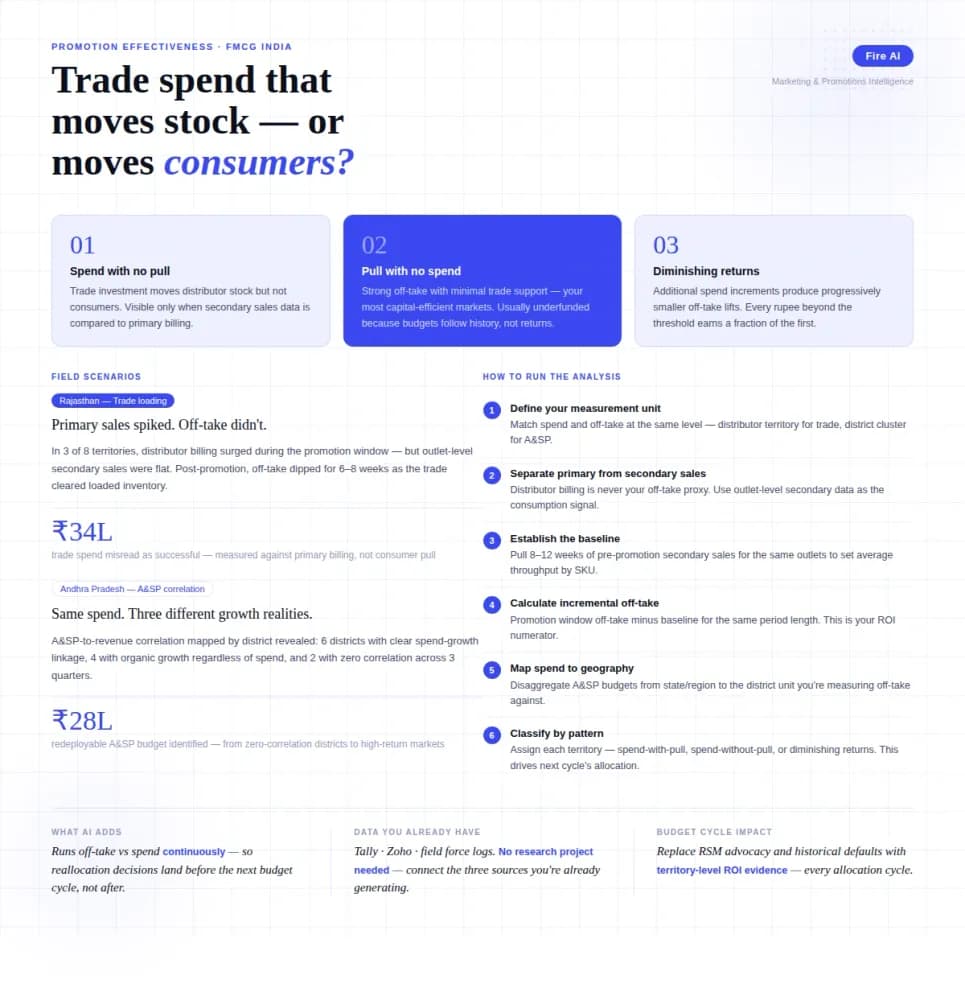
Measuring Promotion Effectiveness: A Data-Driven Guide for FMCG Marketers
FMCG brands in India spend 15–25% of gross revenue on trade promotions and A&SP (advertising and sales promotion) every year. Most can tell you how much they spent. Very few can tell you what it returned. The problem isn't a lack of data — it's that the data lives in disconnected places. Trade spend sits in finance. Off-take data lives with the distributor or field team. A&SP budgets are tracked in a marketing spreadsheet. No single view ties promotional investment to consumer pull at the outlet level. The result is a budget cycle where last year's spend allocation becomes next year's default, because no one has the numbers to argue for something different. This guide walks through how FMCG marketing and trade teams can build a promotion effectiveness framework that actually connects spend to outcome — not just channel-level assumptions.