

Quick answer
Indian businesses use inventory analytics to prevent stockouts, eliminate dead stock, improve cash flow, and optimise buying decisions. Connect Tally stock data to FireAI (₹4,999/month, zero code) for real-time stock levels, days-of-supply alerts, and dead-stock identification — freeing ₹10–50 lakhs in working capital within months, with NLQ in Hindi and English.
Inventory is one of the largest working capital commitments for Indian manufacturing, distribution, and retail businesses — and analytics delivers some of the fastest ROI of any business intelligence use case by reducing stockouts, clearing dead stock, and improving buying accuracy.
Key Inventory Analytics Use Cases
Stockout Prevention
A stockout dashboard monitors all SKUs against their minimum stock levels and reorder points.
What to build:
- Real-time stock level by SKU and warehouse
- Days of supply remaining (stock ÷ daily consumption rate)
- Items below reorder point (alert immediately)
- Items at risk of stockout in next 7/14/30 days based on consumption rate
Impact: Prevents lost sales from stockouts. For an Indian FMCG or distribution company, preventing 2–3 major stockouts per month can easily justify the entire analytics investment.
Dead and Slow-Moving Stock Identification
Dead stock ties up working capital and occupies warehouse space. Most Indian businesses discover dead stock only when doing year-end physical inventory.
What to build:
- Stock aging dashboard: items with no movement in 30/60/90/180 days
- Dead stock value by category and supplier
- Stock-to-sales ratio by SKU (high ratio = too much inventory relative to sales)
- Comparison to reorder triggers (items that keep getting reordered but not selling)
Impact: Freeing ₹50–100 lakhs in working capital tied up in slow-moving stock is a common early win.
Demand-Based Reorder Optimisation
Most Indian businesses reorder based on fixed quantities or experience. Analytics enables demand-based reordering that accounts for actual consumption patterns.
What to build:
- Average daily/weekly consumption per SKU over rolling period
- Safety stock calculation (consumption rate × supplier lead time)
- Optimal reorder point and reorder quantity
- Seasonality adjustment (pre-Diwali, pre-season buying)
Supplier Performance and Procurement Analytics
What to build:
- Supplier on-time delivery percentage
- Lead time variance (consistency of delivery time)
- Price trend by supplier and category
- Quality rejection rate by supplier
Inventory Analytics for Indian Business Contexts
Tally integration: Tally's stock ledger is the primary inventory data source for most Indian manufacturers and distributors. A BI tool with native Tally connectivity provides real-time inventory visibility without manual exports.
Multi-location inventory: For businesses with multiple warehouses or consignment stock with distributors, analytics should show consolidated and location-wise inventory separately.
Indian GST implications: Inventory analytics for Indian businesses should include goods blocked due to GST/tax disputes, and track ITC (Input Tax Credit) utilisation.
Seasonal demand: Indian demand patterns have sharp seasonal peaks (pre-Diwali, festivals, crop seasons). Inventory analytics should incorporate year-on-year comparison for the relevant period.
How FireAI Powers Inventory Analytics for Indian Businesses
FireAI is purpose-built for Indian inventory challenges:
- Native Tally integration: Reads stock ledger, godown-wise stock, and stock group data directly from Tally — no exports, no CSV files
- Real-time stock visibility: See current stock levels across all godowns/warehouses on a single dashboard, updated automatically
- Dead stock identification: AI automatically flags items with no movement in 30/60/90 days and calculates the working capital locked
- Reorder alerts: Configurable alerts when SKUs fall below reorder point based on actual consumption rate
- NLQ in Hindi and English: Ask "कौन से items 90 दिन से ज़्यादा पड़े हैं?" or "What is the days-of-supply for our top 20 SKUs?" and get instant answers
- 700+ connectors: Combine Tally inventory data with POS, e-commerce, and WMS data for complete visibility
- ₹4,999/month flat: No per-user fees, no implementation consultants
4-Step Inventory Analytics Setup with FireAI
- Connect Tally (30 minutes): Sync stock groups, stock items, and godown data using the native connector
- Build stock dashboard (1 hour): Use pre-built inventory templates showing stock levels, days-of-supply, and aging analysis
- Configure alerts (30 minutes): Set reorder point alerts for critical SKUs and dead stock flags at 60/90-day thresholds
- Review and act (weekly): Use the dead stock report to liquidate slow movers and the reorder report to optimise buying
Real impact: A Surat-based textile wholesaler with 8,000+ SKUs connected Tally to FireAI and identified ₹72 lakhs in dead stock (items with zero movement in 6+ months) within the first week. By running a clearance campaign on these items, they recovered ₹48 lakhs in working capital in 45 days — an 80x return on the annual tool cost.
See inventory dashboard for the key metrics to track, and why Indian businesses need BI for the strategic case.
Ready to act on your data?
See how teams use FireAI to ask in plain language and get analytics they can trust.
Explore FireAI workflows
Go from this topic into product features and solution paths that match what you read here.
Topic hub
BI Fundamentals
Foundational guides on business intelligence, analytics architecture, self-service BI, and core data concepts.
Explore hubFrequently asked questions
How do you set up inventory analytics using Tally?
To set up inventory analytics with Tally: (1) connect a BI tool with native Tally integration (like FireAI) to your Tally database, (2) map your stock groups, categories, and godowns to the analytics model, (3) build a stock-level dashboard showing current inventory vs reorder points, (4) configure stockout alerts for critical SKUs. The initial setup takes 1–2 days with a native Tally connector — no custom development required.
What is the most valuable inventory analytics metric for Indian businesses?
Days of supply (current stock ÷ average daily consumption) is the most valuable single inventory metric — it immediately shows which SKUs are at risk of stockout (low days of supply) and which have excess stock (high days of supply). Combined with a reorder point alert, it prevents both stockouts and overbuying. This single metric, tracked for all SKUs automatically, delivers immediate working capital and service level benefits.
How does inventory analytics reduce working capital?
Inventory analytics reduces working capital by: identifying dead and slow-moving stock for liquidation (immediate cash recovery), preventing overordering through demand-based reorder quantities (reduce average inventory holding), enabling just-in-time reordering for fast-moving items (reduce safety stock requirements), and identifying items where supplier lead time can be reduced (allowing lower safety stock). Indian businesses typically reduce inventory working capital by 15–25% within 6–12 months of implementing inventory analytics.
How much working capital can Indian businesses free by using inventory analytics?
Indian manufacturers and distributors typically free 15–25% of inventory working capital within 6–12 months. For a ₹20 crore revenue company holding ₹3 crore in inventory, that is ₹45–75 lakhs freed. The biggest wins come from dead stock liquidation (immediate), demand-based reordering (reduces overbuying by 20–30%), and multi-location stock balancing (prevents excess in one warehouse while another runs out). FireAI identifies these opportunities automatically from Tally data.
Can Indian manufacturers use inventory analytics without ERP or WMS systems?
Yes — if you use Tally for stock management, you already have the data needed. FireAI connects natively to Tally and reads your stock groups, stock items, and godown data directly. No ERP or WMS is required. Even businesses tracking inventory in Excel or Google Sheets can connect to FireAI using its 700+ connectors. The key is having item-level stock-in and stock-out data, which most Tally users already maintain.
Related in this topic
What is an Inventory Dashboard? Metrics and Features
An inventory dashboard provides real-time visibility into stock levels, turnover, reorder alerts, and dead stock. Learn what metrics belong in an inventory dashboard and how Indian businesses can build one from Tally or their ERP.
Tally Analytics: Turn Tally Data into Dashboards & Reports
Get AI-powered analytics and dashboards from Tally Prime data without SQL. FireAI connects to Tally for live GST, sales, inventory, and P&L—no spreadsheet exports.
Why Indian Businesses Need Business Intelligence in 2026
Discover why Indian businesses in 2026 need BI tools to compete — from GST compliance to data-driven pricing, inventory optimisation, and real-time decision making with Tally data.
What is a KPI Dashboard? Definition and Examples
A KPI dashboard is a visual display of key performance indicators that gives business leaders an at-a-glance view of performance against goals. Learn what KPI dashboards include, how to build one, and see examples across sales, finance, and operations.
From the blog

Democratizing Data: How AI Analytics Levels the Playing Field for Small Businesses and Freelancers
For decades, data-driven decision making was a luxury that only enterprises could afford. Big companies hired data scientists, purchased expensive BI tools, and built complex data warehouses. In exchange, they received precise insights that guided budgets, strategy, and growth.
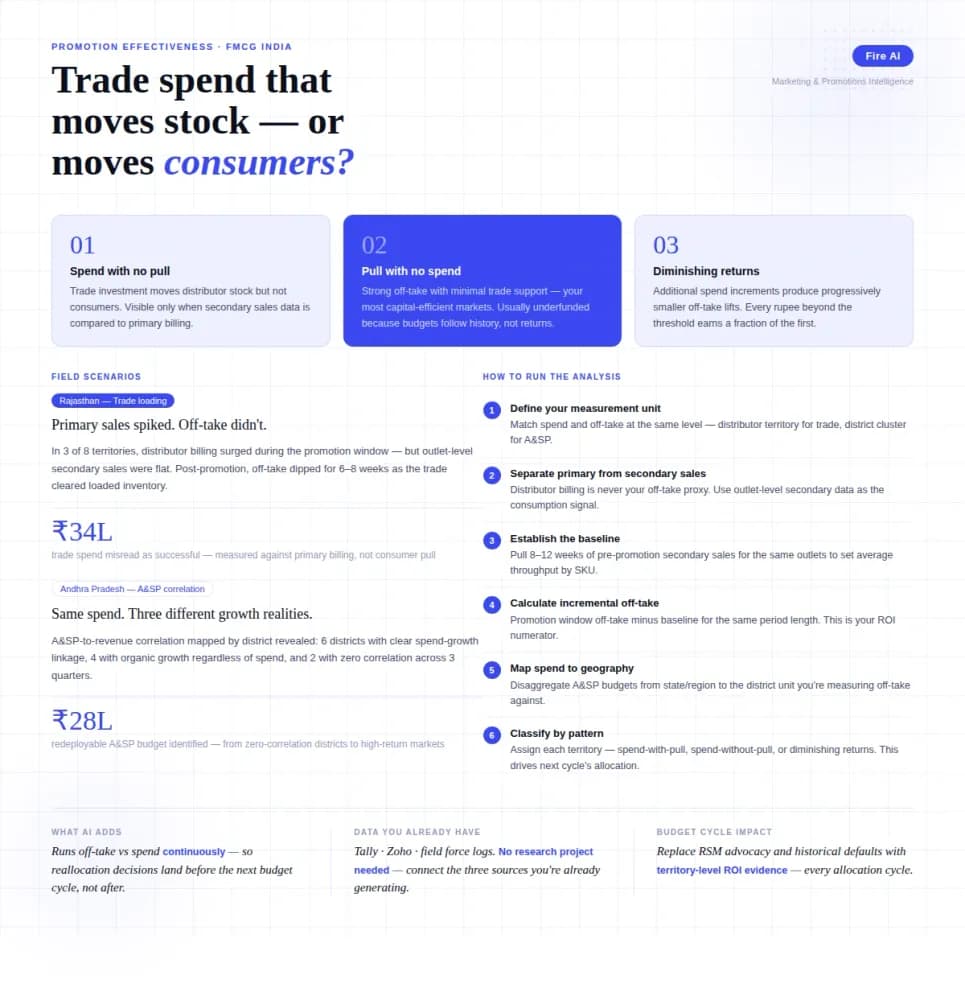
Measuring Promotion Effectiveness: A Data-Driven Guide for FMCG Marketers
FMCG brands in India spend 15–25% of gross revenue on trade promotions and A&SP (advertising and sales promotion) every year. Most can tell you how much they spent. Very few can tell you what it returned. The problem isn't a lack of data — it's that the data lives in disconnected places. Trade spend sits in finance. Off-take data lives with the distributor or field team. A&SP budgets are tracked in a marketing spreadsheet. No single view ties promotional investment to consumer pull at the outlet level. The result is a budget cycle where last year's spend allocation becomes next year's default, because no one has the numbers to argue for something different. This guide walks through how FMCG marketing and trade teams can build a promotion effectiveness framework that actually connects spend to outcome — not just channel-level assumptions.
Tally Analytics Dashboards for Indian Businesses
80% of Indian SMBs use Tally. Fewer than 5% have dashboards. Learn how to build real-time P&L, cash flow, and receivables analytics from your Tally Prime data.