

Quick answer
Measure analytics ROI across three categories: time savings from automated reporting, revenue gains from better decisions, and operational efficiency improvements. Formula: ROI = (Total Value − Cost) / Cost × 100. Indian SMBs using FireAI at ₹4,999/month typically see 200–500% ROI within 12 months — from eliminated manual Excel work, faster collections, and data-driven pricing.
Measuring analytics ROI is essential for justifying the investment, securing continued funding, and understanding which analytics initiatives deliver the most value.
The challenge is that analytics value is partly quantifiable (time saved, revenue from data-driven decisions) and partly qualitative (better decision confidence, faster problem detection). This framework captures both.
The Analytics ROI Formula
Analytics ROI (%) = (Total Value Generated − Analytics Cost) / Analytics Cost × 100
Analytics Cost includes:
- BI platform licensing fees
- Implementation and setup costs
- Training time
- Ongoing maintenance
Total Value Generated includes all three categories below.
Category 1: Time Savings
The most directly quantifiable value. Calculate the time your team no longer spends on manual analytics tasks:
Manual report preparation time eliminated:
- How many hours per month was each report taking to prepare manually?
- How many reports are now automated?
- What is the loaded hourly cost of the people preparing those reports?
Example calculation:
- CFO and Finance Manager spent 12 hours/month on monthly management pack
- 3 × Monthly report cycles = 36 hours/year
- Loaded cost: ₹3,000/hour = ₹1.08 lakh/year in time savings
Multiply across all automated reports to get total time savings value.
Analyst bottleneck reduction:
- How many ad hoc data requests per month did the analyst handle?
- Average time per request?
- With self-service BI, how many are now handled by requestors directly?
Category 2: Decision Quality Improvements
Harder to quantify but often the largest value component. Identify specific business decisions where better/faster data changed the outcome:
Revenue improvements from analytics-driven decisions:
- "Identified a customer segment at risk of churn 2 months earlier → retained 8 accounts → ₹24 lakh retained revenue"
- "Analytics showed Region X was underperforming; shifted 2 reps there → ₹18 lakh incremental revenue"
Cost avoidance from analytics alerts:
- "Inventory alert prevented a ₹6 lakh stockout on a key SKU during peak season"
- "Fraud detection caught ₹2.8 lakh in duplicate vendor payments"
- "Cash flow alert triggered collection push; reduced 90-day overdue from ₹15L to ₹8L"
Document each case with:
- The analytics-triggered action
- The estimated financial impact
- Confidence level (high/medium/low)
Category 3: Operational Improvements
Analytics that changed how the business operates, with measurable efficiency gains:
- Inventory optimisation reduced average stock holding by 15% → working capital freed
- Pricing analytics increased average margin by 1.2% → ₹X per year at current revenue
- Route optimisation reduced logistics cost by 8%
Analytics ROI Calculation Example
For an Indian SMB with ₹50 lakh annual analytics investment:
| Value Category | Annual Value (₹) |
|---|---|
| Time savings (reports + analyst) | 2.4 lakh |
| Revenue from data-driven decisions | 8.2 lakh |
| Cost avoidance (fraud, inventory) | 3.6 lakh |
| Operational efficiency gains | 2.8 lakh |
| Total Value | 17 lakh |
ROI = (17L − 5L) / 5L × 100 = 240%
(Assuming ₹5 lakh total analytics cost including platform + implementation)
Establishing a Baseline Before Implementing Analytics
To calculate ROI accurately, you need a "before" baseline:
- Document time spent on manual reporting today
- Track the number and frequency of data-related bottlenecks
- Note any recurring problems that data visibility would have caught earlier
After 6–12 months of analytics adoption, compare against this baseline to calculate actual ROI.
Why Most Analytics ROI is Underestimated
Organisations typically under-count analytics ROI because:
- Attribution is difficult: When a good decision involves data + judgment + execution, it's tempting to give judgment full credit
- Counterfactuals are hard: "What would have happened without the analytics alert?" requires estimation
- Soft value is ignored: Faster decisions, higher team confidence, and fewer arguments about data all have real business value
Even the most conservative analytics ROI calculations typically show 2–3x return in the first year.
FireAI ROI: A Real-World Calculation
For an Indian SMB using FireAI (₹4,999/month = ₹59,988/year):
| Value Category | Annual Value (₹) |
|---|---|
| Manual reporting time saved (CFO + accountant, 15 hrs/month × ₹500/hr) | 90,000 |
| At-risk customer retention (3 accounts saved × ₹4L avg value) | 12,00,000 |
| Dead stock reduction (identified via inventory dashboard) | 3,50,000 |
| Faster collections (reduced 90-day overdue by 40%) | 2,80,000 |
| Total Annual Value | ₹18,20,000 |
ROI = (₹18.2L − ₹0.6L) / ₹0.6L × 100 = 2,933%
The key driver: FireAI's Tally integration eliminates manual data preparation, and natural language queries in Hindi and English mean business owners get answers instantly — no waiting for an analyst to build a report. With 700+ connectors, the same platform scales from Tally to CRM to payment gateways as data needs grow.
See why Indian businesses need BI for the strategic case, and what is FireAI for how AI-native BI changes the ROI equation.
Ready to act on your data?
See how teams use FireAI to ask in plain language and get analytics they can trust.
Explore FireAI workflows
Go from this topic into product features and solution paths that match what you read here.
Topic hub
BI Fundamentals
Foundational guides on business intelligence, analytics architecture, self-service BI, and core data concepts.
Explore hubFrequently asked questions
How long does it take to see ROI from a BI implementation?
Most organisations see positive ROI within 3–6 months for simple implementations (automating existing reports, building KPI dashboards from Tally data). More complex enterprise implementations may take 12–18 months to reach positive ROI. The fastest ROI comes from eliminating manual reporting time and catching one or two early-warning business problems.
What is a good ROI for analytics investment?
A 200–500% annual ROI is typical for well-implemented business analytics. Gartner and McKinsey research consistently shows data-driven organisations outperform peers across financial metrics. For Indian SMBs, the ROI is often higher because the starting baseline (manual Excel reporting, no automated alerts) has more inefficiency to eliminate.
How do I justify analytics investment to my CFO or board?
Use the three-category framework: (1) time savings in hours × cost per hour, (2) specific decision improvements with estimated revenue or cost impact, and (3) operational efficiency gains. Then compare total value against total analytics cost. Even conservative calculations typically show positive ROI well within the first year.
What is the ROI of FireAI for an Indian SMB using Tally?
Indian SMBs using FireAI at ₹4,999/month typically see ROI of 10–30x within the first year. The biggest value drivers are: automated Tally reporting saving 10–20 hours/month of manual work, at-risk customer alerts preventing ₹5–20 lakhs in revenue churn, dead stock identification freeing ₹10–50 lakhs in working capital, and faster collection follow-ups reducing overdue receivables by 30–50%.
How do I track analytics ROI on an ongoing basis after implementation?
Set up a quarterly ROI review: (1) log every manual report that has been automated and calculate hours saved, (2) maintain a decision log documenting analytics-triggered actions and their estimated financial impact, (3) compare key operational metrics (inventory turns, collection days, margin) against pre-analytics baselines, and (4) survey dashboard users on time saved and decisions improved. Tools like FireAI provide usage analytics showing which dashboards are used most — helping you focus on high-value analytics.
Related in this topic
What is a KPI Dashboard? Definition and Examples
A KPI dashboard is a visual display of key performance indicators that gives business leaders an at-a-glance view of performance against goals. Learn what KPI dashboards include, how to build one, and see examples across sales, finance, and operations.
What is Business Intelligence? Definition and Benefits
Business intelligence (BI) combines data analysis, visualization, and reporting to transform raw data into actionable insights. Learn how BI systems work, which tools to use, and how they enable data-driven decision-making.
What is Analytics ROI? How to Calculate Returns
Analytics ROI is the financial return generated by analytics tools and initiatives relative to their cost. Learn how to calculate analytics ROI, what factors to include, and what typical ROI looks like for business intelligence implementations.
Analytics for Indian SMBs: What Works & What to Avoid
Most Indian SMBs struggle with analytics because enterprise tools are too expensive, complex, and don't support Tally. Here's what actually works — and how to start for under ₹10K/month.
From the blog

How a Modern Analytics Platform Transforms Business Intelligence
Why faster decision-making, real-time analytics, and AI-driven intelligence separate market leaders from laggards—and how Fire AI closes the gap between data and action.

Calculating ROI on AI Analytics Tools: Are They Worth the Investment?
A practical breakdown of how AI analytics delivers real, measurable ROI across speed, accuracy, forecasting, and decision-making. This guide helps leaders evaluate true impact beyond costs to understand why AI is now a business-critical investment.
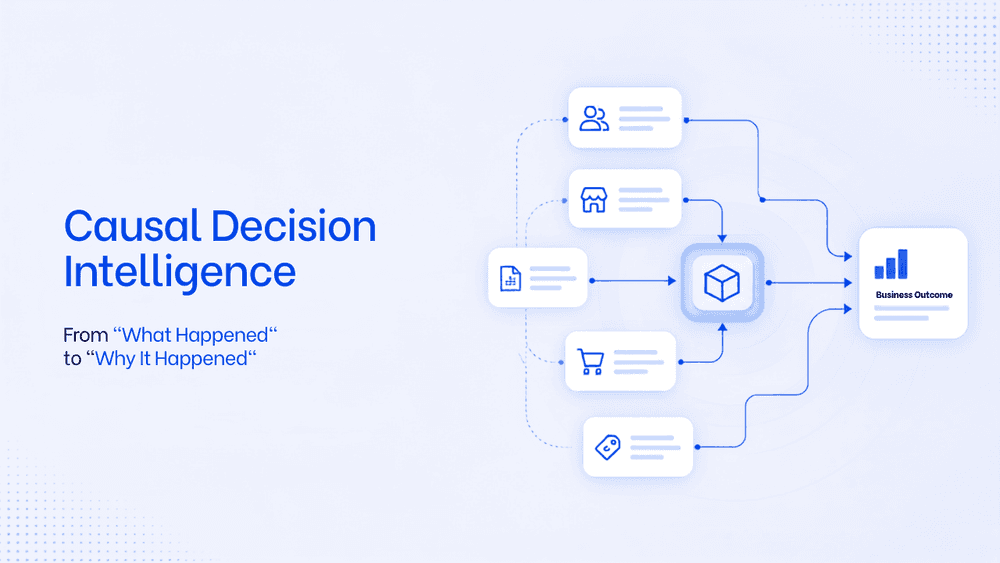
What Is Causal Decision Intelligence? A Framework To Move From "What Happened" to "Why It Happened"
Business intelligence tools are limited in their capability to find the root cause and the trigger behind it. Causal decision intelligence is the AI layer that helps business take faster, smarter decision with an auditable explanation. This will transform the way business analyse data and strategise on teh next actionable steps.