

Quick answer
Attrition analytics measures workforce turnover and why it happens so HR can intervene early. Teams track voluntary and involuntary exit rates by department and tenure and study drivers such as pay and manager stability. Predictive scores highlight flight risk. FireAI connects HRMS and payroll data to dashboards and plain-language questions so patterns appear without manual reports.
Attrition analytics is the practice of measuring who leaves, how fast, and why, so people leaders can protect capacity, cost, and culture. It goes beyond a monthly headcount report by connecting exits to structure (location, band, manager), timing, and leading signals you can act on before resignations spike.
For FMCG, pharma, logistics, and other people-heavy sectors in India, attrition often varies sharply by region, channel-facing role, and incentive design. Analytics makes those patterns visible so HR and line managers do not rely on anecdotes. For how field and commercial roles fit into broader people programs, see FMCG HR use cases and pharma HR use cases.
What attrition analytics includes
Core outcomes are how many people exited, who they were, and whether the loss was regrettable (high performer, critical skill, or hard-to-fill role).
Typical building blocks:
- Headcount and exit volumes by month, business unit, location, and employment type (permanent, contract)
- Attrition rate and regrettable attrition rate tracked on consistent definitions
- Tenure and demographic cuts (early attrition in the first 12 months is a common diagnostic)
- Exit reasons from interviews or HRMS codes, with quality checks so “personal reasons” is not a black hole
- Leading indicators such as overtime, absenteeism spikes, promotion delays, or pay band compa-ratios where data exists
Attrition analytics is complementary to, but narrower than, a full HR analytics dashboard: the dashboard spans hiring and payroll; this discipline focuses on turnover dynamics and prevention.
How to calculate attrition rate
A simple, widely used formula is:
Attrition rate (period) = Number of separations in period ÷ Average headcount in period
Practical rules that keep leadership trust:
- Use the same numerator and denominator rules every month (for example, whether probation exits count, whether involuntary exits are split out)
- Report voluntary vs involuntary separately when possible; blending hides fixable process issues
- Show annualized and rolling 12-month views alongside the last month, so one quiet month does not disguise a trend
Regrettable attrition is usually defined by performance rating, critical role tags, or skill scarcity. The analytics task is not the label itself but stable tagging so trends are comparable quarter to quarter.
For Indian teams, compare against realistic peer bands (IT services, retail, and manufacturing differ sharply) and against your own history, not only industry averages.
Root cause analysis
Root cause work links exits to operational facts, not only exit survey text.
Useful angles:
- Manager and team concentration: a single leader with outlier turnover is a different problem than a company-wide pay ceiling
- Compensation and progression: time-in-band, promotion velocity, and market positioning for hot skills
- Workload and scheduling: common in field, plant, and 24/7 operations where analytics can tie exits to shift patterns or travel load
- Early-life experience: onboarding, first manager, and first promotion window for campus or lateral hires
Diagnostic analytics overlaps with diagnostic analytics in BI language: you are testing hypotheses with data rather than stopping at the headline rate.
Predictive attrition
Predictive attrition uses rules, scoring, or models to estimate who is more likely to leave in the next few months.
Common inputs include tenure, compensation movement, rating history, absenteeism, internal mobility, and engagement pulses where available. The goal is not perfect prediction but a ranked queue for retention conversations, succession planning, and targeted interventions.
This is the workforce parallel to customer churn analysis: both combine history, behavioral signals, and early warnings so the business acts while saving a relationship is still realistic.
Retention strategies informed by analytics
Analytics does not replace management, but it shows where retention budgets and time earn the highest return.
Examples:
- Targeted stay conversations for high-risk, high-value segments surfaced by scores
- Manager enablement where data shows people leave for leadership reasons, not pay alone
- Role redesign when exits cluster in impossible job architectures (unrealistic territory size, unsafe shift mix)
- Selective compensation fixes when analytics proves systematic under-market bands for roles that drive revenue or compliance
How FireAI helps
FireAI connects HRMS, payroll, and spreadsheet extracts into live attrition views without forcing HR teams to maintain pivot tables. You can ask questions in plain language (for example, which pharma region saw the largest rise in voluntary exits among medical representatives, or which FMCG depot band has the highest early attrition) and layer alerts when a team crosses thresholds you define.
If you are starting from disconnected sources, see how to create an HR dashboard for a practical layout you can extend with attrition-specific cards and filters.
Ready to act on your data?
See how teams use FireAI to ask in plain language and get analytics they can trust.
Explore FireAI workflows
Go from this topic into product features and solution paths that match what you read here.
Topic hub
Industry Analytics In India
Comparison pages and implementation guidance for industry-specific BI, dashboards, and analytics use cases in India.
Explore hubFrequently asked questions
What is the difference between attrition and turnover?
In HR analytics the terms are often used interchangeably. Some organizations use turnover for all separations and attrition for voluntary exits only. What matters is that your dashboards define the numerator clearly and apply it consistently across months and business units.
What data do you need for attrition analytics?
Minimum viable data includes hire date, exit date, separation type, role, department, location, manager, and employment type. Stronger programs add performance tags, compensation history, attendance, internal transfers, and structured exit reasons. FireAI can combine HRMS and payroll exports with Excel or Google Sheets where systems are still fragmented.
How accurate does predictive attrition need to be?
Most teams use prediction to prioritize conversations, not to automate decisions. A model that reliably ranks the top twenty percent of flight-risk employees in critical roles is often enough to improve retention ROI, especially when paired with manager judgment and fair process.
Can small and mid-sized companies run attrition analytics?
Yes. Even with a few hundred employees, trend views by manager and location reveal problems early. FireAI’s templates and connectors reduce the engineering burden so HR analysts and business partners can own the dashboards without a dedicated data team.
Related in this topic
What is an HR Analytics Dashboard?
An HR analytics dashboard displays workforce metrics — headcount, attrition, payroll, attendance, and hiring — in one visual interface. Learn what HR dashboards include and how to use them for better people management decisions.
HR Analytics for Indian Companies: A Complete Guide
HR analytics in India helps companies manage workforce data — from attrition prediction to payroll analytics, HRMS integration, and compliance reporting. Learn how Indian businesses use people analytics to improve hiring, retention, and workforce productivity.
How to Create an HR Dashboard (Step-by-Step)
Learn how to create an HR analytics dashboard for your Indian business — from choosing HR metrics to connecting HRMS data and building dashboards that track headcount, attrition, payroll, and productivity. Practical guide for HR managers and business owners.
What is Predictive Analytics? Methods and Examples
Predictive analytics uses statistical algorithms and machine learning to forecast future outcomes based on historical data. Learn how predictive modeling works, which methods are used, and how businesses apply it for sales forecasting, risk management, and strategic planning.
From the blog
Causal Chain Analysis: Fix What's Breaking Revenue
Causal chain analysis traces metric drops to their root cause. Learn how Indian businesses use it to stop revenue leaks before they compound.
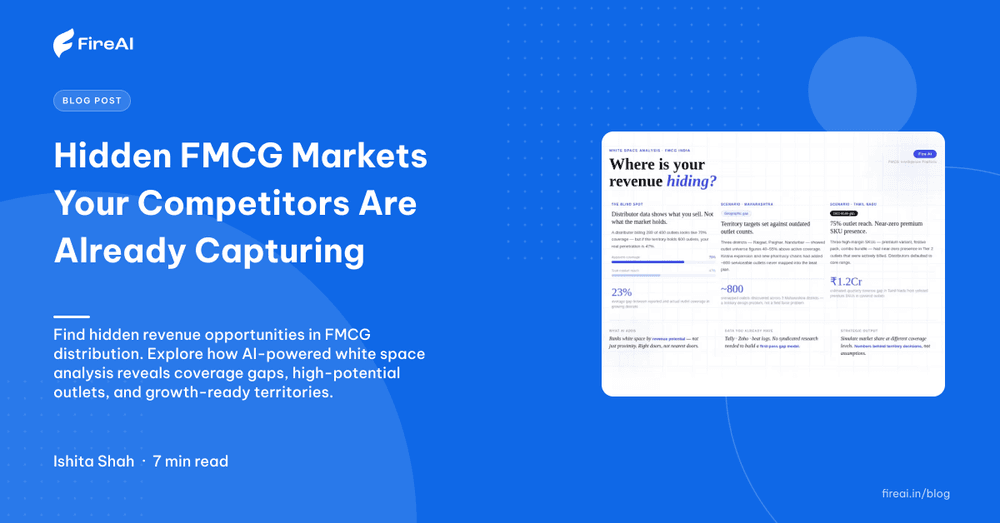
White Space Analysis for FMCG: Finding Untapped Markets with AI
Most FMCG sales leaders assume their coverage gaps are known. They're not — they're estimated. Based on distributor claims, field rep feedback, and the occasional market visit. The outlets you aren't reaching don't appear in your Tally data. The SKUs your distributors aren't pushing don't show up on beat reports. What's missing is, by definition, invisible. That invisibility is expensive.
Best AI Analytics Platforms in India (2026): An Honest Comparison
An honest comparison of 7 AI analytics platforms for Indian businesses: FireAI, Power BI Copilot, ThoughtSpot, Tableau, Zoho Analytics, Tellius and Julius AI.