

Quick answer
HR analytics in India uses data from HRMS, payroll, and attendance systems to drive better workforce decisions — attrition prediction, hiring efficiency, compliance tracking, and compensation benchmarking. With 20–25% IT attrition and complex PF/ESI/PT compliance across states, tools like FireAI connect HRMS and Tally payroll data into unified people dashboards at ₹4,999/month.
India's HR challenges are distinct from other markets — a complex labour law framework, high attrition in certain sectors (IT, retail, BPO), diverse workforce with regional variations, and a mix of formal and informal employment that requires careful analytics design.
Key HR Analytics Use Cases for Indian Companies
Attrition Analytics and Prediction
India's attrition problem is one of the largest people analytics challenges:
- IT sector: 20–25% annual attrition
- Retail/BPO: 40–60% annual attrition
- Manufacturing: 10–15% annual attrition
What HR analytics enables:
- Early attrition signals: employees showing patterns (late attendance, reduced productivity, peer network departures) that historically precede resignation
- Department-level attrition trend tracking
- Cost of attrition calculation (replacement cost, lost productivity, training cost)
- Cohort analysis: which batches of joiners retain best, and why?
Payroll and Compensation Analytics
What HR analytics covers:
- Total payroll cost vs revenue (benchmarked by industry)
- Compensation distribution by level, department, and geography
- Increments given vs market benchmarks
- Fixed vs variable cost ratio
- Benefits utilisation tracking
For Indian companies, payroll analytics must handle: statutory deductions (PF, ESI, PT), TDS calculations, LWF (Labour Welfare Fund) by state, and gratuity provisions.
Compliance and Statutory Reporting
India's labour law compliance requirements include:
- Form 16 / 16A (TDS certificates)
- PF remittance and EPFO annual return
- ESI remittance and ESIC return
- Professional Tax (state-specific)
- Labour welfare fund (state-specific)
- Various Labour Act registers (attendance, wages, leave)
HR analytics automates the data collection for these filings and tracks compliance status across locations.
Hiring Analytics
What to track:
- Time-to-fill by role and level
- Cost per hire by channel (referral, agency, job portal, campus)
- Offer acceptance rate
- Quality of hire (retention rate at 6/12 months for each source)
HR Analytics Tools for Indian Companies
HRMS platforms with built-in analytics:
- Keka HR (strong analytics, popular in Indian mid-market)
- Darwin Box (enterprise focus, deep analytics)
- greytHR (strong statutory compliance, good for SMBs)
Standalone BI connected to HRMS:
- FireAI (connects to HRMS APIs or exports, strong for people + business analytics combination)
- Zoho Analytics + Zoho People (for Zoho-native HR teams)
- Microsoft Power BI (enterprise HR analytics)
HR Analytics Data Privacy in India
India's Digital Personal Data Protection Act (DPDP) 2023 applies to employee data. Key considerations:
- Employee data can be processed for employment purposes with consent
- HRMS systems should support data retention policies
- Access controls: only HR and relevant managers should see individual employee data
- Aggregate/anonymised data for general workforce analytics
How FireAI Helps Indian Companies with HR Analytics
FireAI bridges the gap between HRMS, payroll, and business data:
- Tally + HRMS integration: Connect Tally (payroll costs, statutory deductions) with HRMS platforms like Keka, Darwin Box, or greytHR for unified people-cost dashboards. A Bengaluru IT company with 500 employees connected Keka + Tally and discovered payroll cost as % of revenue had silently crept from 48% to 56%
- 700+ connectors: Pull data from HRMS APIs, attendance systems, ATS (applicant tracking), and LMS (learning management) alongside Tally financial data
- Ask in Hindi or English: An HR manager can type "पिछली तिमाही में किस department में सबसे ज़्यादा attrition हुआ?" and get instant analysis — no SQL, no data team
- ₹4,999/month flat pricing: The entire HR and leadership team accesses dashboards for one flat price — no per-user fees that scale with headcount
- Pre-built HR dashboards: Attrition tracker, payroll cost analyser, hiring funnel, compliance status, and headcount vs budget — live in days
- Compliance automation: Track PF/ESI remittance status, Professional Tax by state, LWF compliance, and Form 16 readiness from Tally data
HR KPIs You Can Track from Day One
| KPI | Source | Indian Benchmark |
|---|---|---|
| Annualised attrition | HRMS | IT: 20–25%, BPO: 40–60% |
| Payroll cost % of revenue | Tally | 25–40% services, 10–20% manufacturing |
| Time-to-fill (days) | ATS/HRMS | 30–45 days avg |
| Cost per hire | Tally + HRMS | ₹25K–₹1L depending on level |
| PF/ESI compliance rate | Tally | 100% target |
Real Indian HR Scenario
A 300-employee manufacturing company in Gurugram was spending ₹18 lakh/year on compliance penalties due to delayed PF/ESI filings and incorrect TDS calculations. After connecting Tally + greytHR to FireAI, compliance dashboards flagged overdue filings 15 days before deadlines. Penalties dropped to zero, and the HR team saved 40 hours/month previously spent on manual compliance tracking.
See business intelligence for broader BI concepts and implementation guidance.
Ready to act on your data?
See how teams use FireAI to ask in plain language and get analytics they can trust.
Explore FireAI workflows
Go from this topic into product features and solution paths that match what you read here.
Topic hub
Industry Analytics In India
Comparison pages and implementation guidance for industry-specific BI, dashboards, and analytics use cases in India.
Explore hubFrequently asked questions
What are the most important HR metrics for Indian companies?
Key HR metrics: annualised attrition rate, time-to-fill, cost per hire, payroll cost as % of revenue, absenteeism rate, and PF/ESI compliance rate. FireAI connects Tally (payroll data) with HRMS to track all of these automatically — with alerts when any metric crosses threshold.
How do Indian companies predict employee attrition with analytics?
Track early warning signals: declining attendance, reduced performance, manager departures (triggering team exits), peer attrition, time since last revision, and 2-year tenure patterns. FireAI connects HRMS data to build attrition risk dashboards — helping HR teams intervene before resignation, saving ₹3–8 lakh per retained employee in replacement costs.
What is the best HR analytics tool for Indian mid-size companies?
FireAI connects to Keka, Darwin Box, greytHR, and Tally natively. At ₹4,999/month flat (no per-user fees), it provides attrition dashboards, payroll cost analysis, compliance tracking, and hiring funnel analytics. Unlike Power BI, it requires no DAX formulas — HR managers can ask questions in Hindi or English.
How does HR analytics help with PF/ESI compliance in India?
FireAI pulls statutory deduction data from Tally and HRMS to track PF remittance status, ESI contribution accuracy, Professional Tax by state, and filing deadlines. Automated alerts flag overdue filings 15 days before deadlines — preventing penalties of ₹5,000–₹25,000 per delayed filing that add up to ₹2–5 lakh/year for mid-size companies.
Can Indian startups use HR analytics without a dedicated HR team?
Yes. FireAI zero-code dashboards connect to your HRMS and Tally, auto-generating headcount tracking, payroll cost trends, attrition alerts, and compliance status. A 50-person startup can set up HR analytics in under a day at ₹4,999/month — the founder or HR generalist can ask questions in plain English or Hindi.
Related in this topic
What is Business Intelligence? Definition and Benefits
Business intelligence (BI) combines data analysis, visualization, and reporting to transform raw data into actionable insights. Learn how BI systems work, which tools to use, and how they enable data-driven decision-making.
What is a KPI Dashboard? Definition and Examples
A KPI dashboard is a visual display of key performance indicators that gives business leaders an at-a-glance view of performance against goals. Learn what KPI dashboards include, how to build one, and see examples across sales, finance, and operations.
Tally Analytics: Turn Tally Data into Dashboards & Reports
Get AI-powered analytics and dashboards from Tally Prime data without SQL. FireAI connects to Tally for live GST, sales, inventory, and P&L—no spreadsheet exports.
What is Self-Service BI? Benefits and Tools
Self-service BI empowers business users to analyze data independently without IT assistance. Learn how self-service BI works, which tools enable it, and how to implement it to democratize data access and accelerate decision-making.
From the blog

Democratizing Data: How AI Analytics Levels the Playing Field for Small Businesses and Freelancers
For decades, data-driven decision making was a luxury that only enterprises could afford. Big companies hired data scientists, purchased expensive BI tools, and built complex data warehouses. In exchange, they received precise insights that guided budgets, strategy, and growth.
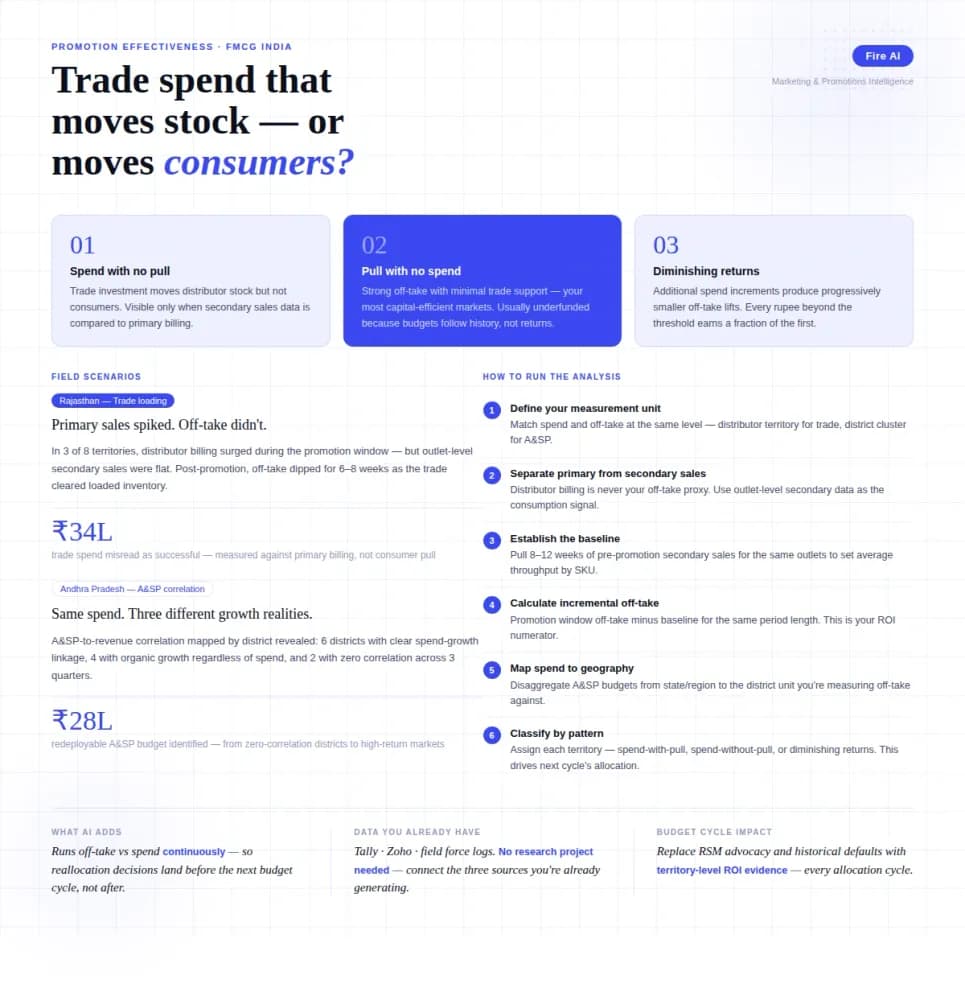
Measuring Promotion Effectiveness: A Data-Driven Guide for FMCG Marketers
FMCG brands in India spend 15–25% of gross revenue on trade promotions and A&SP (advertising and sales promotion) every year. Most can tell you how much they spent. Very few can tell you what it returned. The problem isn't a lack of data — it's that the data lives in disconnected places. Trade spend sits in finance. Off-take data lives with the distributor or field team. A&SP budgets are tracked in a marketing spreadsheet. No single view ties promotional investment to consumer pull at the outlet level. The result is a budget cycle where last year's spend allocation becomes next year's default, because no one has the numbers to argue for something different. This guide walks through how FMCG marketing and trade teams can build a promotion effectiveness framework that actually connects spend to outcome — not just channel-level assumptions.
Tally Analytics Dashboards for Indian Businesses
80% of Indian SMBs use Tally. Fewer than 5% have dashboards. Learn how to build real-time P&L, cash flow, and receivables analytics from your Tally Prime data.