

Quick answer
Procurement analytics uses purchase, supplier, and contract data to measure spend by category, supplier on-time delivery, price variance versus benchmarks, and purchase lead times. It helps teams cut maverick spend, negotiate with evidence, and avoid stockouts from unreliable vendors. FireAI connects sources like Tally and operations data so leaders get live dashboards and answers in plain language.
Procurement analytics is the practice of measuring and improving how your organisation buys goods and services using data from purchase orders, invoices, contracts, and supplier performance. It sits between finance (what we paid) and operations (what we need on time) so sourcing decisions are visible, comparable, and tied to cash flow.
Indian companies often run procurement through Tally, spreadsheets, and email approvals. Without analytics, the same category can be bought at three different rates, critical vendors miss delivery dates quietly, and nobody sees total spend until month-end closes. This page defines the main building blocks of procurement analytics and how FireAI helps teams act faster. For inventory-heavy operators, pair this with F&B inventory use cases and logistics operations use cases.
Why procurement analytics matters
Procurement is a direct lever on working capital and service levels. Late or low-quality supply creates production delays, stockouts in retail and F&B, and emergency freight. Uncontrolled spend inflates COGS before anyone notices. Analytics makes those trade-offs explicit: which suppliers are reliable, where prices drift, and which categories absorb the most rupees.
Supplier and vendor performance analytics
Supplier analytics scores vendors on dimensions that match your risk: on-time in-full (OTIF), quality rejects or returns, responsiveness to issues, and invoice accuracy. The goal is not a one-time vendor list but a living scorecard that procurement and plant or outlet managers use in weekly reviews.
Typical views include:
- OTIF % by vendor and by item family
- Reject or return rate as a share of receipts
- Lead time variance (promised vs actual receipt dates)
- Concentration risk (share of spend with top three suppliers)
For businesses that record purchases primarily in Tally, vendor-level behaviour is already in the vouchers; the gap is usually trend and ranking, not data entry. See Tally purchase analytics for a Tally-focused deep dive. This page stays at the cross-system definition level.
Cost variance and purchase price analytics
Cost variance analytics compares what you paid to a reference: last period’s rate, another branch’s rate, a contracted price, or a budget. Purchase price variance (PPV) is the classic finance view: standard or expected cost minus actual, extended by volume.
Useful questions procurement analytics answers:
- Which SKUs or raw materials moved more than X% in rate over 90 days?
- Which outlet or plant pays more for the same item than peers?
- Did scheme or bulk discounts actually flow through to the net rate?
In India, GST-inclusive and multi-Godown purchases can hide true unit economics unless analytics nets discounts, returns, and taxes consistently. That is where a BI layer on top of Tally or ERP beats static registers.
Lead time and replenishment analytics
Lead time tracking connects order date, promised date, and goods receipt date. Analytics surfaces vendors with creeping delays, seasonal slippage, and categories where safety stock is doing hidden work for poor suppliers.
Combined with demand forecasting and inventory analytics, lead-time insight drives reorder points and safety stock that match reality, not a static rule from three years ago.
Spend analytics and category management
Spend analytics classifies procurement into categories (ingredients, packaging, fuel, MRO, IT, logistics buy) and shows who buys from whom, how much, and on what terms. It is the foundation for tenders, vendor consolidation, and compliance (for example, preferred vendor policies in F&B chains or logistics fleets).
Common outputs:
- Spend by category, business unit, and time
- Maverick spend (off-contract or non-catalog purchases)
- Payment terms and early-payment discount capture (where finance and procurement overlap)
For organisations with both central kitchens and outlets, or hubs and lanes in logistics, spend analytics often needs hierarchy roll-ups so category heads see the same numbers as unit managers.
How FireAI supports procurement analytics
FireAI is built for teams that want live visibility without a separate data warehouse project:
- Connectors for sources many Indian SMBs already use (including Tally for purchases and payables) so voucher-level detail feeds dashboards automatically.
- Dashboards and NLQ so a category manager can ask “Which vendors had OTIF below 85% last quarter?” or “Show ingredient spend trend for the top five SKUs” without waiting for a static report.
- Cross-functional views that relate procurement to inventory and operations metrics, aligned with how supply chain dashboards are used in practice.
If your immediate need is purchase-register intelligence inside Tally, start with Tally purchase analytics; if you want the end-to-end chain, see how to build a supply chain dashboard.
Common pitfalls
- Mixing gross and net rates across returns and credit notes, which flatters or punishes vendors incorrectly.
- Vendor scorecards without OTIF definitions agreed with receiving teams, so “on time” means different things in different sites.
- One annual spend review instead of continuous variance monitoring, which lets rate creep continue for quarters.
- Ignoring logistics-linked procurement (fuel, tyres, spare parts) when those categories are material to unit economics in transport and last mile.
Ready to act on your data?
See how teams use FireAI to ask in plain language and get analytics they can trust.
Explore FireAI workflows
Go from this topic into product features and solution paths that match what you read here.
Topic hub
BI Fundamentals
Foundational guides on business intelligence, analytics architecture, self-service BI, and core data concepts.
Explore hubFrequently asked questions
What is procurement analytics in simple terms?
Procurement analytics uses purchase and supplier data to show where money is spent, how vendors perform on delivery and quality, whether prices are drifting versus benchmarks, and how long orders take to arrive. It helps businesses buy smarter, reduce stockouts, and protect margins.
What metrics are included in a procurement dashboard?
Typical procurement dashboards include spend by category and supplier, on-time in-full rate, lead time and variance, purchase price or cost variance, concentration of spend with top vendors, and maverick or off-contract spend. The exact set depends on whether the business is manufacturing, F&B, retail, or logistics.
How is procurement analytics different from inventory analytics?
Procurement analytics focuses on buying: suppliers, contracts, rates, and purchase lead times. Inventory analytics focuses on stock: turnover, dead stock, safety stock, and expiry risk. They connect because poor supplier lead times force higher inventory, and weak demand visibility causes wrong purchase quantities.
Can FireAI analyse procurement data from Tally?
Yes. FireAI connects to Tally purchase and related data so teams can build vendor performance, spend, and variance views without manual exports. You can combine Tally purchases with other operational data for a fuller picture, depending on your connectors and data model.
Related in this topic
Tally Purchase Analytics: Vendor & Procurement Data
Understand how Tally purchase analytics helps Indian businesses track vendor performance, procurement trends, and purchase cost optimisation from Tally Prime data.
What is a Supply Chain Dashboard? Key Metrics
A supply chain dashboard is a visual analytics tool that tracks procurement, inventory, logistics, and supplier performance metrics in one place. Learn what a supply chain dashboard includes, which KPIs matter most, and how to build one for your business.
What Is Inventory Analytics? Why It Matters for Indian Businesses
Inventory analytics measures stock health, turnover, and risk using your operational data. Learn what it includes (dead stock, safety stock, expiry), why it matters for working capital, and how FireAI builds inventory dashboards from Tally.
What is Demand Forecasting? Methods and AI Techniques
Demand forecasting uses historical sales data and statistical or AI models to predict future product demand. Learn the key methods — time series, causal, and machine learning — and how tools like FireAI automate demand planning directly from Tally and DMS data.
From the blog
Tally Analytics Dashboards for Indian Businesses
80% of Indian SMBs use Tally. Fewer than 5% have dashboards. Learn how to build real-time P&L, cash flow, and receivables analytics from your Tally Prime data.
CFO’s AI Analytics Guide 2026: From Monthly Close to Real Time
A working CFO AI analytics guide: replace the monthly close lag with real-time financial analytics, AI FP&A automation, and a CFO dashboard that decides.
Measuring Promotion Effectiveness: A Data-Driven Guide for FMCG Marketers
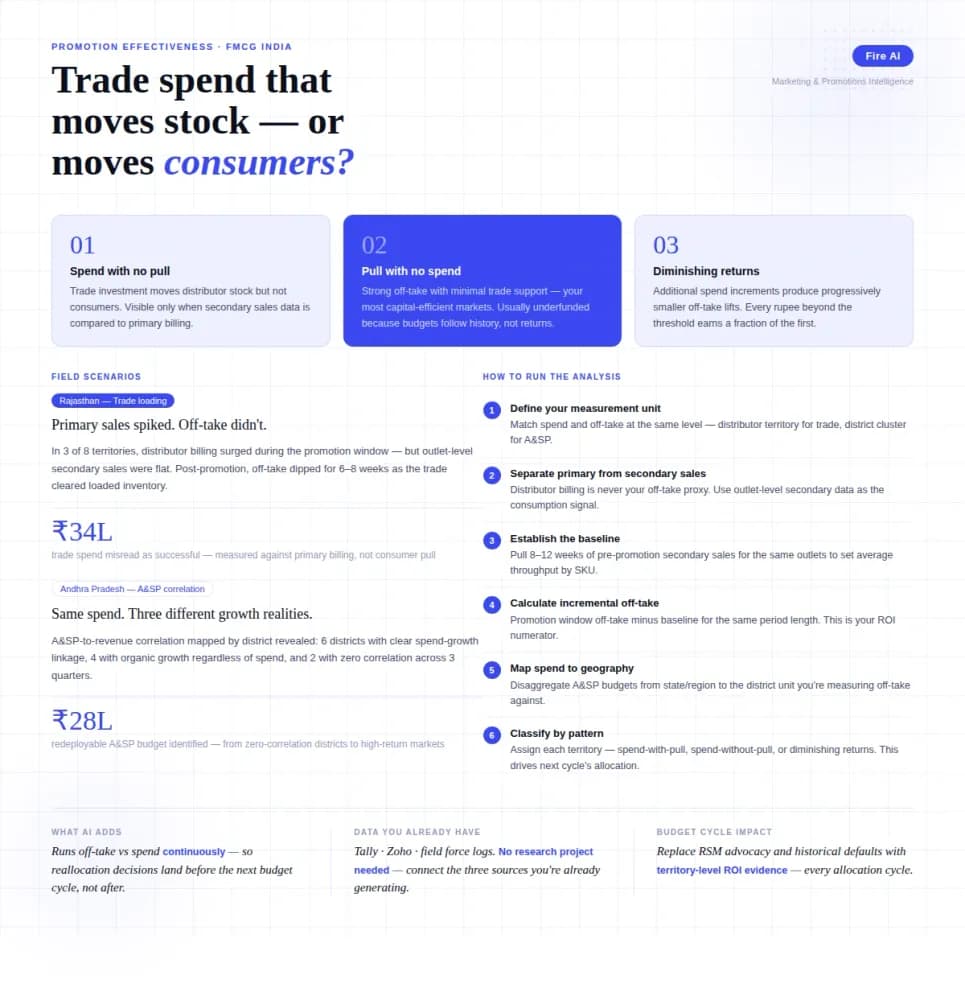
FMCG brands in India spend 15–25% of gross revenue on trade promotions and A&SP (advertising and sales promotion) every year. Most can tell you how much they spent. Very few can tell you what it returned. The problem isn't a lack of data — it's that the data lives in disconnected places. Trade spend sits in finance. Off-take data lives with the distributor or field team. A&SP budgets are tracked in a marketing spreadsheet. No single view ties promotional investment to consumer pull at the outlet level. The result is a budget cycle where last year's spend allocation becomes next year's default, because no one has the numbers to argue for something different. This guide walks through how FMCG marketing and trade teams can build a promotion effectiveness framework that actually connects spend to outcome — not just channel-level assumptions.