

Quick answer
Tally multi-company analytics consolidates data from multiple Tally Prime company files — separate branches, GSTINs, or legal entities — into unified dashboards. FireAI's one-click Tally connector auto-syncs all companies simultaneously, enabling group-level P&L, consolidated balance sheets, inter-company elimination, and cross-branch performance comparison without manual Excel merging.
Indian businesses commonly operate through multiple Tally companies — separate entities for each state GSTIN, manufacturing vs trading units, or holding and subsidiary structures. Each company is a separate data silo in Tally. Multi-company analytics breaks these silos.
Why Multi-Company Analytics Is Critical
The Problem
In Tally Prime, each company is a standalone file. To get a group view, the accountant typically:
- Opens each Tally company separately
- Exports reports to Excel
- Manually aligns chart of accounts (which may differ across companies)
- Creates a consolidated sheet
- Repeats every month
This process takes days, is error-prone, and produces a stale snapshot by the time it's ready.
The Solution
A BI layer that connects to all Tally company files simultaneously, maps accounts, eliminates inter-company transactions, and produces a real-time consolidated view.
Common Multi-Company Structures in India
State-Wise GSTIN Companies
Same business, but separate Tally companies for each state registration:
- ABC Traders (Maharashtra - GSTIN: 27XXXXX)
- ABC Traders (Karnataka - GSTIN: 29XXXXX)
- ABC Traders (Tamil Nadu - GSTIN: 33XXXXX)
Manufacturing + Trading Split
- ABC Manufacturing Pvt Ltd (production unit)
- ABC Trading Pvt Ltd (sales and distribution arm)
Holding + Subsidiary
- ABC Group Holdings Pvt Ltd
- ABC Retail Pvt Ltd (subsidiary)
- ABC Properties Pvt Ltd (subsidiary)
Branch-Wise Companies
- ABC Traders - Delhi Branch
- ABC Traders - Mumbai Branch
- ABC Traders - Chennai Branch
Core Multi-Company Dashboard Views
Consolidated P&L
A single P&L dashboard combining all companies:
| Line Item | Company A | Company B | Company C | Consolidated |
|---|---|---|---|---|
| Revenue | 48% share | 34% share | 18% share | 100% |
| Gross Margin | 40% | 35% | 38% | 38% |
| Operating Expenses | 45% of segment | 60% of segment | 71% of segment | 58% overall |
| Net Profit Margin | 12.5% | 9.4% | 4.4% | 10% |
Consolidated Balance Sheet
Combines assets, liabilities, and equity across all entities. Inter-company balances (e.g., amounts owed between Company A and Company B) must be eliminated to avoid double-counting.
Branch Performance Comparison
Side-by-side comparison of key metrics:
- Revenue per branch
- Margin percentage per branch
- DSO per branch
- Operating expense ratio per branch
This identifies the best and worst performing branches instantly.
Group Cash Position
Aggregated bank balances and cash position across all companies. The group treasurer needs to know total cash available, not just one company's balance.
Consolidated GST Compliance
GST filing status across all GSTINs in one calendar. Ensures no GSTIN misses a filing deadline.
Technical Challenges and Solutions
Chart of Accounts Mapping
Different Tally companies may use different ledger names for the same concept (e.g., "Staff Salary" in Company A, "Employee Wages" in Company B). Multi-company analytics requires a mapping layer that aligns these to a standard chart of accounts.
Inter-Company Elimination
When Company A sells goods to Company B, the revenue for A and purchase for B must be eliminated in consolidation to avoid inflating group revenue. Analytics identifies and eliminates these transactions based on inter-company ledger tags.
Currency and Valuation Differences
For groups with entities in different countries or using different valuation methods, analytics handles currency conversion and valuation adjustments during consolidation.
Different Financial Year Endings
Some companies may follow different financial years (e.g., one ends March 31, another December 31). Analytics aligns periods for meaningful comparison.
Use Cases for Indian Businesses
CA Firms Managing Multiple Clients
CAs managing 20–50 Tally companies need consolidated reporting across clients. Analytics provides a portfolio view — all clients' compliance status, financial health, and pending tasks in one dashboard.
Group Companies
Promoters running multiple businesses through separate entities need group-level profitability, cash position, and financial ratios. This is also needed for consolidated financial statements under Companies Act when applicable.
Franchise Operations
Franchisors who require franchisees to maintain Tally can consolidate all franchise performance data — revenue by franchise, compliance status, and profitability comparison.
Multi-Location Retail
Retail chains with separate Tally companies per store need consolidated sales data, inventory visibility across locations, and store-wise P&L comparison.
Implementation Considerations
Data Freshness
Each Tally company must sync to the analytics layer at the same frequency. If Company A syncs daily but Company B weekly, consolidated reports are misleading.
User Access Control
Different users need different views:
- Group CEO: Consolidated dashboards
- Branch manager: Only their branch data
- CFO: All entities with drill-down
- CA: Compliance-focused view across all companies
Scalability
As the group adds new companies or branches, the analytics layer should accommodate new data sources without rebuilding dashboards.
Benefits of Multi-Company Analytics
- Time savings: Eliminate 3–5 days of manual consolidation work per month
- Real-time visibility: See group financial position daily, not monthly
- Better decisions: Compare branch performance and allocate resources to high-performing units
- Compliance assurance: No GSTIN left behind in filing calendars
- Audit readiness: Consolidated statements and elimination schedules always current
How FireAI Helps
FireAI's one-click Tally connector syncs multiple Tally Prime company files simultaneously — no separate setup per company, no CSV exports, no IT team. The zero-code platform builds consolidated dashboards automatically: group P&L, combined balance sheet, branch comparison, and multi-GSTIN compliance tracking. Inter-company eliminations are handled automatically.
What makes FireAI different for multi-company analytics:
- Pre-built consolidation templates: Ready-made dashboards for group P&L, consolidated balance sheet, and branch comparison — live within minutes of connecting
- Real-time auto-sync: All companies sync at the same frequency, ensuring consolidated reports are always accurate
- Natural language queries (NLQ): Ask "What's the consolidated revenue for all branches this quarter?" or "Which branch has the lowest net margin?" and get instant visual answers
- Role-based access: Group CEO sees consolidated view, branch managers see only their data, CAs see compliance dashboards — all from the same platform
- 700+ data connectors: Beyond Tally, connect databases, ERPs, CRMs, and cloud apps to overlay operational data with financial consolidation
Example: A textile group in Surat with 4 Tally companies (₹35 Crore combined turnover) was spending 5 days every month on manual consolidation. After connecting all companies to FireAI, consolidated P&L and branch comparison dashboards were ready on day 1 of each month — saving the finance team ₹1.5 lakh annually in time and CA consolidation fees.
Ready to act on your data?
See how teams use FireAI to ask in plain language and get analytics they can trust.
Explore FireAI workflows
Go from this topic into product features and solution paths that match what you read here.
Topic hub
Tally Analytics
Analytics for Tally Prime and Tally ERP — one of 700+ data sources FireAI connects to — including dashboards, reporting, GST, and finance workflows.
Explore hubFrequently asked questions
How does multi-company analytics handle different chart of accounts across Tally companies?
The analytics layer includes an account mapping feature that maps ledgers from each Tally company to a standardised group chart of accounts. For example, "Staff Salary" in one company and "Employee Wages" in another both map to a unified "Employee Costs" category. This mapping is configured once and applied automatically.
Can multi-company analytics eliminate inter-company transactions?
Yes. When Company A sells to Company B, the revenue for A and purchase for B are identified through inter-company ledger tagging and automatically eliminated in consolidated reports. This prevents inflated group revenue and gives an accurate picture of external business performance.
How many Tally companies can be consolidated in one dashboard?
FireAI can handle 10–100+ Tally companies in a single consolidated view. All companies sync at the same frequency automatically, so consolidated reports are always accurate. For CA firms managing many client companies, this makes portfolio-level oversight practical without manual data gathering.
How long does it take to set up multi-company analytics from Tally?
With FireAI's one-click Tally connector, connecting each company takes under 5 minutes. For a group with 5 Tally companies, you can have a consolidated dashboard live within 30 minutes — including account mapping and template configuration. No IT team or technical skills required.
Can I track GST compliance across multiple GSTINs in one dashboard?
Yes. FireAI consolidates GST filing status, ITC reconciliation, and compliance calendars across all state-wise GSTIN registrations into one dashboard. This is critical for businesses operating in multiple states — you see which GSTINs have filed, which are pending, and which have ITC mismatches, all in a single view.
Related in this topic
Tally Analytics: Turn Tally Data into Dashboards & Reports
Get AI-powered analytics and dashboards from Tally Prime data without SQL. FireAI connects to Tally for live GST, sales, inventory, and P&L—no spreadsheet exports.
Tally P&L Dashboard: Profit and Loss Analytics
Build a visual Profit & Loss dashboard from Tally Prime data. Track revenue, expenses, gross margin, operating profit, and net profit trends with interactive charts and drill-downs.
Tally Balance Sheet Dashboard: Assets & Net Worth
Visualise your Tally Prime balance sheet as an interactive dashboard. Track assets, liabilities, equity, key ratios, and net worth trends with drill-downs and period comparisons.
How to Build Financial Dashboards
Learn how to build effective financial dashboards by focusing on key financial metrics, designing CFO-friendly layouts, and implementing real-time financial monitoring. Discover which metrics to track, dashboard design principles, and best practices for financial analytics.
From the blog
Tally Analytics Dashboards for Indian Businesses
80% of Indian SMBs use Tally. Fewer than 5% have dashboards. Learn how to build real-time P&L, cash flow, and receivables analytics from your Tally Prime data.
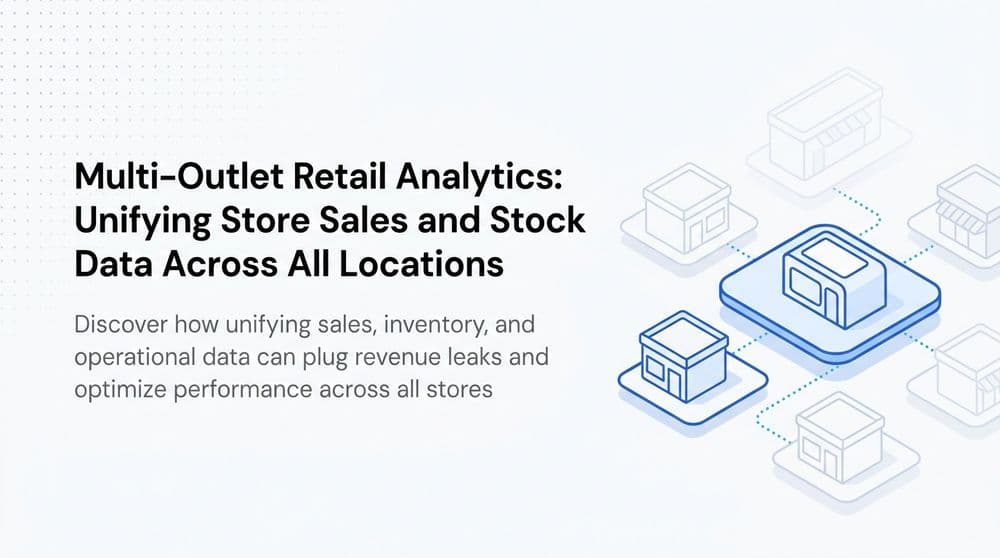
Multi-Outlet Retail Analytics: Track Store Sales
Track sales, stockouts, and staff performance across all stores. Learn how multi-outlet retail analytics can find the root cause of revenue leaks.

CFO’s AI Analytics Guide 2026: From Monthly Close to Real Time
A working CFO AI analytics guide: replace the monthly close lag with real-time financial analytics, AI FP&A automation, and a CFO dashboard that decides.