

Quick answer
Tally GST analytics extracts GSTR-1, GSTR-3B, and ITC data from Tally Prime and displays it in visual compliance dashboards. It helps businesses track filing status, catch ITC mismatches early, monitor GST liability trends, and avoid penalties — replacing manual register cross-checking with automated, real-time reconciliation views.
GST compliance is one of the biggest pain points for Indian businesses using Tally, and a GST analytics dashboard solves it by turning Tally's GST data into actionable compliance views.
Why GST Analytics from Tally Data Matters
India's GST regime requires monthly and quarterly filings with precise reconciliation between outward supplies (GSTR-1), summary returns (GSTR-3B), and input tax credit (ITC) claims. Tally Prime records all GST transactions, but its native reports don't provide the visual compliance overview that finance teams need.
Common problems without GST analytics:
- ITC mismatch discovered only at filing time — a ₹35,000 mismatch (like the example below) can mean penalties and interest
- Late identification of vendors who haven't filed their GSTR-1 (affecting your ITC)
- No visibility into GST liability build-up during the month
- Manual reconciliation of GSTR-2A/2B with purchase register taking 2–3 days per month
- CA firms spending 4–5 hours per client on GST reconciliation that could be automated
Key Components of a Tally GST Dashboard
GSTR-1 Outward Supply Tracking
- B2B invoice summary by customer and HSN code
- B2C small and large invoice aggregation
- Credit and debit note tracking
- Export and SEZ supply monitoring
- Amendment tracking for revised invoices
GSTR-3B Summary View
- Output GST liability (CGST, SGST, IGST) for the month
- ITC available vs ITC claimed
- Tax payable after ITC adjustment
- Interest liability on late payment
- Month-over-month GST liability trend
ITC Reconciliation Dashboard
| Source | CGST | SGST | IGST | Total |
|---|---|---|---|---|
| As per Tally purchase register | 2,50,000 | 2,50,000 | 1,80,000 | 6,80,000 |
| As per GSTR-2B | 2,35,000 | 2,35,000 | 1,75,000 | 6,45,000 |
| Mismatch | 15,000 | 15,000 | 5,000 | 35,000 |
This kind of mismatch view — showing exactly where ITC claimed in Tally doesn't match the government portal — prevents GST notices and penalties.
Compliance Calendar
- Filing due dates for GSTR-1, GSTR-3B, and annual returns
- Status tracking (filed, pending, overdue)
- Auto-alerts before due dates
- Late fee and interest calculator for delayed filings
How Tally GST Analytics Works
Data Flow
- Extract: GST voucher data from Tally Prime — sales invoices, purchase invoices, credit notes, debit notes, and journal entries with GST details
- Transform: Map transactions to GSTR-1 tables (B2B, B2CS, B2CL, CDNR, HSN summary) and GSTR-3B format
- Reconcile: Compare Tally data with GSTR-2A/2B downloaded from the GST portal
- Visualise: Present compliance status, mismatches, and trends in dashboards
Automated Alerts
- ITC mismatch exceeding a configurable threshold
- Filing deadline approaching (7 days, 3 days, 1 day before)
- Vendors who haven't uploaded their invoices to GSTR-1
- Unusual GST liability spikes compared to previous months
Common GST Compliance Issues Caught by Analytics
ITC Claimed but Not Available in GSTR-2B
Vendors may have recorded sales in Tally but not filed their GSTR-1. Analytics flags these vendors so your team can follow up before filing.
HSN Code Mismatches
Inconsistent HSN codes across invoices can trigger GST notices. A dashboard highlights products with multiple HSN codes for correction.
Reverse Charge Mechanism (RCM) Gaps
Purchases attracting RCM (unregistered vendors, specified services) need separate GST treatment. Analytics identifies RCM-liable transactions that may have been missed.
Place of Supply Errors
Inter-state vs intra-state classification errors lead to IGST vs CGST/SGST mismatches. Analytics catches invoices where the place of supply doesn't match the GST type charged.
GST Analytics for Different Business Types
Traders and Distributors
High volume of B2B invoices means frequent GSTR-1 reconciliation. Analytics automates the matching of hundreds or thousands of invoices per month against GSTR-2A/2B data.
Manufacturers
Input materials attract different GST rates. ITC tracking across multiple HSN codes and rate slabs (5%, 12%, 18%, 28%) is complex without automated analytics.
Service Companies
Reverse charge on imports of services, place of supply rules for inter-state services, and TDS under GST all require careful tracking that analytics simplifies.
Multi-Branch Businesses
Each GSTIN files separately. Multi-company analytics consolidates GST data across branches for a group-level compliance view.
How FireAI Automates GST Analytics from Tally
FireAI connects to Tally Prime with a one-click connector — no ODBC, no CSV exports, zero code — and automatically builds a GST compliance dashboard with real-time auto-sync.
What FireAI's GST dashboard delivers:
- GSTR-1 vs GSTR-3B reconciliation with visual mismatch highlighting
- ITC tracking showing claimed vs available with vendor-level breakdown
- Filing deadline alerts — get notified 7 days, 3 days, and 1 day before due dates
- HSN code consistency checks across all invoices
- NLQ queries: Ask "Which vendors have ITC mismatches above ₹10,000 this month?" in English or Hindi and get instant answers
Example: A ₹12 Cr trading company in Surat was manually reconciling GSTR-2B every month, taking 3 days of an accountant's time. After connecting Tally Prime to FireAI, the ITC mismatch dashboard runs automatically — flagging problematic vendors within seconds and saving ₹15,000+ per month in accounting hours.
FireAI supports 700+ data sources beyond Tally, so GST data can be combined with sales analytics, receivables, and cash flow for a complete compliance and financial view.
Ready to act on your data?
See how teams use FireAI to ask in plain language and get analytics they can trust.
Explore FireAI workflows
Go from this topic into product features and solution paths that match what you read here.
Topic hub
Tally Analytics
Analytics for Tally Prime and Tally ERP — one of 700+ data sources FireAI connects to — including dashboards, reporting, GST, and finance workflows.
Explore hubFrequently asked questions
How does Tally GST analytics help with ITC reconciliation?
It automatically compares your Tally purchase register with GSTR-2A/2B data from the GST portal. Mismatches are highlighted at vendor level with exact amounts — e.g., showing ₹35,000 ITC gap from a specific supplier — so your team can follow up before filing and avoid losing eligible ITC.
Can Tally GST analytics prevent GST notices and penalties?
Yes. By catching HSN code inconsistencies, place of supply mismatches, RCM gaps, and ITC overclaims weekly instead of at filing time, businesses file accurate returns. FireAI's automated GST dashboard flags these issues in real time, helping avoid show-cause notices from department audits.
Does Tally GST analytics work for businesses with multiple GSTINs?
Yes. FireAI consolidates GST compliance data across all state-wise registrations into a single dashboard. Businesses with branches in multiple states get a unified compliance view while each GSTIN's filings are tracked independently.
How much time does GST analytics save compared to manual reconciliation?
Most businesses report saving 2–3 days per month on GSTR-2B reconciliation alone. CA firms managing 15+ clients can save 40–60 hours per month. FireAI automates the matching that accountants currently do manually in Excel, flagging only the mismatches that need human attention.
Can I ask GST questions in plain English from my Tally data?
Yes. FireAI's NLQ (natural language query) engine lets you ask questions like "Show vendors with ITC mismatch above ₹5,000" or "What is my total GST liability for March?" in English or Hindi and get instant visual answers from your Tally Prime data.
Related in this topic
Tally Analytics: Turn Tally Data into Dashboards & Reports
Get AI-powered analytics and dashboards from Tally Prime data without SQL. FireAI connects to Tally for live GST, sales, inventory, and P&L—no spreadsheet exports.
GST Return Analytics: GSTR-1, GSTR-3B & ITC Tracking
GST return analytics helps Indian businesses track GSTR-1, GSTR-3B filings, ITC reconciliation, and compliance status. Dashboards for GST data from Tally, ERP, or accounting software.
How to Build a GST Dashboard from Tally Data
Learn how to build a real-time GST dashboard from Tally Prime data — track GSTR-1, GSTR-3B, input tax credit, and GST liability with visual analytics and automated alerts.
Can AI Automate GST Reconciliation from Tally Data?
Yes — AI can automate GST reconciliation by matching your Tally purchase register against GSTR-2B data, flagging mismatches, and tracking ITC discrepancies in real time.
From the blog
Tally Analytics Dashboards for Indian Businesses
80% of Indian SMBs use Tally. Fewer than 5% have dashboards. Learn how to build real-time P&L, cash flow, and receivables analytics from your Tally Prime data.
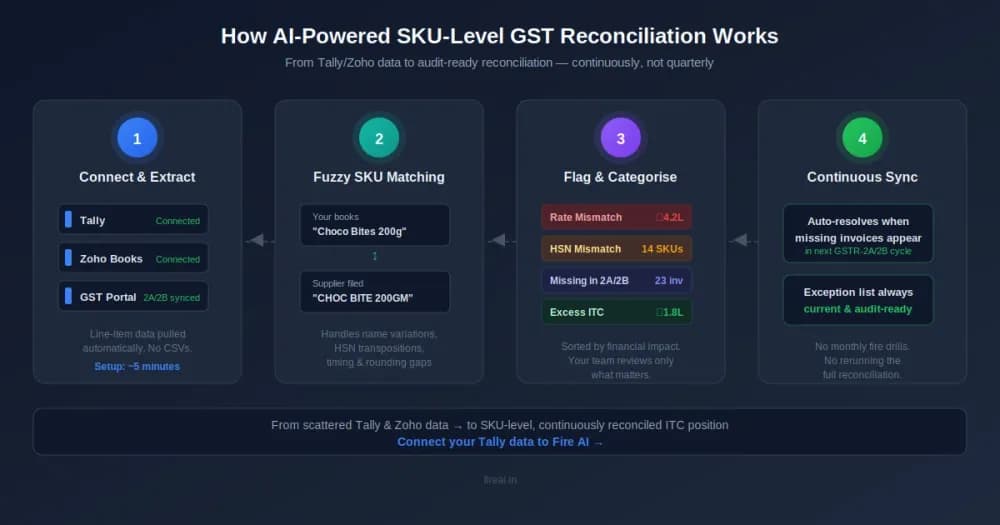
GST Credit Reconciliation by SKU: An AI-Powered Approach for FMCG
Your invoice totals match. Your GSTR-2A looks clean. But buried three levels down, at the SKU level, there's ₹14 lakh in ITC you either shouldn't have claimed — or haven't claimed at all. Here's how AI surfaces what spreadsheets can't.

CFO’s AI Analytics Guide 2026: From Monthly Close to Real Time
A working CFO AI analytics guide: replace the monthly close lag with real-time financial analytics, AI FP&A automation, and a CFO dashboard that decides.