

Quick answer
Startup founders need analytics because data-driven decisions identify product-market fit faster, catch cash-flow crises early, and build investor confidence with hard numbers. Tools like FireAI let founders track revenue, churn, and unit economics directly from Tally — starting at ₹4,999/month with zero code and NLQ in Hindi or English.
The best founders are obsessive about their numbers — not because VCs demand it, but because data is how they know if their bets are working.
Analytics for founders isn't about sophisticated data science. It's about having clear, reliable signals that tell you whether the business is working or not.
Why Analytics Matters More for Founders Than Anyone Else
Founders make more decisions per day than any other role in the company. Pricing, hiring, product direction, market focus, partnership priorities — all happening simultaneously, with limited information and high stakes.
Analytics doesn't make decisions for founders. It makes the information available to make decisions faster, with more confidence, and with less regret.
What Founders Need to Track
At Pre-Revenue / Seed Stage:
- User acquisition: Where are users coming from? What's working?
- Engagement: Are users returning? Where do they drop off?
- Feedback signals: What are users asking for most?
- Burn rate and runway: How many months do we have?
At Early Revenue (₹0–₹1Cr ARR):
- Revenue by customer and channel
- Gross margin (are we making money on each sale?)
- Churn rate (who's leaving and why?)
- CAC vs LTV (is customer acquisition sustainable?)
- Month-over-month growth rate
At Growth Stage (₹1Cr–₹20Cr ARR):
- All of the above, plus:
- Cohort analysis (are newer cohorts performing better or worse than older ones?)
- Unit economics by segment, geography, or channel
- Team productivity metrics
- Sales pipeline and conversion by stage
Analytics as Investor Readiness
Investors fund data-driven founders. When you can walk into a pitch and say "Our Month 6 cohort retains at 72% vs Month 3 cohort at 58% — we've found the intervention that improves retention" — you signal that you run the business rigorously.
Many Indian startups reach Series A discussions without being able to answer basic questions: What's your net revenue retention? What's LTV by customer segment? What's CAC by channel? Analytics turns these from scary questions into competitive advantages.
The Founder's Analytics Stack in 2026
Early-stage founders don't need a data warehouse. They need a tool that connects directly to their existing data and answers questions instantly.
FireAI for founders:
- Connects to Tally, Google Sheets, Razorpay, Shopify, and 700+ data sources — no engineering required
- Ask questions in plain Hindi or English: "इस महीने हमारा burn rate क्या है?" or "Which customer segment has the highest LTV?"
- Zero-code dashboards that a non-technical founder can build in minutes
- Starts at ₹4,999/month — less than a freelance analyst's daily rate
- AI-powered alerts when metrics deviate from plan
Real founder scenario: A Jaipur-based D2C brand founder connected Shopify + Razorpay + Google Ads to FireAI. Within a week, she discovered her highest-CAC channel (Instagram) was also her highest-LTV channel — justifying the spend her accountant wanted to cut. That single insight saved ₹8 lakhs in annual revenue.
Avoiding the Analytics Trap
A warning: analytics can become a distraction for founders.
Don't track vanity metrics: User count means nothing if users don't engage. Impressions mean nothing if they don't convert. Focus on metrics that directly measure value creation.
Don't analyse instead of act: Some founders use "we need more data" as a reason to avoid difficult decisions. When you have enough information to make a reasonable decision, act.
Don't build before you sell: Analytics infrastructure is useful after you have customers. For pre-revenue startups, talk to customers directly — that's better analytics than any dashboard.
See best BI tools in India for platform comparisons, how to measure analytics ROI for justifying the investment, and what is FireAI for a deeper look at India's AI-native BI platform.
Ready to act on your data?
See how teams use FireAI to ask in plain language and get analytics they can trust.
Explore FireAI workflows
Go from this topic into product features and solution paths that match what you read here.
Topic hub
Dashboard And Reporting
Practical content on KPI dashboards, executive reporting, trend analysis, charts, and reporting automation.
Explore hubFrequently asked questions
What analytics do startup founders need to track?
Early-stage founders should track: monthly revenue and month-over-month growth rate, number of active customers, customer churn rate, gross margin, cash burn and runway, and the one metric that is most predictive of value creation for their specific business model (daily active users for consumer apps, pipeline conversion for B2B sales, NPS for service businesses). Keep it to 5–8 metrics maximum — more metrics means less focus.
When should a startup invest in analytics tools?
Startups should invest in analytics tools when: (1) you have paying customers and need to understand their behaviour, (2) you're making decisions about where to focus (product, channel, market) that need data support, (3) you're preparing for a funding round and need to demonstrate business performance rigorously, or (4) manual tracking in spreadsheets is taking significant team time. For most Indian startups, this is around ₹20–50L ARR.
How do analytics help founders raise funding?
Analytics help founders raise funding by: demonstrating that the business is run rigorously (investors back founders who know their numbers), showing trend evidence of product-market fit (not just snapshots but improving cohort retention), enabling accurate financial projections (based on real unit economics), and reducing due diligence time (investors get answers faster when data is organised and accessible). Founders with clear analytics packages typically close funding rounds faster.
What is the best affordable analytics tool for Indian startup founders?
FireAI is purpose-built for Indian founders — it connects to Tally, Razorpay, Shopify, and 700+ sources without any coding. Founders can ask business questions in Hindi or English using natural language queries. At ₹4,999/month with no per-user fees, it costs less than a single freelance analyst session. Alternatives include Zoho Analytics (best if already in the Zoho ecosystem) and Metabase (free but requires technical setup).
How can a non-technical founder set up business analytics without a data team?
Use a zero-code BI tool like FireAI with native integrations for Tally, ERPs, and payment platforms. Connect your data sources in under 30 minutes, use pre-built dashboard templates for SaaS, D2C, or B2B metrics, and ask questions in natural language instead of writing SQL. Most non-technical founders have their first dashboard running within a day — no data engineer needed.
Related in this topic
What is Analytics ROI? How to Calculate Returns
Analytics ROI is the financial return generated by analytics tools and initiatives relative to their cost. Learn how to calculate analytics ROI, what factors to include, and what typical ROI looks like for business intelligence implementations.
What is Data Democratization? Benefits and Challenges
Data democratization enables all employees to access and analyze business data without technical barriers. Learn how data democratization works, which benefits it provides, and how to implement it to transform organizations into data-driven cultures.
7 Best BI Tools in India (2026)
Compare the best business intelligence tools for Indian businesses in 2026. See pricing features and which BI platform fits SMBs mid-market and enterprise.
Why Companies Fail at Analytics (and How to Succeed)
Most analytics initiatives fail — not because of bad technology, but because of poor strategy, cultural resistance, and the wrong approach. Learn the most common reasons analytics programmes fail and what successful companies do differently.
From the blog

Democratizing Data: How AI Analytics Levels the Playing Field for Small Businesses and Freelancers
For decades, data-driven decision making was a luxury that only enterprises could afford. Big companies hired data scientists, purchased expensive BI tools, and built complex data warehouses. In exchange, they received precise insights that guided budgets, strategy, and growth.

From Gut Feel to Data-Driven: A Marketer’s Guide to Embracing AI Insights
A practical guide for modern marketers on shifting from instinct-driven decisions to AI-powered, data-driven insights with real examples of how tools like FireAI make analytics conversational and actionable.
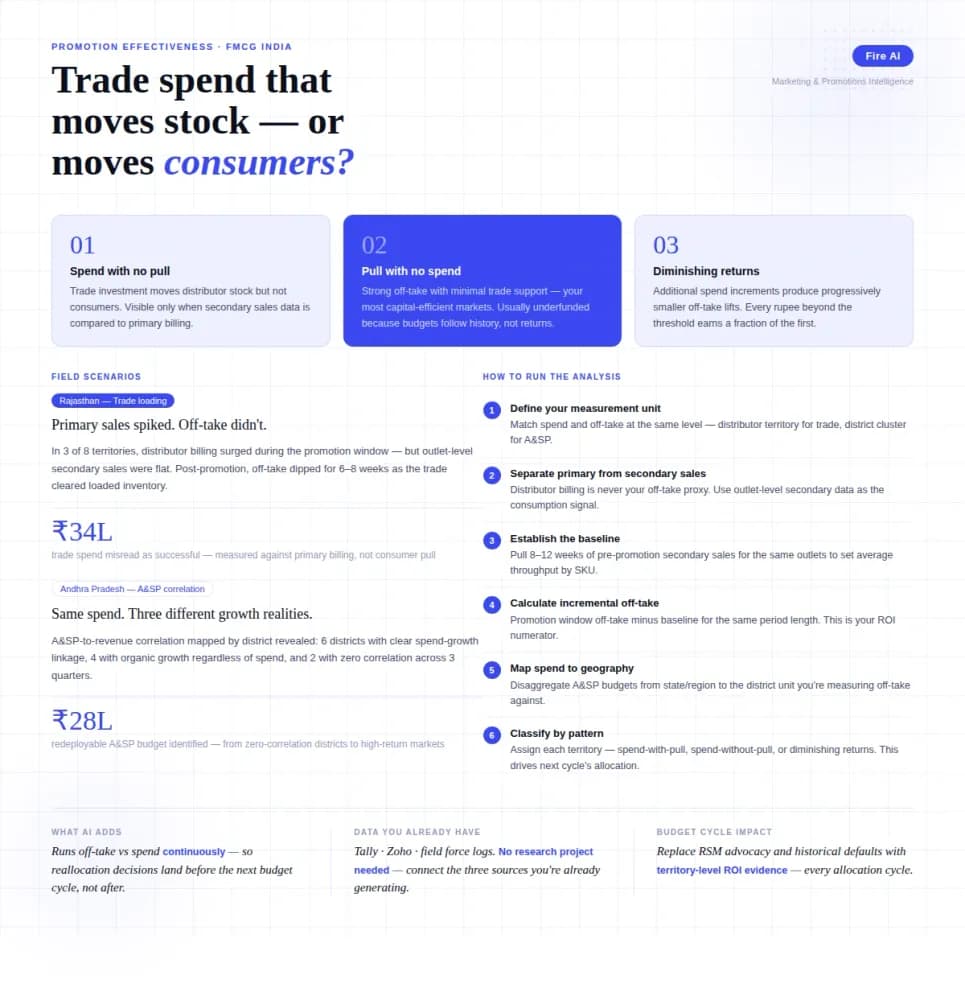
Measuring Promotion Effectiveness: A Data-Driven Guide for FMCG Marketers
FMCG brands in India spend 15–25% of gross revenue on trade promotions and A&SP (advertising and sales promotion) every year. Most can tell you how much they spent. Very few can tell you what it returned. The problem isn't a lack of data — it's that the data lives in disconnected places. Trade spend sits in finance. Off-take data lives with the distributor or field team. A&SP budgets are tracked in a marketing spreadsheet. No single view ties promotional investment to consumer pull at the outlet level. The result is a budget cycle where last year's spend allocation becomes next year's default, because no one has the numbers to argue for something different. This guide walks through how FMCG marketing and trade teams can build a promotion effectiveness framework that actually connects spend to outcome — not just channel-level assumptions.