

Quick answer
Sales teams use analytics to identify at-risk accounts before they churn, prioritise high-potential leads, track target progress in real time, and forecast revenue accurately. With FireAI, Indian sales managers ask "किस customer ने इस हफ्ते order नहीं दिया?" in Hindi — getting instant answers from Tally data, zero code needed, at just ₹4,999/month.
The difference between a sales team that hits target and one that misses is often visibility — not effort, not talent, but the ability to see what's working and act on it while there's still time.
Analytics gives sales teams that visibility.
Why Sales Analytics Matters
From Reactive to Proactive Customer Management
Without analytics: A key account goes quiet. The sales rep notices at month-end when the order doesn't come. The quarter is already lost.
With analytics: An automated alert triggers when a top-10 account hasn't ordered in 12 days (unusual for their pattern). The rep calls on day 13, discovers there was a payment dispute, resolves it, and the order arrives. Quarter saved.
Territory and Account Prioritisation
Without analytics: Sales reps visit accounts based on habit, proximity, and personal relationships. High-potential accounts are under-visited because they're less familiar.
With analytics: Account scoring shows which customers have the most growth potential based on order history, category, and similar-customer benchmarks. Reps spend more time in the right places.
Pipeline Accuracy and Forecast Reliability
Without analytics: "We have a big month coming" or "the pipeline looks healthy" — gut-feel forecasts that leave management scrambling when reality differs.
With analytics: Conversion rates by stage, deal aging, and historical close rate by salesperson combine to produce a statistically-grounded forecast. Management plans with confidence.
Channel and Product Mix Optimisation
Without analytics: The national sales head knows the top-line number. Whether it's coming from the right channels and right products is unclear until a problem emerges.
With analytics: Real-time dashboard shows channel mix, product mix, and margin profile of the sales portfolio. Trends are visible while there's still time to intervene.
What Sales Analytics Looks Like in Practice
Sales manager's morning routine (with analytics):
- Open dashboard: check yesterday's performance vs target
- Review accounts flagged as at-risk (no order in X days)
- Check team's activity for the day (calls planned, visits scheduled)
- Identify 1–2 specific coaching conversations based on data
- Time: 10 minutes
Sales manager's morning routine (without analytics):
- Call/WhatsApp each team member: "What's happening?"
- Mental arithmetic on who's on track and who isn't
- React to incoming information rather than guide based on data
- Time: 45–60 minutes, and still less actionable
Key Sales KPIs to Track
- Revenue vs target (daily, MTD)
- Number of active accounts (ordered in last 30 days) vs total accounts
- At-risk accounts (no order in >21 days)
- New accounts opened vs target
- Average order value trend
- Salesperson-wise performance vs target
- Channel/category mix vs plan
How FireAI Powers Sales Analytics
FireAI gives Indian sales teams an unfair advantage:
- Tally-native: Pulls daily invoice data automatically — no exports, no delays
- NLQ in Hindi and English: Sales managers type "दिल्ली region में इस हफ्ते कितनी sales हुई?" and get instant answers
- At-risk account alerts: Configurable triggers when top accounts go silent
- ₹4,999/month, zero code: No IT team required — the sales head sets it up in a day
- 700+ connectors: Combine Tally + CRM + WhatsApp Business data for complete sales visibility
- Mobile-first: Field sales reps check dashboards between customer visits
Real impact: A Pune-based industrial distributor with 40 salespeople reduced at-risk account losses by 35% in the first quarter after deploying FireAI's automated account health alerts — recovering ₹28 lakhs in revenue that would have churned silently.
See analytics for sales teams in India for India-specific implementation advice, and sales dashboard for the metrics that matter.
Ready to act on your data?
See how teams use FireAI to ask in plain language and get analytics they can trust.
Explore FireAI workflows
Go from this topic into product features and solution paths that match what you read here.
Topic hub
BI Fundamentals
Foundational guides on business intelligence, analytics architecture, self-service BI, and core data concepts.
Explore hubFrequently asked questions
How does analytics help sales teams hit their targets?
Analytics helps sales teams hit targets by providing: real-time visibility into progress vs target (so corrective action is taken mid-month, not at month-end), early warning on at-risk accounts (so intervention happens before the order is lost), data on which activities and accounts drive the most revenue (so effort is focused correctly), and accurate forecasting (so the pipeline is managed based on evidence, not optimism).
What data do sales teams need for analytics?
Sales teams need: order/invoice data (typically from Tally or ERP), customer master data (account details, segment, region), salesperson assignments, targets by salesperson and territory, and ideally CRM data (pipeline, interactions, activities). Most Indian B2B companies have the first three in Tally — connecting Tally to a BI tool gives sales managers immediate visibility into most critical metrics.
How do I get my sales team to use analytics dashboards?
Sales teams adopt analytics dashboards when: (1) the dashboard answers questions they actually have ("who hasn't ordered this week?"), (2) the sales manager reviews the dashboard in every team meeting, (3) high performers are recognised publicly using dashboard data, (4) dashboard access is mobile-friendly so reps check it in the field, and (5) the first version is simple — too many metrics creates abandonment. Start with 5–7 metrics that sales reps care about, not the full analytics suite.
Can Indian sales teams use analytics without knowing English or SQL?
Yes. FireAI supports natural language queries in Hindi and English — sales managers can ask "इस महीने किस salesperson ने सबसे ज़्यादा orders लिए?" and get instant answers without writing any code or SQL. The interface is designed for business users, not technical staff. This removes the biggest adoption barrier for Indian sales teams where Hindi is the working language.
What ROI can a sales team expect from investing in analytics tools?
Sales teams typically see 3–5x ROI within 6 months. The value comes from: reducing at-risk account losses (worth ₹10–50 lakhs for mid-size B2B companies), improving target achievement by 15–25% through better territory allocation, saving 5–10 hours per week of manual reporting time for sales managers, and more accurate forecasting that improves inventory and cash planning. At ₹4,999/month for FireAI, even one recovered at-risk account covers a full year of the tool.
Related in this topic
Analytics for Sales Teams: Use Data to Hit Targets
Learn how Indian sales teams use analytics to track performance, identify at-risk accounts, prioritise territory coverage, and forecast revenue more accurately. Practical guide for sales managers and heads of sales in Indian businesses.
What is a Sales Dashboard? Metrics and Examples
A sales dashboard is a visual tool that displays real-time sales performance metrics — revenue, pipeline, win rate, and team performance — on a single screen. Learn what to include in a sales dashboard and how to build one.
What are Business Metrics? Key Metrics to Track
Business metrics are quantifiable measures used to track and assess the performance of a business or business function. Learn the most important business metrics, how to organise them in dashboards, and which ones matter most for Indian SMBs.
What is a KPI Dashboard? Definition and Examples
A KPI dashboard is a visual display of key performance indicators that gives business leaders an at-a-glance view of performance against goals. Learn what KPI dashboards include, how to build one, and see examples across sales, finance, and operations.
From the blog
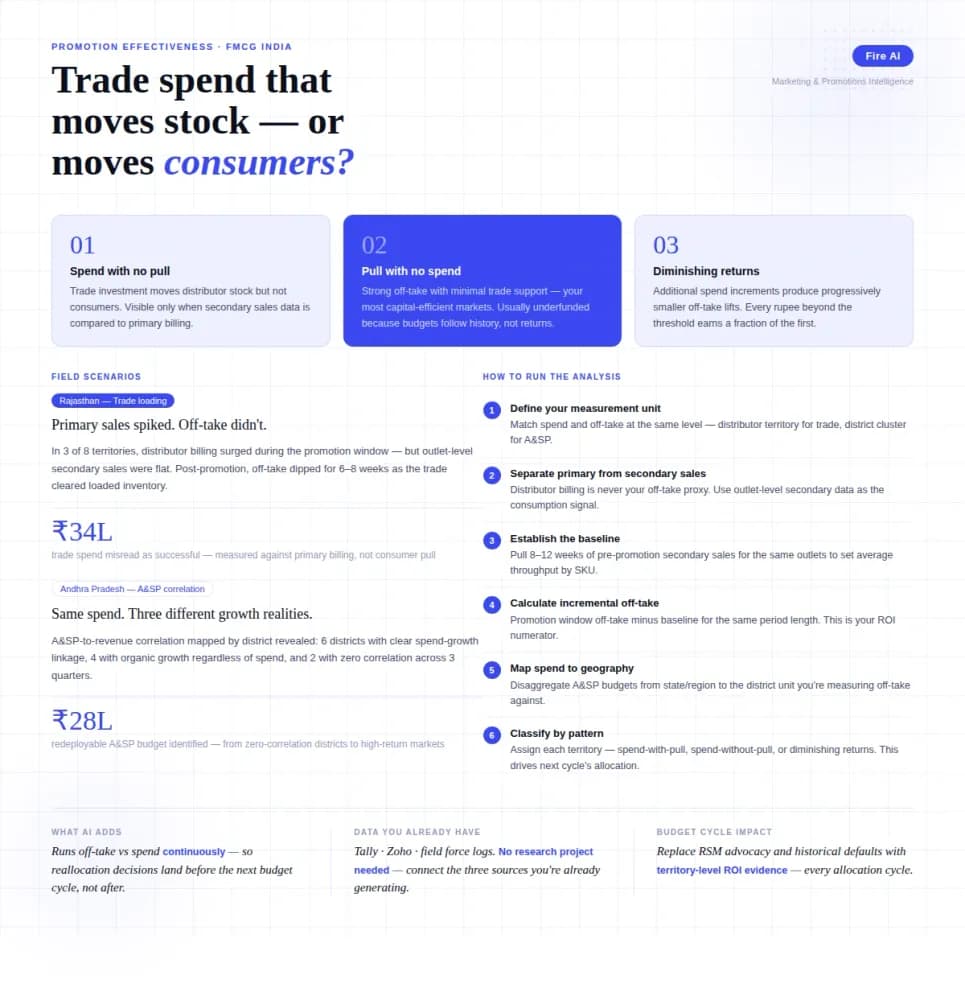
Measuring Promotion Effectiveness: A Data-Driven Guide for FMCG Marketers
FMCG brands in India spend 15–25% of gross revenue on trade promotions and A&SP (advertising and sales promotion) every year. Most can tell you how much they spent. Very few can tell you what it returned. The problem isn't a lack of data — it's that the data lives in disconnected places. Trade spend sits in finance. Off-take data lives with the distributor or field team. A&SP budgets are tracked in a marketing spreadsheet. No single view ties promotional investment to consumer pull at the outlet level. The result is a budget cycle where last year's spend allocation becomes next year's default, because no one has the numbers to argue for something different. This guide walks through how FMCG marketing and trade teams can build a promotion effectiveness framework that actually connects spend to outcome — not just channel-level assumptions.

Democratizing Data: How AI Analytics Levels the Playing Field for Small Businesses and Freelancers
For decades, data-driven decision making was a luxury that only enterprises could afford. Big companies hired data scientists, purchased expensive BI tools, and built complex data warehouses. In exchange, they received precise insights that guided budgets, strategy, and growth.
Tally Analytics Dashboards for Indian Businesses
80% of Indian SMBs use Tally. Fewer than 5% have dashboards. Learn how to build real-time P&L, cash flow, and receivables analytics from your Tally Prime data.