

Quick answer
Indian sales teams use analytics to track revenue vs target in real time, spot at-risk accounts before they churn, and optimise territory allocation. Connect Tally data to FireAI (₹4,999/month, zero code) for daily sales dashboards, salesperson scorecards, and at-risk alerts — with NLQ in Hindi and English so field reps ask questions naturally.
Indian sales teams face unique analytics challenges — multi-tier distribution, seasonal demand, regional language barriers, and data spread across Tally, CRM, and WhatsApp. This guide addresses these specifics.
The Most Valuable Sales Analytics for Indian Businesses
Daily Sales vs Target Tracking
The fundamental sales analytics requirement: every morning, the sales manager knows whether the team is on track, ahead, or behind.
What to build: A dashboard showing:
- Today's orders (value and count) vs same day last month
- Month-to-date revenue vs MTD target
- Salesperson-wise performance vs their individual targets
- Channel-wise breakdown (direct, distributor, online)
Data required: Daily order data from Tally invoices or ERP sales module.
At-Risk Account Detection
In Indian B2B sales, losing a customer rarely happens suddenly — there's almost always a gradual reduction in order frequency or value before outright churn.
What to build: An at-risk account dashboard showing:
- Top accounts by revenue with last order date
- Accounts whose order frequency has dropped by >30% vs previous period
- Accounts with declining average order value
- Accounts not placed in 14+ days (configurable threshold)
Impact: Sales team calls the right accounts at the right time instead of discovering lost business at month-end.
Territory and Account Prioritisation
Many Indian sales teams allocate territory and account coverage based on geography and personal relationships rather than revenue potential. Analytics reveals the gaps.
What to build: An account prioritisation view showing:
- Revenue per account vs number of visits
- High-value accounts with low visit frequency (underserved)
- Low-value accounts with high visit frequency (inefficient)
- White space accounts (similar profile to current customers, not yet onboarded)
Sales Forecast Accuracy
Indian sales managers typically forecast from gut feel ("I think we'll close ₹1.2Cr this month"). Analytics-based forecasting uses historical conversion rates and pipeline data for a more reliable number.
Approach: Track actual close rates by:
- Stage of pipeline (early conversation vs quote submitted vs negotiation)
- Salesperson (some reps convert at higher rates than others)
- Product category and deal size
- Seasonality (same-period-last-year comparison)
Analytics Tools for Indian Sales Teams
FireAI — Built for Indian Sales Teams
- Native Tally integration: Pulls daily invoice/order data automatically — no exports, no delays
- NLQ in Hindi and English: Sales managers ask "इस हफ्ते दिल्ली zone में कितनी sales हुई?" and get instant answers
- At-risk account alerts: Configurable triggers when order frequency drops or accounts go silent
- Salesperson scorecards: Target vs actual with drill-down by territory, product, and channel
- Mobile-first: Field reps check dashboards on their phones between customer visits
- 700+ connectors: Combine Tally + CRM + WhatsApp Business for complete visibility
- ₹4,999/month flat: No per-user fees — the entire sales team gets access
Zoho Analytics + Zoho CRM
- Full CRM pipeline analytics
- Sales forecast vs actual tracking
- Activity analytics (calls, emails, meetings vs outcome)
- Best for CRM-driven B2B organisations already in the Zoho ecosystem
Custom CRM Analytics
- Salesforce Analytics Cloud, HubSpot Dashboards, or LeadSquared Analytics for companies using these CRMs
Getting Sales Teams to Actually Use Analytics
The biggest challenge isn't building the dashboards — it's getting salespeople to use them.
What works: Make the dashboard the first thing discussed in every Monday team meeting. "Let's look at who's on track and who needs support this week." When the dashboard is part of the meeting rhythm, adoption happens naturally.
What doesn't work: Sending a PDF report that requires the sales manager to interpret and communicate. By the time it's read, it's already 24 hours old.
Step-by-Step: Setting Up Sales Analytics with FireAI
- Connect Tally (30 minutes): Use FireAI's native Tally connector to sync invoice, order, and customer data automatically
- Set targets (1 hour): Upload salesperson-wise and territory-wise monthly targets
- Build 3 core dashboards (2 hours): Daily sales vs target, at-risk accounts, and salesperson scorecards using pre-built templates
- Configure alerts (30 minutes): Set at-risk account thresholds (e.g., no order in 14 days for top accounts)
- Train the team (1 hour): Show sales managers how to ask questions in Hindi/English using NLQ
- Review cadence (ongoing): Start every Monday meeting with the dashboard — adoption follows routine
Total setup time: 1 day. Total cost: ₹4,999/month.
Real impact: A Chennai-based building materials distributor with 25 salespeople implemented FireAI sales analytics in 2 days. Within the first month, they identified 12 at-risk accounts worth ₹18 lakhs/month in revenue — recovering 9 of them through timely intervention. The sales manager now spends 10 minutes on the morning dashboard instead of 45 minutes on WhatsApp check-ins.
See why sales teams use analytics for the strategic case, and sales dashboard for the metrics that matter most.
Ready to act on your data?
See how teams use FireAI to ask in plain language and get analytics they can trust.
Explore FireAI workflows
Go from this topic into product features and solution paths that match what you read here.
Topic hub
BI Fundamentals
Foundational guides on business intelligence, analytics architecture, self-service BI, and core data concepts.
Explore hubFrequently asked questions
What sales data should Indian B2B companies track in analytics?
Indian B2B companies should track: revenue by salesperson and territory vs target, active customer count (ordered in last 30 days) vs total accounts, at-risk accounts (declining order frequency), new customer acquisition vs target, average order value trend, top-10 account performance, and channel mix (direct vs distributor vs online). For distributors, add secondary sales data if available.
How can sales teams in India use analytics with Tally data?
Sales teams can connect Tally to a BI tool to get: daily invoice data for performance tracking, customer-wise revenue trends (who is growing vs declining), product-wise sales mix, outstanding receivables by customer (useful for the sales team to follow up), and historical data for forecast comparisons. Tools like FireAI connect directly to Tally without exports, giving sales teams a live view of their Tally data.
How does sales analytics help with target setting in India?
Sales analytics improves target setting by: revealing individual salesperson performance history (enabling fair, evidence-based targets rather than arbitrary increases), showing seasonality patterns (targets can reflect actual market demand, not just last year + X%), identifying account growth potential (high-potential accounts can receive stretch targets), and tracking territory potential (enabling territory-based fair allocation rather than pure historical performance).
How much does sales analytics cost for an Indian B2B company?
FireAI starts at ₹4,999/month with no per-user fees — the entire sales team gets access. This includes native Tally integration, NLQ in Hindi and English, at-risk account alerts, and salesperson scorecards. Compare this to Tableau (₹5,000+/user/month) or Power BI with consultants (₹2–5 lakhs implementation). For most Indian B2B companies, FireAI delivers the fastest ROI because it eliminates the data engineering and training overhead.
Can field sales reps in India use analytics dashboards on their phones?
Yes. FireAI is mobile-first — sales reps access dashboards on their phones between customer visits. They can check their target progress, see which accounts to prioritise today, and even ask questions in Hindi using natural language ("आज मुझे किस customer को visit करना चाहिए?"). Mobile access is critical for Indian field sales teams who spend most of their time on the road, not at a desk.
Related in this topic
Why Sales Teams Should Use Analytics Dashboards
Sales teams that use analytics consistently outperform those that don't — closing more deals, retaining more customers, and hitting targets more reliably. Learn why analytics gives sales teams a decisive competitive advantage.
What is a Sales Dashboard? Metrics and Examples
A sales dashboard is a visual tool that displays real-time sales performance metrics — revenue, pipeline, win rate, and team performance — on a single screen. Learn what to include in a sales dashboard and how to build one.
Tally Analytics: Turn Tally Data into Dashboards & Reports
Get AI-powered analytics and dashboards from Tally Prime data without SQL. FireAI connects to Tally for live GST, sales, inventory, and P&L—no spreadsheet exports.
What is a KPI Dashboard? Definition and Examples
A KPI dashboard is a visual display of key performance indicators that gives business leaders an at-a-glance view of performance against goals. Learn what KPI dashboards include, how to build one, and see examples across sales, finance, and operations.
From the blog
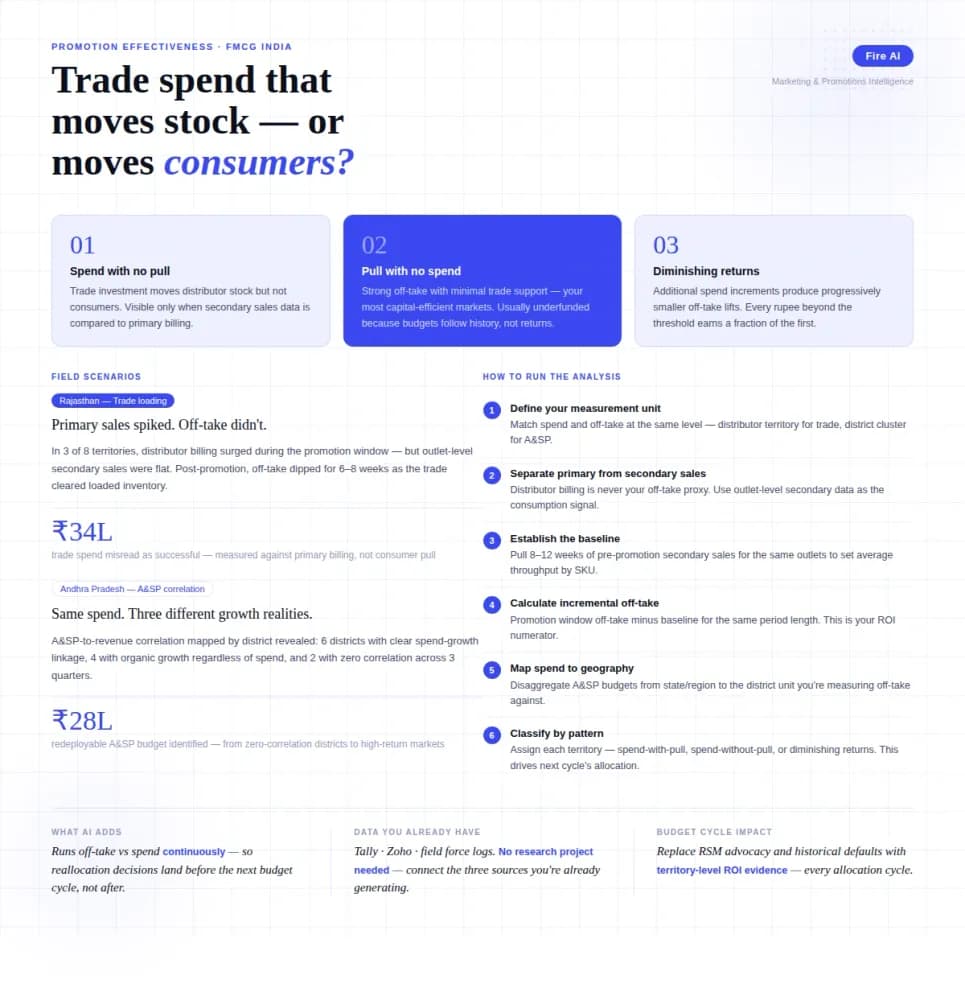
Measuring Promotion Effectiveness: A Data-Driven Guide for FMCG Marketers
FMCG brands in India spend 15–25% of gross revenue on trade promotions and A&SP (advertising and sales promotion) every year. Most can tell you how much they spent. Very few can tell you what it returned. The problem isn't a lack of data — it's that the data lives in disconnected places. Trade spend sits in finance. Off-take data lives with the distributor or field team. A&SP budgets are tracked in a marketing spreadsheet. No single view ties promotional investment to consumer pull at the outlet level. The result is a budget cycle where last year's spend allocation becomes next year's default, because no one has the numbers to argue for something different. This guide walks through how FMCG marketing and trade teams can build a promotion effectiveness framework that actually connects spend to outcome — not just channel-level assumptions.

Democratizing Data: How AI Analytics Levels the Playing Field for Small Businesses and Freelancers
For decades, data-driven decision making was a luxury that only enterprises could afford. Big companies hired data scientists, purchased expensive BI tools, and built complex data warehouses. In exchange, they received precise insights that guided budgets, strategy, and growth.
Data-Driven Customer Success: How Real-Time Metrics Reduce Churn
Discover how data-driven customer success teams use real-time metrics, causal analytics, and tools like FireAI to predict churn before it happens and turn insights into retention.