

Quick answer
Yes — AI can automatically analyse sales data to identify trends, detect anomalies, compare channel and salesperson performance, answer natural language queries ("Which products declined this month?"), and generate narrative summaries of sales performance. AI handles the descriptive and diagnostic analysis that previously required analyst hours. Human judgment is still needed for strategic interpretation and action decisions.
AI has transformed sales analytics from a weekly review exercise into a continuous, automatic process. Instead of waiting for a monthly sales review, AI continuously monitors sales data and alerts you to patterns that need attention.
What AI Can Do with Sales Data
Automatic Trend Detection
AI identifies patterns in sales data without being told what to look for:
- Products with accelerating or decelerating sales velocity
- Customers with declining order frequency
- Regions where performance is diverging from company average
- Day-of-week and time-of-day patterns in order placement
Natural Language Sales Queries
Ask questions about your sales data in plain language:
- "What were the top 10 products this month by revenue?"
- "Which customers haven't ordered in 30 days?"
- "How is Maharashtra performing vs same quarter last year?"
- "Show me the salespeople with the biggest gap between target and actual"
AI interprets the question, queries the data, and returns the answer with a supporting chart.
Automatic Performance Comparison
AI compares performance across dimensions automatically — salesperson vs target, region vs region, channel vs channel — and surfaces the significant variances without requiring manual setup.
Narrative Generation
Modern AI systems generate plain-language summaries:
"Sales declined 8% week-over-week, driven primarily by a 23% drop in the Retail channel. Three accounts (ABC Retail, XYZ Traders, PQR Stores) account for 71% of the decline and have not placed orders in the last 15 days. Direct sales and Online channels remain on target."
This replaces the analysis paragraph that previously required an analyst to write.
Anomaly Alerts
AI monitors sales metrics 24/7 and sends alerts when something unusual happens:
- A top-10 account hasn't ordered this week (unusual for their pattern)
- A product's sales rate doubled overnight (is there an issue with pricing or a data error?)
- A region's sales collapsed midday (possible connection issue or field force problem?)
What AI Still Needs Human Judgment For
Root cause investigation: AI identifies that sales in Gujarat declined 20%. Investigating whether it's competition, price, product issue, or sales force problem requires context and field knowledge.
Strategic decisions: AI shows you the data. Deciding to restructure the sales territory, change pricing, or launch a new product requires human judgment and accountability.
Customer relationship context: "Customer XYZ hasn't ordered this week" triggers an alert. Whether to call, wait, or check for a payment dispute requires knowledge of the customer relationship that AI doesn't have.
AI Sales Analytics for Indian Businesses
For Indian sales teams, AI sales analytics adds specific value:
- Multi-tier channel visibility: Track primary + secondary + tertiary sales from manufacturer to retailer
- Regional language support: Sales managers in Hindi-speaking regions can query data in Hindi
- Tally integration: Sales data from Tally connected to AI analytics without manual exports
- Distributor performance: Monitor distributor-wise sales, offtake, and target achievement
See how to create sales performance dashboards for building the reporting foundation, and can AI predict sales trends for AI forecasting beyond descriptive analysis.
Ready to act on your data?
See how teams use FireAI to ask in plain language and get analytics they can trust.
Explore FireAI workflows
Go from this topic into product features and solution paths that match what you read here.
Topic hub
AI Analytics
Guides on natural language querying, AI-powered analytics, forecasting, anomaly detection, and automated insights.
Explore hubFrequently asked questions
How does AI analyse sales data differently from traditional analytics?
Traditional sales analytics requires analysts to define what to look for, build reports, and interpret results. AI sales analytics automatically monitors all metrics simultaneously, detects patterns without predefined rules, answers natural language questions, generates narrative summaries, and delivers proactive alerts. The core difference is that AI is continuous and comprehensive — traditional analytics is reactive and selective.
What sales metrics can AI automatically monitor?
AI can automatically monitor: revenue by product, region, channel, and salesperson; order frequency by customer; average order value trends; conversion rate from leads to orders; salesperson performance vs target; inventory-to-sales velocity; price realisation vs list price; and customer acquisition and churn. Any metric in your data can be monitored — the breadth of AI monitoring is limited only by the data available, not by analyst bandwidth.
Can AI analyse sales data from Tally automatically?
Yes — with a BI tool that has a native Tally connector, AI can analyse Tally sales data automatically. FireAI connects directly to Tally and enables natural language querying of your sales ledger, product-wise sales analysis, customer-wise revenue trends, and automatic anomaly detection on Tally sales data. This works without manual exports — the connection is live and refreshes on a schedule.
Related in this topic
Can AI Predict Sales Trends?
Yes—AI can forecast sales trends using history, seasonality, and signals. Learn how predictive analytics works for business, including Indian sales and demand examples.
What is a Sales Dashboard? Metrics and Examples
A sales dashboard is a visual tool that displays real-time sales performance metrics — revenue, pipeline, win rate, and team performance — on a single screen. Learn what to include in a sales dashboard and how to build one.
How to Create a Sales Performance Dashboard
Build a sales performance dashboard with the right KPIs, layout templates, and best practices. Cover pipeline, revenue, quota, and territory metrics in one view.
Can AI Do Data Analytics? Examples, Capabilities and Limits
Yes, AI can perform sophisticated data analytics including pattern recognition, predictive modeling, and automated insights generation. Learn how AI does data analytics, which capabilities it provides, and see examples of AI-powered business intelligence.
From the blog
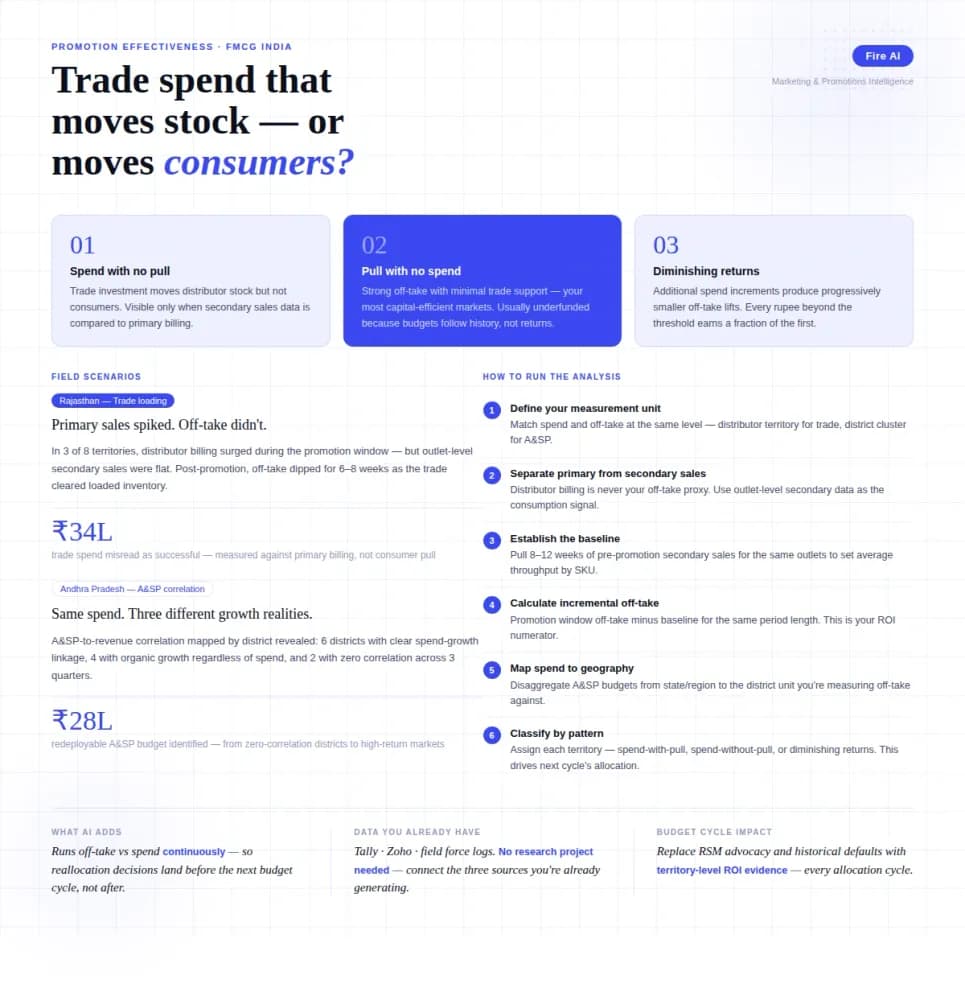
Measuring Promotion Effectiveness: A Data-Driven Guide for FMCG Marketers
FMCG brands in India spend 15–25% of gross revenue on trade promotions and A&SP (advertising and sales promotion) every year. Most can tell you how much they spent. Very few can tell you what it returned. The problem isn't a lack of data — it's that the data lives in disconnected places. Trade spend sits in finance. Off-take data lives with the distributor or field team. A&SP budgets are tracked in a marketing spreadsheet. No single view ties promotional investment to consumer pull at the outlet level. The result is a budget cycle where last year's spend allocation becomes next year's default, because no one has the numbers to argue for something different. This guide walks through how FMCG marketing and trade teams can build a promotion effectiveness framework that actually connects spend to outcome — not just channel-level assumptions.
Democratizing Data: How AI Analytics Levels the Playing Field for Small Businesses and Freelancers
For decades, data-driven decision making was a luxury that only enterprises could afford. Big companies hired data scientists, purchased expensive BI tools, and built complex data warehouses. In exchange, they received precise insights that guided budgets, strategy, and growth.

How AI-Powered Analytics Can Transform India’s Arbitration Bottleneck?
AI-powered analytics can transform India's arbitration system by automating case classification, predicting timelines, and optimizing arbitrator allocation to cut delays.