

Quick answer
Yes, AI can analyse supply chain data across demand forecasting, inventory optimisation, supplier risk assessment, delivery performance, and cost analysis. AI models process historical procurement, production, logistics, and sales data to identify patterns, predict disruptions, and recommend optimisation actions that manual analysis cannot match at scale.
Yes — AI transforms supply chain analytics from periodic reporting into continuous, predictive intelligence.
Indian supply chains are complex. Multi-tier supplier networks, monsoon-driven demand seasonality, GST reconciliation, and regional logistics variations create an analytical environment that traditional tools handle poorly. AI excels at exactly this kind of multi-dimensional complexity.
What AI Can Analyse in Supply Chains
1. Demand Forecasting
AI models analyse historical sales data, seasonality patterns, external demand signals, and promotional calendars to predict future demand with higher accuracy than statistical methods alone.
For Indian businesses, this means:
- Festive season demand planning (Diwali, Eid, harvest seasons)
- Regional demand variations across geographies
- SKU-level forecasts rather than just aggregate category forecasts
- Real-time forecast updates as new sales data arrives
2. Inventory Optimisation
Using demand forecasts and lead time data, AI determines optimal inventory levels — high enough to prevent stockouts, low enough to avoid overstock tying up working capital.
Key outputs:
- Optimal safety stock per SKU and location
- Dynamic reorder points that adjust to demand changes
- Excess stock identification for markdown or redistribution
- Near-expiry alerts for perishable goods
See can AI predict inventory stockouts for detailed inventory forecasting capability.
3. Supplier Risk Analytics
AI can model supplier risk by analysing:
- Delivery performance history (on-time delivery rate, variance)
- Lead time trends and variability
- Geographic and geopolitical risk factors
- Price volatility patterns
- Concentration risk (dependency on a single supplier for critical materials)
Proactive alerts when a supplier's delivery reliability deteriorates give procurement teams time to qualify alternatives before supply disruptions occur.
4. Procurement and Cost Analytics
- Purchase price trends by material and supplier
- Landed cost analysis (material + freight + duties)
- Payment terms optimisation based on cash flow position
- Bid comparison and should-cost modelling
- GST input credit tracking and reconciliation
5. Logistics and Delivery Analytics
- Carrier performance by route (on-time delivery, damage rate)
- Freight cost per kg/km optimisation
- Delivery exception analysis (delay reasons, patterns)
- Customer delivery performance against SLA
6. Supply Chain Risk and Resilience
AI models can simulate supply chain disruption scenarios:
- "What happens to our production if Supplier X delays by 2 weeks?"
- "Which SKUs are at risk if monsoon delays logistics in the East zone?"
- "What is our exposure if raw material price increases 15%?"
This is prescriptive analytics at the supply chain level.
AI Supply Chain Analytics for Indian Businesses
Tally Integration for Financial Supply Chain Data
Most Indian SMBs manage procurement, inventory, and supplier payments in Tally. AI analytics platforms like FireAI connect directly to Tally and extract:
- Purchase vouchers for vendor spend analysis
- Stock items for inventory analytics
- Party ledgers for supplier payment and credit terms
- Manufacturing entries for production cost tracking
Multi-Location Inventory
Indian businesses often operate multiple warehouses, branches, or retail locations. AI can optimise inventory allocation across all locations simultaneously — identifying imbalances and recommending transfers before stockouts occur.
Monsoon and Festival Seasonality
India's strong seasonal patterns — Diwali, Holi, harvest seasons, monsoon logistics disruptions — are learnable by AI models if sufficient historical data exists. Incorporating calendar events and their historical impact improves forecast accuracy significantly.
Getting Started with AI Supply Chain Analytics
- Connect your data sources — Tally for inventory and procurement, logistics provider APIs for delivery data
- Define key supply chain metrics — on-time delivery %, inventory turnover, days of stock remaining
- Start with demand forecasting — this typically has the highest immediate ROI
- Add supplier risk monitoring — track on-time delivery trends for key suppliers
- Build cost analytics — identify where margins are eroding in the supply chain
For Indian businesses using Tally, FireAI provides a starting point for supply chain analytics that connects natively to your existing data with no additional infrastructure required.
Ready to act on your data?
See how teams use FireAI to ask in plain language and get analytics they can trust.
Explore FireAI workflows
Go from this topic into product features and solution paths that match what you read here.
Topic hub
AI Analytics
Guides on natural language querying, AI-powered analytics, forecasting, anomaly detection, and automated insights.
Explore hubFrequently asked questions
How does AI improve supply chain analytics?
AI improves supply chain analytics by enabling real-time monitoring across all supply chain components, providing predictive demand forecasts at SKU level, assessing supplier risk proactively, optimising inventory levels dynamically, and generating natural language insights without requiring a supply chain analyst to run every query.
Can AI predict supply chain disruptions?
AI can identify early warning signals of potential disruptions — a supplier's declining delivery reliability, unusual lead time increases, or inventory depletion rates that suggest upcoming shortfalls. It cannot predict external black-swan events but significantly improves visibility into emerging risks within the supply chain.
What supply chain data does AI need to work effectively?
AI supply chain analytics needs: historical demand/sales data (2+ years ideally), inventory levels and movement data, supplier delivery history, lead times, and cost data. For Indian businesses in Tally, all of this typically exists in the Tally database and can be connected to AI analytics platforms directly.
Related in this topic
Can AI Predict Inventory Stockouts?
Yes — AI can predict inventory stockouts by analysing historical sales velocity, reorder patterns, and lead times to flag at-risk SKUs before they run out. Learn how AI-powered inventory forecasting prevents stockouts and reduces lost sales.
Best BI Tools for Logistics Companies in India (2026)
Compare the best BI and analytics platforms for Indian logistics and transport companies. See how tools stack up on fleet management, lane profitability, delivery SLA tracking, and Tally-friendly finance dashboards.
What is Predictive Analytics? Methods and Examples
Predictive analytics uses statistical algorithms and machine learning to forecast future outcomes based on historical data. Learn how predictive modeling works, which methods are used, and how businesses apply it for sales forecasting, risk management, and strategic planning.
What is Agentic Analytics? AI Agents for BI
Agentic analytics uses autonomous AI agents to proactively analyze data, surface insights, trigger alerts, and take actions without human prompting. Learn how agentic AI differs from traditional BI, and what it means for business decision-making.
From the blog
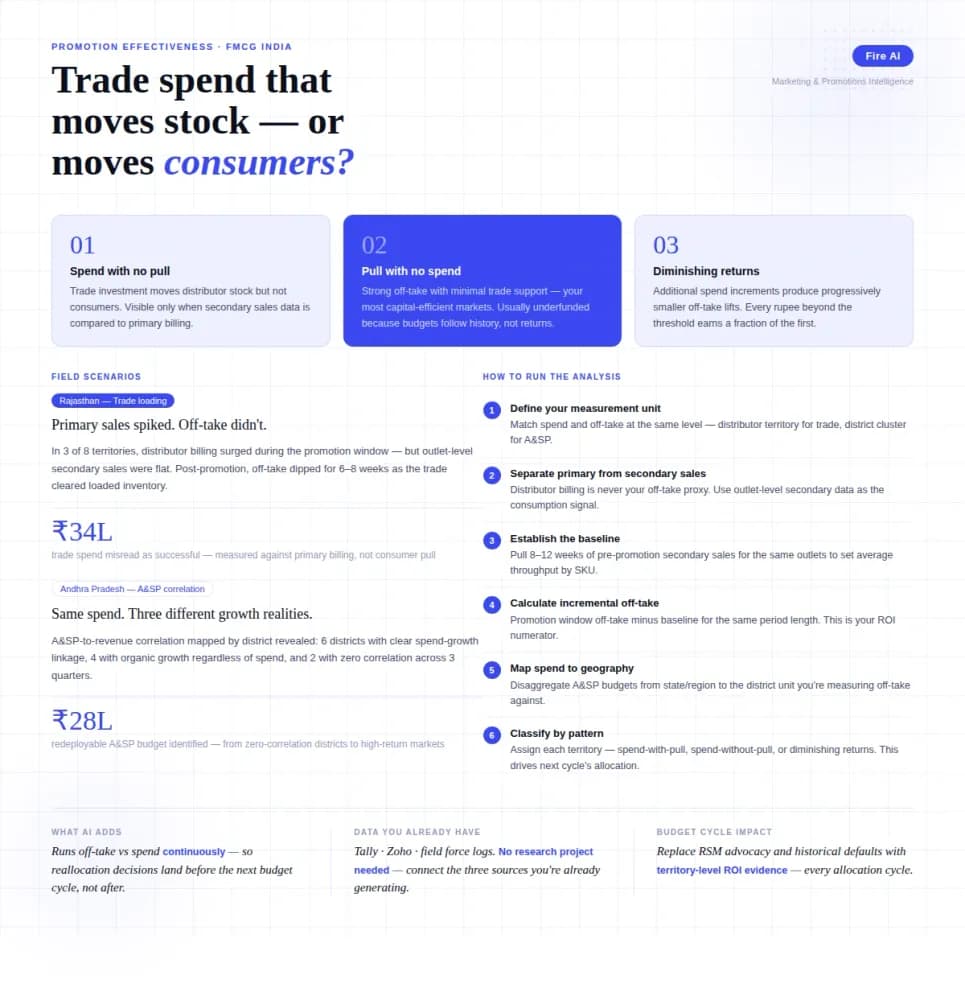
Measuring Promotion Effectiveness: A Data-Driven Guide for FMCG Marketers
FMCG brands in India spend 15–25% of gross revenue on trade promotions and A&SP (advertising and sales promotion) every year. Most can tell you how much they spent. Very few can tell you what it returned. The problem isn't a lack of data — it's that the data lives in disconnected places. Trade spend sits in finance. Off-take data lives with the distributor or field team. A&SP budgets are tracked in a marketing spreadsheet. No single view ties promotional investment to consumer pull at the outlet level. The result is a budget cycle where last year's spend allocation becomes next year's default, because no one has the numbers to argue for something different. This guide walks through how FMCG marketing and trade teams can build a promotion effectiveness framework that actually connects spend to outcome — not just channel-level assumptions.

How AI-Powered Analytics Can Transform India’s Arbitration Bottleneck?
AI-powered analytics can transform India's arbitration system by automating case classification, predicting timelines, and optimizing arbitrator allocation to cut delays.
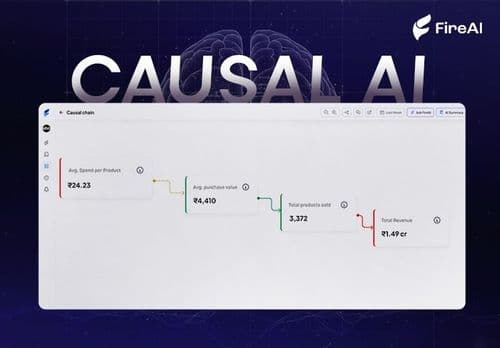
Causal AI Explained: Uncovering the “Why” in Data with Machine Learning
Causal AI reveals not just what will happen, but why — and exactly what changes if you act differently. It turns predictions into high-ROI decisions by uncovering true cause-and-effect in your data.