

Quick answer
Yes, AI can automate freight invoice reconciliation by matching carrier bills to trips, rate cards, and ERP accruals and flagging mismatches. Rules handle three-way matching; machine learning helps with reference data quality, exception clustering, and ambiguous line items. FireAI connects freight and finance data so logistics teams reduce manual matching and close accruals faster.
Yes. AI-assisted automation can run most of freight invoice reconciliation at scale when you connect carriers, TMS or trip data, contracts, and your finance system. Freight bills are voluminous, inconsistently keyed, and full of accessorials. The goal is not to remove every human check, but to auto-match the majority of lines and push only true exceptions to a short, ranked queue.
This page explains why freight reconciliation is hard, how three-way matching applies, what exception handling should look like, and how FireAI supports logistics finance with faster, auditable matching.
Why freight invoice reconciliation is difficult
Carriers, 3PLs, and in-house fleet operations all generate invoices that must tie back to what you expected to pay. Common friction points include:
- Multiple identifiers for the same movement (LR number, trip ID, vehicle, consignment, PO) that do not align across systems
- Rate complexity: per km, per kg, per trip, zone tables, minimum charges, and accessorials (loading, detention, tolls, fuel surcharges)
- Partial trips, multi-drop runs, and returns that split one invoice across several internal cost objects
- Duplicate or revised bills and credit notes that arrive out of order
- GST and place-of-supply nuances when branches and transporters sit in different states
Manual matching in spreadsheets does not scale past a few hundred lines a month. That is where rules plus AI for normalisation, fuzzy matching, and exception ranking add leverage.
Three-way matching for freight (what “automated” usually means)
Three-way matching compares three layers before a bill is approved for payment:
- Carrier invoice (what you were billed)
- Proof of service (trip completion, POD, weight, distance, or consignment-level delivery evidence)
- Contract or rate master (what you agreed to pay for that lane, vehicle type, and service level)
Automation encodes your rate cards and business rules, joins invoice lines to trip or order facts, and marks lines as matched, variance within tolerance, or exception. AI is most useful where keys are messy: OCR or PDF line extraction, matching free-text location names to master lanes, and clustering similar disputes so finance works the same root cause once.
Exception handling that finance and ops can trust
Not every variance should block payment. Strong workflows define:
- Tolerance bands (e.g., small rounding or fuel surcharge drift within ₹X per trip)
- Materiality thresholds so high-value discrepancies escalate first
- Reason codes (rate mismatch, missing POD, duplicate LR, quantity variance) tied to corrective action
- Audit trails showing which rule or model suggested the match and what human approved the exception
Goal: accountants spend time on material freight leakage and disputed accessorials, not on rebuilding VLOOKUPs every month. That aligns with broader reconciliation analytics practice across vendor, GST, and freight domains.
How FireAI fits freight reconciliation for Indian logistics teams
Data in: Carrier invoices (CSV, portal export, or integrated feed), trip or TMS data, contracts and rate matrices, and optional ERP or Tally-side accruals. FireAI normalises identifiers, applies rule-based three-way checks, and uses AI where labels and references do not join cleanly.
Operational outcomes:
- Faster month-end close for transport spend with fewer open accruals
- Clear visibility of lane-level or transporter-level leakage to complement lane profitability views
- Natural-language questions for finance ("Which transporter had the highest unmatched diesel surcharge last quarter?") on top of logistics dashboards
FireAI does not replace legal dispute letters or carrier negotiation; it reduces the clerical burden and surfaces evidence (matched trip, applied rate rule, variance) when you need it.
Summary
- AI can automate much of freight invoice reconciliation through three-way matching, tolerances, and ranked exceptions when trip, contract, and invoice data connect.
- Hardest parts are identifier alignment, accessorial interpretation, and high volume; machine learning helps most on fuzzy joins and repeat patterns.
- FireAI supports logistics finance with automated reconciliation, dashboards, and NLQ so teams protect margin alongside operations.
For freight operations beyond billing, pairing this topic with can AI optimise delivery routes shows how routing analytics and invoice discipline connect across the logistics stack.
Ready to act on your data?
See how teams use FireAI to ask in plain language and get analytics they can trust.
Explore FireAI workflows
Go from this topic into product features and solution paths that match what you read here.
Topic hub
Industry Analytics In India
Comparison pages and implementation guidance for industry-specific BI, dashboards, and analytics use cases in India.
Explore hubFrequently asked questions
Can AI fully replace manual freight invoice checks?
What data is required to automate freight reconciliation?
How is freight reconciliation different from GST or bank reconciliation?
Does FireAI work for both fleet owners and 3PL shippers?
Related in this topic
Reconciliation Analytics: Bank, GST & Vendor Matching
Reconciliation analytics turns bank, vendor, GST, and freight matching into measurable workflows: exception rates, aging, and automation.
Build a Logistics Dashboard: KPIs & Data | FireAI
Practical steps to build a transport and logistics analytics dashboard: pick the right KPIs, connect GPS, TMS, and ERP, design executive and hub views.
What Is Lane Profitability Analysis in Logistics?
Lane profitability analysis breaks down revenue and costs by origin-destination route so transport and 3PL teams know which lanes earn margin.
Can AI Optimize Delivery Routes for Logistics? How It Works
AI can optimize delivery routes using vehicle routing algorithms, real-time traffic, and constraints like capacity and time windows. Learn how machine learning cuts distance and fuel, and how FireAI turns GPS and trip data into route analytics for Indian logistics teams.
From the blog

How AI-Powered Analytics Can Transform India’s Arbitration Bottleneck?
AI-powered analytics can transform India's arbitration system by automating case classification, predicting timelines, and optimizing arbitrator allocation to cut delays.
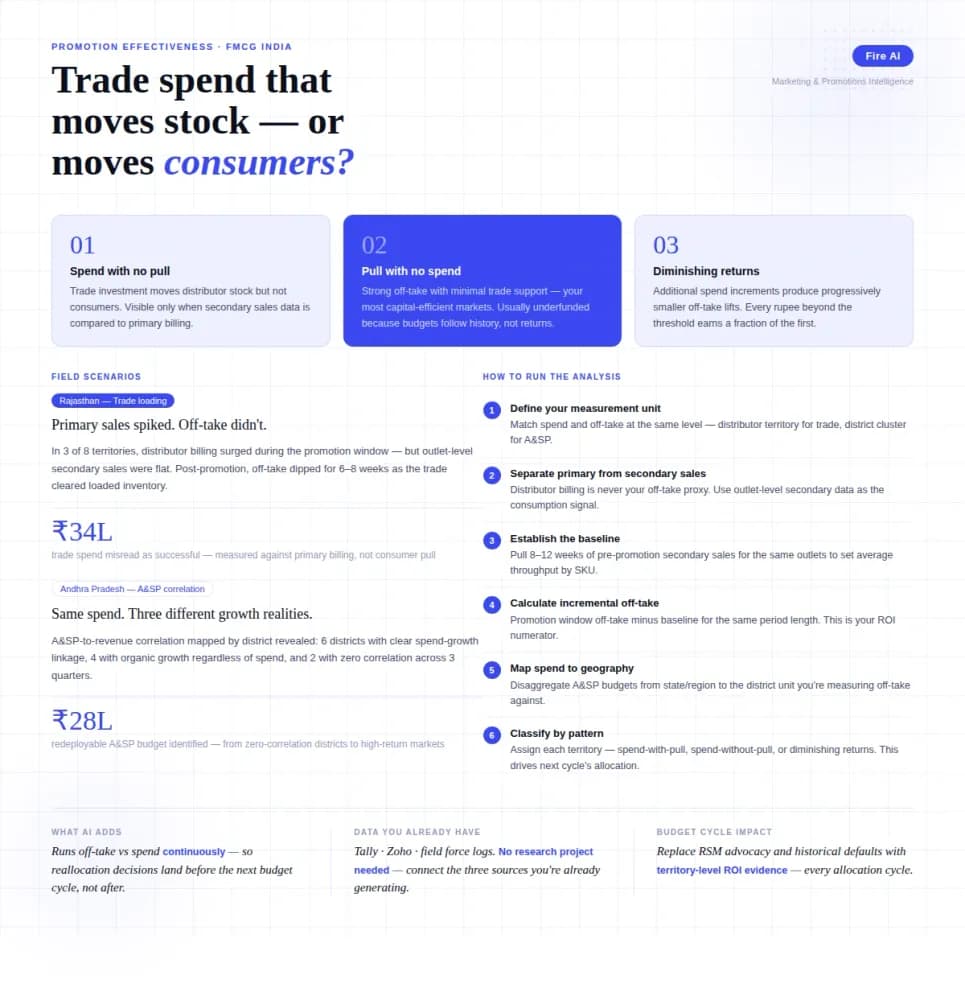
Measuring Promotion Effectiveness: A Data-Driven Guide for FMCG Marketers
FMCG brands in India spend 15–25% of gross revenue on trade promotions and A&SP (advertising and sales promotion) every year. Most can tell you how much they spent. Very few can tell you what it returned. The problem isn't a lack of data — it's that the data lives in disconnected places. Trade spend sits in finance. Off-take data lives with the distributor or field team. A&SP budgets are tracked in a marketing spreadsheet. No single view ties promotional investment to consumer pull at the outlet level. The result is a budget cycle where last year's spend allocation becomes next year's default, because no one has the numbers to argue for something different. This guide walks through how FMCG marketing and trade teams can build a promotion effectiveness framework that actually connects spend to outcome — not just channel-level assumptions.
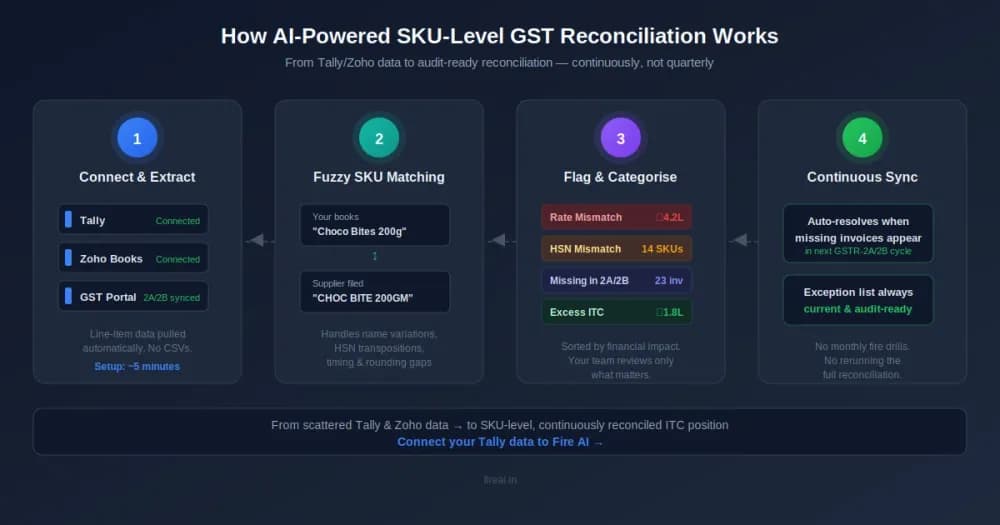
GST Credit Reconciliation by SKU: An AI-Powered Approach for FMCG
Your invoice totals match. Your GSTR-2A looks clean. But buried three levels down, at the SKU level, there's ₹14 lakh in ITC you either shouldn't have claimed — or haven't claimed at all. Here's how AI surfaces what spreadsheets can't.