

Quick answer
Yes, AI can optimize delivery routes by solving vehicle routing with orders, capacity, time windows, and traffic to cut distance, time, and fuel. Machine learning on GPS and trip history flags recurring gaps between planned and actual runs, which means fewer empty kilometers and better on-time delivery when teams act on the signals.
Yes, AI is widely used to optimize delivery and pickup routes, especially where manual planning cannot handle scale, change, and cost trade-offs in real time. It does not replace every operational rule your business already uses, but it can propose and refine routes that humans or spreadsheets would take far longer to build and keep current.
Logistics in India adds complexity: mixed urban density, variable road quality, customer time slots, and multi-stop B2B runs. That is where algorithmic route optimization, paired with fleet analytics and a clear cargo and logistics strategy, makes the difference between a map on a screen and margin you can measure.
Why route planning is hard without AI
- Scale and combinatorial explosion: The number of possible stop orders grows extremely fast as stops per vehicle and fleet size increase. Heuristics and gut feel work for a few trucks, not for a national network.
- Constraints: Capacity by weight or volume, driver shift limits, customer delivery windows, vehicle type (refrigerated, tail lift), and hub cut-offs all need to be satisfied at once.
- Change: Cancellations, ad-hoc pickups, and traffic change the best plan by midday. Static morning plans go stale.
- Cost visibility: Without linking trips to distance, fuel, and delay penalties, you cannot see which routes or customers erode margin.
How AI optimizes delivery routes
1. Vehicle routing and optimization (VRP)
Core algorithms and solvers (often mixed-integer or specialized heuristics) search for routes that minimize distance, time, or cost subject to your constraints. This is the workhorse of last-mile and distribution planning.
2. Traffic, ETA, and dynamic re-routing
When real-time or predictive traffic is fed in, AI can re-sequence or reassign stops to avoid predictable delays, within the limits of your operational rules.
3. Machine learning on historical trips
Models learn patterns from past GPS and trip data: which lanes or slots chronically underperform, which drivers or hubs show systematic variance, and where “planned” and “actual” consistently diverge. That supports continuous improvement, not just a one-off plan.
4. Predictive load and order patterns
Forecasting order volume and timing by area or day helps pre-position capacity and set realistic routes before the day starts.
Fuel savings, distance, and service impact
Route optimization typically targets fewer kilometers, less idling, and better sequencing, which reduces fuel spend and wear when execution follows the plan. The uplift varies by network, but teams usually care about the same few outcomes: lower cost per stop, higher on-time delivery, and fewer first-attempt failures. Measuring those before and after is how you validate AI, not the algorithm name on a slide.
How FireAI fits: GPS, trips, and route analytics
FireAI is not only a point solver for a single VRP run. It helps logistics teams integrate and analyse the data you already have:
- GPS and telematics: distance, speed, and stop-level timing to compare planned vs actual routes
- Trip and delivery records from TMS or operations systems: on-time performance, delay reasons, and per-route cost signals
- Dashboards and natural language questions so ops and branch heads ask why certain routes or hubs underperform, without a dedicated analytics project each week
You connect execution data, then use analytics to see whether optimization (in-house, TMS, or specialist routing software) is actually showing up in fuel per km, on-time %, and penalty exposure. For a deeper look at the logistics data landscape in India, see logistics analytics in India.
If you are comparing platforms for the full stack, best BI tools for logistics in India explains what to look for when fleet, lane, and SLA analytics must sit with finance in one place.
Summary
- AI can optimize delivery routes through VRP, constraints, and increasingly through ML on rich trip data.
- Savings show up in fuel, time, and service levels when you measure plans against reality.
- FireAI helps teams unify GPS and trip data with insight so route decisions are visible, comparable, and improvable over time. Explore fleet use cases and the cargo and logistics solution to see how analytics ties into your network.
Ready to act on your data?
See how teams use FireAI to ask in plain language and get analytics they can trust.
Explore FireAI workflows
Go from this topic into product features and solution paths that match what you read here.
Topic hub
Industry Analytics In India
Comparison pages and implementation guidance for industry-specific BI, dashboards, and analytics use cases in India.
Explore hubFrequently asked questions
Can AI fully replace a human dispatcher for route planning?
AI is best used to generate and adjust optimized routes and to surface patterns from data. Many operators keep humans for exceptions, customer-specific rules, and on-the-day judgment. The typical setup is algorithm-assisted planning with clear escalation paths, not full removal of human oversight.
What data does AI need to optimize delivery routes well?
At minimum: stop locations, time windows, vehicle capacity, and shift limits. Better results add historical trip or GPS data, live traffic or ETA feeds, and actual service times at stops. Without accurate addresses and constraints, any solver will return mathematically optimal routes that are operationally wrong.
How is AI route optimization different from simple map navigation?
Navigation tools optimize one vehicle path between points you choose. Route optimization for logistics assigns many stops to many vehicles, respects capacity and time windows, and often minimizes cost or time for the whole fleet. Multi-stop, multi-vehicle, and business rules are the extra layer that general navigation does not solve.
How does FireAI help if we already have a routing tool?
FireAI focuses on analytics across GPS, trips, and financial data. It helps you track whether planned routes are executed, benchmark fuel and on-time performance by route or hub, and ask questions in natural language. That closes the loop between optimization output and business outcomes, especially when Tally or billing data is part of the picture.
Related in this topic
What is Fleet Management Analytics? Key Metrics Explained
Fleet management analytics tracks vehicle utilization, fuel efficiency, idle time, driver performance, and maintenance costs in one dashboard. Learn the key metrics, India-specific benchmarks, and how FireAI builds live fleet dashboards from GPS, TMS, and Tally data.
Logistics Analytics in India: Fleet, Delivery & Costs
Logistics analytics in India covers fleet tracking, delivery performance, freight cost optimisation, and warehouse efficiency. Learn key metrics for Indian logistics operations.
Why Logistics Companies Need Analytics in 2026
Learn why transport and logistics operators need analytics: margin pressure, fleet underutilization, delivery SLA risk, and fuel waste. See how dashboards and AI-driven insights from trip, fuel, and ERP data improve profitability.
Best BI Tools for Logistics Companies in India (2026)
Compare the best BI and analytics platforms for Indian logistics and transport companies. See how tools stack up on fleet management, lane profitability, delivery SLA tracking, and Tally-friendly finance dashboards.
From the blog
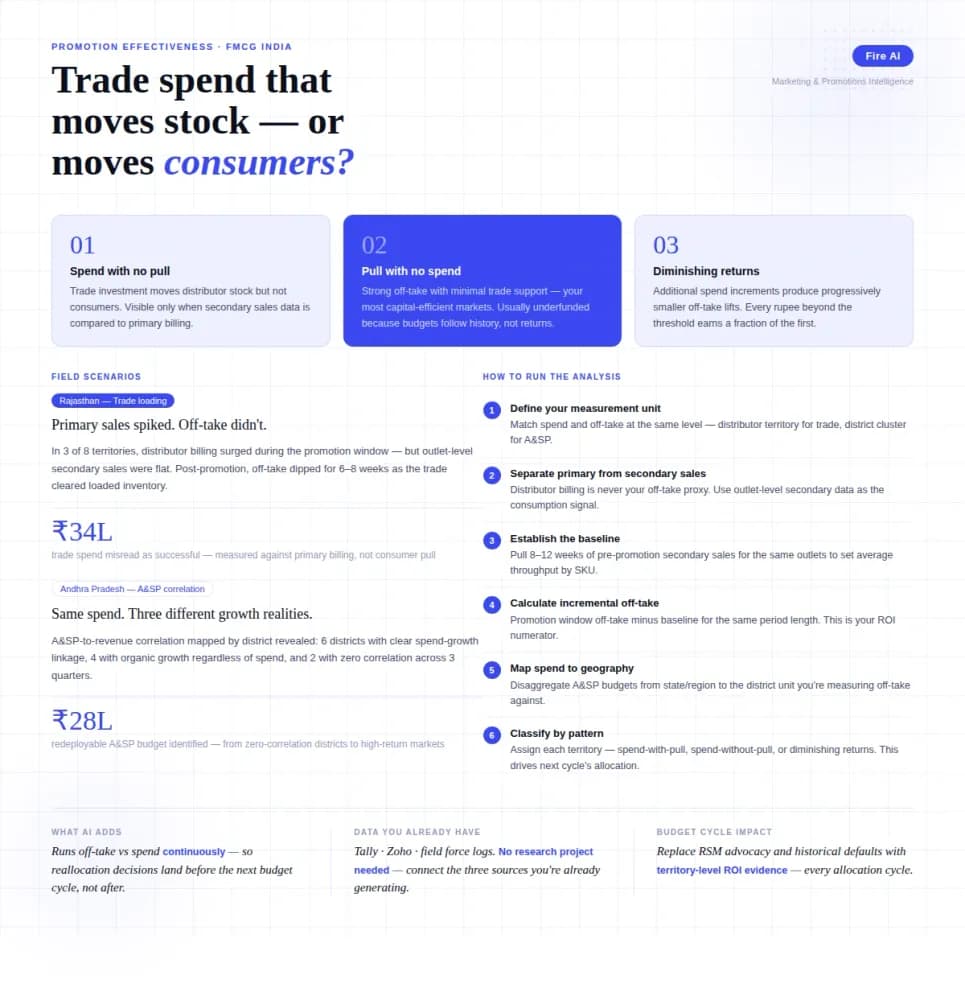
Measuring Promotion Effectiveness: A Data-Driven Guide for FMCG Marketers
FMCG brands in India spend 15–25% of gross revenue on trade promotions and A&SP (advertising and sales promotion) every year. Most can tell you how much they spent. Very few can tell you what it returned. The problem isn't a lack of data — it's that the data lives in disconnected places. Trade spend sits in finance. Off-take data lives with the distributor or field team. A&SP budgets are tracked in a marketing spreadsheet. No single view ties promotional investment to consumer pull at the outlet level. The result is a budget cycle where last year's spend allocation becomes next year's default, because no one has the numbers to argue for something different. This guide walks through how FMCG marketing and trade teams can build a promotion effectiveness framework that actually connects spend to outcome — not just channel-level assumptions.

How AI-Powered Analytics Can Transform India’s Arbitration Bottleneck?
AI-powered analytics can transform India's arbitration system by automating case classification, predicting timelines, and optimizing arbitrator allocation to cut delays.
Building a Data-Driven Culture: How Leaders Can Drive AI Adoption in Their Organization
AI adoption doesn’t fail because of technology—it fails because of culture. This piece shows how leaders can turn AI into real business impact by embedding data-driven decision-making into everyday leadership behavior and organizational DNA.