

Quick answer
Yes — AI detects duplicate voucher entries, misclassified ledgers, unusual amounts, and missing GST details in Tally data by analysing transaction patterns. With FireAI's one-click Tally connector, your data auto-syncs and AI flags anomalies in real time — reducing manual audit effort by up to 40% for Indian businesses.
Indian businesses using Tally Prime process thousands of voucher entries every month, and errors are inevitable. A misclassified expense, a duplicate purchase entry, a round-number journal entry that lacks supporting documentation — these errors compound over time, distort financial reports, and surface only during audits (if at all). AI-powered analytics can catch most of these errors proactively.
Common Accounting Errors in Tally Prime
1. Duplicate Voucher Entries
The same invoice entered twice — different voucher numbers but same vendor, amount, and date. This inflates expenses or purchases and distorts P&L.
How common: Very common in busy finance teams where multiple people enter vouchers, or when entries are copied.
2. Misclassified Ledger Postings
An expense posted to the wrong ledger — office supplies recorded under "Repairs and Maintenance," or an asset purchase booked as an expense.
Impact: Distorts expense breakdowns, affects tax calculations, and creates audit observations.
3. Missing or Incorrect GST Details
Vouchers without GSTIN, wrong GST rates, or inter-state transactions charged with CGST+SGST instead of IGST.
Impact: GSTR filing mismatches, denied input tax credits, potential penalties.
4. Unusual Transaction Amounts
An expense voucher for ₹5,00,000 when the average for that ledger is ₹50,000. Could be legitimate (annual payment) or an error (extra zero).
5. Voucher Date Anomalies
Entries dated on Sundays or public holidays, entries in the wrong financial year, or large gaps between consecutive voucher numbers.
6. Unbalanced Cost Centre Allocations
Cost centre totals not matching the voucher total — common when partial cost centre allocation is done carelessly.
How AI Detects These Errors
Pattern Recognition
AI learns what "normal" looks like from historical Tally data:
- Typical transaction amounts per ledger
- Expected vendor-amount combinations
- Regular posting patterns (weekly, monthly, quarterly)
- Usual GST rate for each stock item or service
Anything that deviates significantly from the pattern is flagged for human review.
Rule-Based Detection
AI applies configurable rules:
| Rule | What It Catches |
|---|---|
| Same vendor + amount + date within 7 days | Duplicate voucher entries |
| Amount > 3× standard deviation for the ledger | Unusual transaction amounts |
| IGST on intra-state transaction | GST classification error |
| Voucher date on Sunday/gazetted holiday | Date anomalies |
| Round numbers above ₹1 lakh in expense ledgers | Potential estimates or fictitious entries |
| Missing party ledger on purchase/sales voucher | Data completeness issue |
| Cost centre allocation ≠ voucher total | Cost centre error |
Statistical Anomaly Detection
For larger datasets, AI uses statistical methods (see anomaly detection):
- Z-score analysis flags transactions more than 2–3 standard deviations from the mean for that ledger
- Benford's Law analysis checks if the first-digit distribution of transaction amounts matches expected patterns — deviations may indicate fabricated entries
- Cluster analysis groups similar transactions and flags outliers that do not fit any cluster
What AI Can and Cannot Detect
| Error Type | AI Detection Capability |
|---|---|
| Duplicate entries | High — pattern matching is very effective |
| Amount anomalies | High — statistical flagging works well |
| GST errors | High — rule-based validation |
| Misclassified ledgers | Medium — AI can flag unusual ledger-amount combinations but needs human confirmation |
| Fictitious entries | Medium — Benford's Law and pattern analysis help, but determined fraud is harder |
| Timing differences | Medium — can flag but may generate false positives |
| Judgement-based errors | Low — e.g. wrong depreciation method, incorrect provisions |
| Intentional manipulation | Low to Medium — sophisticated fraud requires forensic analysis beyond basic AI |
Real-World Application: CA Firm in Mumbai
A CA firm managing Tally data for 35 clients implemented AI-based error detection:
Before AI:
- Audit team manually reviewed daybooks, looking for anomalies — taking 3–5 days per client
- Duplicate entries were caught only when trial balance did not match expectations
- GST mismatches discovered during GSTR filing, causing last-minute corrections
After AI implementation:
- AI scanned all 35 clients' Tally data weekly and generated an exception report
- Duplicate entries caught within a week of creation (vs months later during audit)
- GST validation flagged 127 entries with wrong tax rates across all clients in the first month
- Audit preparation time reduced by approximately 40% because obvious errors were already resolved
How Indian Businesses Can Use This
For Business Owners
- Run a monthly "data quality scan" on your Tally company data
- Review flagged entries with your accountant
- Track error rate over time — a declining trend means your bookkeeping quality is improving
For CAs and Audit Firms
- Use AI as a first-pass review tool before detailed audit work
- Flag anomalies across multiple client companies from a single dashboard
- Provide clients with a "data health report" as a value-added service
For Finance Teams
- Set up automated weekly scans on new voucher entries
- Create a workflow: AI flags → Accountant reviews → Correction or confirmation
- Monitor which types of errors occur most frequently and train staff accordingly
Getting Started with FireAI
- Connect Tally Prime in one click — FireAI's native Tally connector syncs your voucher data automatically with zero-code setup. No ODBC drivers, no manual exports. See how to connect Tally to BI
- Run a baseline scan on the current financial year's data — expect to find errors you did not know existed. FireAI's pre-built dashboard templates include anomaly detection views out of the box
- Configure rules based on your business context (e.g. "flag any expense above ₹2 lakhs" or "flag any vendor payment without a purchase voucher reference")
- Use natural language queries (NLQ) — ask FireAI "Show me all duplicate entries this quarter" or "Which ledgers have unusual postings?" and get instant visual answers
- Set up real-time auto-sync so new vouchers are scanned as they are posted — no waiting for month-end
- Review and resolve flagged items — AI flags, humans decide
For a ₹10 crore manufacturing business processing 2,000+ vouchers monthly, this workflow typically catches 15–30 errors per month that manual review misses — saving ₹50,000–₹2 lakhs annually in audit corrections and compliance penalties.
Limitations to Be Aware Of
- False positives are common initially — AI may flag legitimate unusual transactions (annual insurance, one-time asset purchases). These reduce over time as the system learns.
- AI does not replace audit — it is a screening tool that makes audit more efficient, not a substitute for professional judgement.
- Data quality affects AI accuracy — if your Tally data has fundamental structural issues (wrong ledger hierarchy, missing masters), AI detection will be noisy.
- Intentional fraud designed to look like normal transactions is harder for basic AI to catch — forensic analysis may still be needed.
Ready to act on your data?
See how teams use FireAI to ask in plain language and get analytics they can trust.
Explore FireAI workflows
Go from this topic into product features and solution paths that match what you read here.
Topic hub
Tally Analytics
Analytics for Tally Prime and Tally ERP — one of 700+ data sources FireAI connects to — including dashboards, reporting, GST, and finance workflows.
Explore hubFrequently asked questions
Can AI find duplicate entries in Tally automatically?
Yes. AI compares voucher entries across vendor name, amount, date, and invoice reference to flag likely duplicates. FireAI's one-click Tally connector syncs your data automatically, and the AI scans for duplicates in real time. Most Indian businesses find 5–15 duplicate entries per year that manual review missed — saving ₹20,000–₹1 lakh in inflated expenses.
Will AI-based error detection generate too many false alarms?
Initially, expect 20–30% false positives as the system learns your business patterns. Legitimate but unusual transactions (annual insurance payments, one-time asset purchases) get flagged. Over 2–3 months, false alarm rates drop to 5–10%. The net time saved still far exceeds the review effort.
Do I need a separate tool for AI error detection or does Tally Prime have it built in?
Tally Prime does not have built-in AI error detection. You need an external platform like FireAI that connects to Tally via a native one-click connector — no ODBC or manual exports needed. FireAI applies AI algorithms to your transaction data and provides pre-built anomaly detection dashboards as part of its Tally analytics suite.
How does FireAI detect accounting errors in Tally without any coding?
FireAI's zero-code setup connects to Tally Prime in minutes. Your voucher data auto-syncs in real time, and pre-built dashboard templates include anomaly detection rules for duplicates, amount outliers, GST mismatches, and date anomalies. You can also ask natural language questions like "Show unusual expenses this month" to surface errors instantly.
What types of Tally errors can AI catch that auditors might miss?
AI excels at catching high-volume pattern errors that are tedious to spot manually — duplicate entries with slightly different voucher numbers, gradual expense inflation across months, round-number journal entries lacking documentation, and systematic GST rate misapplication. For a ₹15 crore business, these hidden errors typically total ₹1–3 lakhs annually.
Related in this topic
Tally Analytics: Turn Tally Data into Dashboards & Reports
Get AI-powered analytics and dashboards from Tally Prime data without SQL. FireAI connects to Tally for live GST, sales, inventory, and P&L—no spreadsheet exports.
Can AI Work with Tally Prime and ERP 9 Data?
Yes — AI can connect directly to Tally Prime and Tally ERP 9 to deliver instant dashboards, natural language queries, and automated insights on your financial, sales, and inventory data. Learn how AI analytics works with Tally data.
Tally Bank Reconciliation: Automate Statement Matching
Learn how Tally bank reconciliation analytics automates bank statement matching, flags unreconciled entries, and provides cash position dashboards for Indian businesses.
Tally GST Analytics: Compliance, Returns & ITC Tracking
Use Tally GST analytics to track GSTR-1, GSTR-3B filings, ITC reconciliation, and compliance status from your Tally Prime data. Dashboards for Indian GST compliance.
From the blog
Tally Analytics Dashboards for Indian Businesses
80% of Indian SMBs use Tally. Fewer than 5% have dashboards. Learn how to build real-time P&L, cash flow, and receivables analytics from your Tally Prime data.
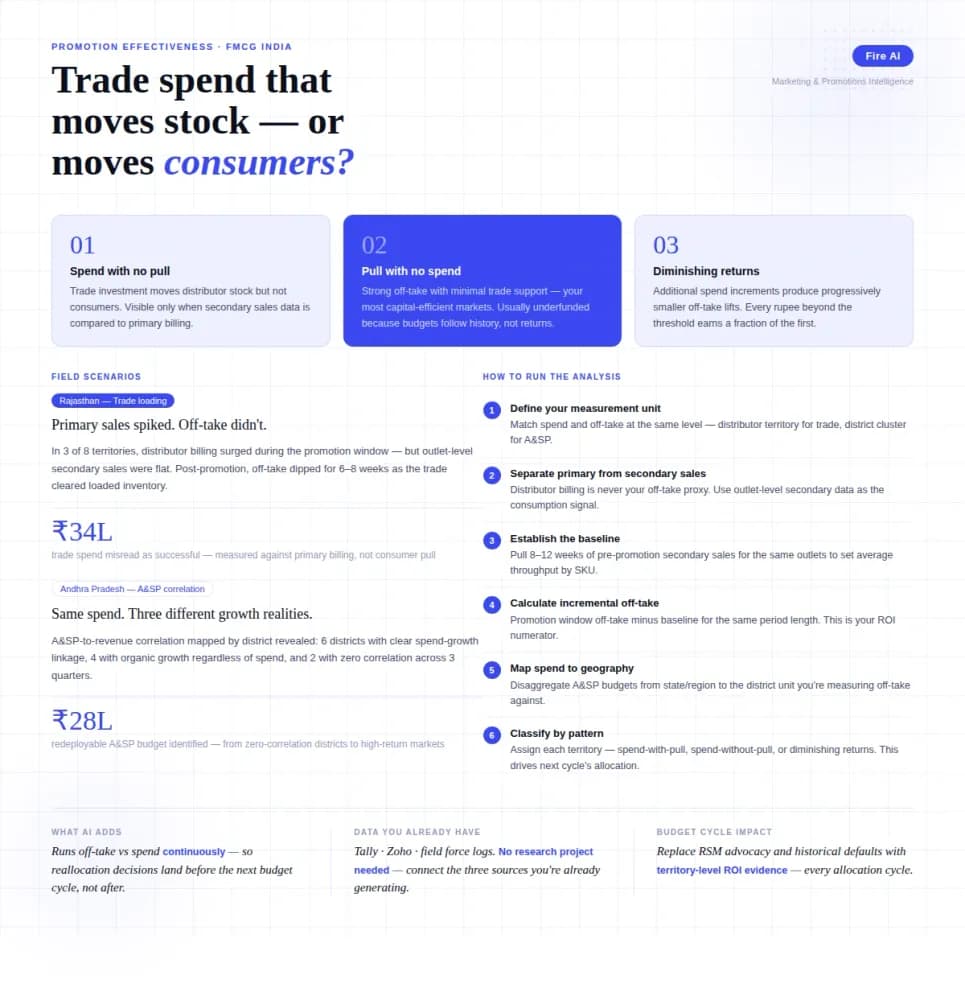
Measuring Promotion Effectiveness: A Data-Driven Guide for FMCG Marketers
FMCG brands in India spend 15–25% of gross revenue on trade promotions and A&SP (advertising and sales promotion) every year. Most can tell you how much they spent. Very few can tell you what it returned. The problem isn't a lack of data — it's that the data lives in disconnected places. Trade spend sits in finance. Off-take data lives with the distributor or field team. A&SP budgets are tracked in a marketing spreadsheet. No single view ties promotional investment to consumer pull at the outlet level. The result is a budget cycle where last year's spend allocation becomes next year's default, because no one has the numbers to argue for something different. This guide walks through how FMCG marketing and trade teams can build a promotion effectiveness framework that actually connects spend to outcome — not just channel-level assumptions.
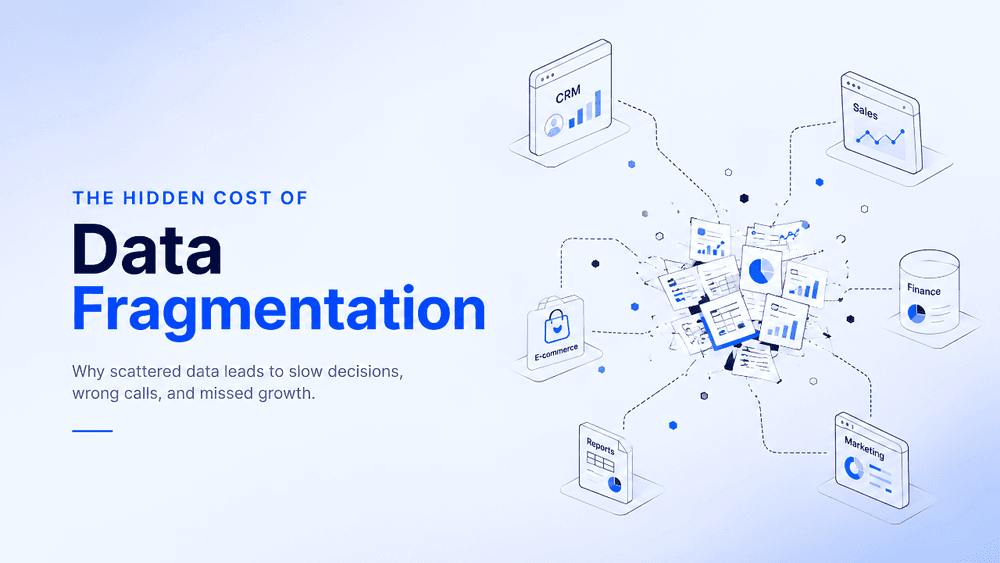
Why Tally + ERP + Excel Will Never Agree With Each Other
Data fragmentation happens when Tally, your ERP, and Excel each hold a different version of the truth. Here's why reconciliation doesn't fix it and what does.