

Quick answer
Yes, AI can predict food demand for restaurant chains from POS sales, reservations, delivery, weather, events, and seasonality. Accuracy needs clean item history and clear promo or menu-change tags. Sharper short-term forecasts cut waste and stockouts. FireAI connects this data for forecast monitoring and plain-language questions.
Yes. Restaurant chains already use statistical and machine learning models to estimate how many covers or orders to expect by day, hour, and menu category. The practical question is which signals you can access, how granular the forecast should be (brand vs outlet vs SKU), and how planners override the model when a festival, cricket match, or sudden rain shifts traffic.
This page covers demand drivers for food service, common AI approaches, waste and margin impact, and how analytics platforms like FireAI fit next to your POS and delivery stack. For inventory execution, see food and beverage inventory analytics. For the broader product story, see FireAI for food and restaurant. FMCG seasonal planning follows a different data shape; compare with can AI forecast seasonal demand for FMCG.
What drives restaurant demand (beyond “last week same day”)
- Seasonality and holidays: Festival weeks, long weekends, and school vacations change mix and volume, especially for dine-in and family formats.
- Weather: Rain and heat shift walk-ins, delivery share, and beverage or soup-heavy orders in many Indian cities.
- Local events: Concerts, matches, office clusters, and metro construction can spike or kill footfall for a single outlet while the rest of the chain looks normal.
- Promotions and pricing: BOGO, platform discounts, and LTOs (limited-time offers) lift volume in ways a naïve average will miss unless tagged in the data.
- Menu and operational changes: New hero items, recipe swaps, or a kitchen running out of a topping change what “demand” means for each SKU.
- Delivery vs dine-in mix: Aggregator dependency means the same brand can see delivery-led spikes that POS-only models underpredict unless delivery data is unified.
How AI prediction usually works for chains
Most production setups blend classical forecasting with ML, rather than a single black box.
| Approach | When it fits | Trade-off |
|---|---|---|
| Moving averages / same-day-last-year rules | Stable outlets with low promo noise | Fast to explain; weak on shocks and promos |
| Gradient boosting or similar on tabular features | Rich history: item, outlet, calendar, weather, promo flags | Needs feature discipline and monitoring |
| Hierarchical forecasting | Many outlets sharing patterns | Better totals; needs reconciliation to outlet level |
Feature examples that often help: hour-of-week, school-day flags, rain index, festival calendar by city, “days since menu change,” and binary promo indicators from POS or CRM. The model’s job is to learn which combinations lift biryani on Friday delivery vs salads at a business-district lunch.
Human-in-the-loop stays essential: A model will not know about a competitor opening next door or a one-off catering order unless someone adjusts or feeds that context.
Impact on waste, availability, and labor
When short-term demand is even modestly more accurate:
- Production planning for central kitchens and commissaries can align batch sizes with expected outlet pull, reducing spoilage on high-variance items.
- Outlet-level prep moves closer to expected covers, which matters for perishable garnish, breads, and proteins.
- Staffing gets a second signal beside manager intuition, useful for multi-outlet ops reviews.
The ROI story is rarely “perfect forecasts.” It is fewer emergency runs, less throwaway, and fewer disappointed guests on high-traffic nights. Pair demand views with menu engineering analytics and inventory analytics so purchasing and the menu team share one picture.
How FireAI helps restaurant operators
FireAI is built to connect to the systems you already use (POS exports, delivery reports, and common spreadsheets) and to surface dashboards and plain-language questions without forcing every area manager to rebuild models in Excel.
Typical workflows
- Sync item-level sales by outlet and channel so historical peaks (festivals, IPL nights, monsoon weeks) are visible in one workspace.
- Monitor forecast vs actual by day part or category, with drill-down when a location drifts from the chain average.
- Ask conversational questions (e.g., “Which outlets under-forecasted delivery last Saturday in Mumbai?”) to catch process issues, not only model error.
- Align finance and ops using the same demand narrative as food cost and inventory planning on F&B inventory use cases.
AI here is not a replacement for a head chef or area manager. It is shared visibility: faster baselines, fewer blind spots before big nights, and a single place to rehearse “what if we run this promo” before you commit food and labor.
When AI demand prediction is not enough
- Sparse or messy history: New outlets, frequent menu overhauls, or POS changes that break item codes will limit any algorithm.
- One-off shocks: Political bandhs, supply strikes, or viral incidents need scenario planning, not only historical fit.
- Data silos: If delivery, dine-in, and catering live in three places that never reconcile, the model inherits that gap.
Summary: AI can predict food demand for restaurant chains when sales history is consistent, drivers are encoded, and teams review forecasts before service. For implementation context across formats, start from FireAI for food and restaurant and deepen execution with food and beverage inventory analytics.
Ready to act on your data?
See how teams use FireAI to ask in plain language and get analytics they can trust.
Explore FireAI workflows
Go from this topic into product features and solution paths that match what you read here.
Topic hub
Industry Analytics In India
Comparison pages and implementation guidance for industry-specific BI, dashboards, and analytics use cases in India.
Explore hubFrequently asked questions
Can AI predict food demand accurately for every menu item?
Not equally. High-volume, repeat items with stable recipes usually forecast better than long-tail or highly seasonal specials. Many chains forecast at category or cluster level first, then allocate to SKUs with rules. Item-level accuracy improves when promotions and outages are tagged in the data.
What data does a restaurant chain need for AI demand forecasting?
Time-stamped sales by outlet and channel, a stable item or PLU mapping, and calendar context (day of week, holidays). Weather and local event feeds help in many cities. Promotion flags and major menu change dates reduce confusion between true demand shifts and pricing effects.
How is restaurant demand forecasting different from FMCG forecasting?
Restaurant demand is often hourly, outlet-specific, and sensitive to weather and events the same week. FMCG forecasting more often works at weekly or daily SKU-region level with distributor and promotion data. The techniques overlap, but the grain of the data and the speed of menu change differ.
How can FireAI support demand prediction for F&B teams?
FireAI connects POS and related exports into analytics workflows with dashboards and natural language questions. Teams compare recent patterns, festival weeks, and outlet performance, then align purchasing and prep decisions without rebuilding spreadsheets for every location.
Related in this topic
What Is Menu Engineering Analytics for Restaurants?
Menu engineering analytics classifies menu items by popularity and profit using the BCG matrix (stars, plowhorses, puzzles, dogs). Learn how Indian restaurants and QSRs optimize menus, and how FireAI auto-classifies items from POS data.
What is Demand Forecasting? Methods and AI Techniques
Demand forecasting uses historical sales data and statistical or AI models to predict future product demand. Learn the key methods — time series, causal, and machine learning — and how tools like FireAI automate demand planning directly from Tally and DMS data.
What Is Inventory Analytics? Why It Matters for Indian Businesses
Inventory analytics measures stock health, turnover, and risk using your operational data. Learn what it includes (dead stock, safety stock, expiry), why it matters for working capital, and how FireAI builds inventory dashboards from Tally.
Why Restaurants Need Real-Time Analytics in 2026
Restaurants run on perishable stock, shifting footfall, and aggregator-driven demand. Learn why delayed reports fail for F&B, and how live POS, labor, and platform data cuts waste, protects margins, and keeps service smooth.
From the blog

How AI-Powered Analytics Can Transform India’s Arbitration Bottleneck?
AI-powered analytics can transform India's arbitration system by automating case classification, predicting timelines, and optimizing arbitrator allocation to cut delays.
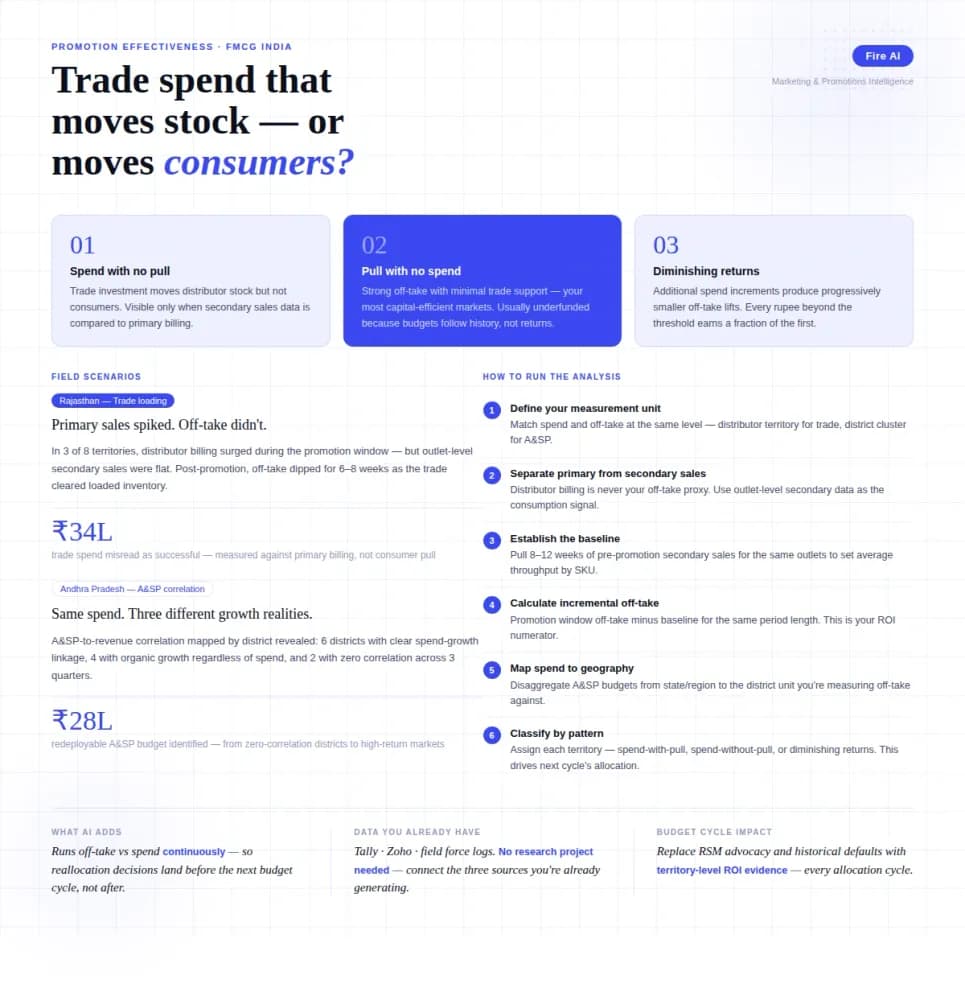
Measuring Promotion Effectiveness: A Data-Driven Guide for FMCG Marketers
FMCG brands in India spend 15–25% of gross revenue on trade promotions and A&SP (advertising and sales promotion) every year. Most can tell you how much they spent. Very few can tell you what it returned. The problem isn't a lack of data — it's that the data lives in disconnected places. Trade spend sits in finance. Off-take data lives with the distributor or field team. A&SP budgets are tracked in a marketing spreadsheet. No single view ties promotional investment to consumer pull at the outlet level. The result is a budget cycle where last year's spend allocation becomes next year's default, because no one has the numbers to argue for something different. This guide walks through how FMCG marketing and trade teams can build a promotion effectiveness framework that actually connects spend to outcome — not just channel-level assumptions.
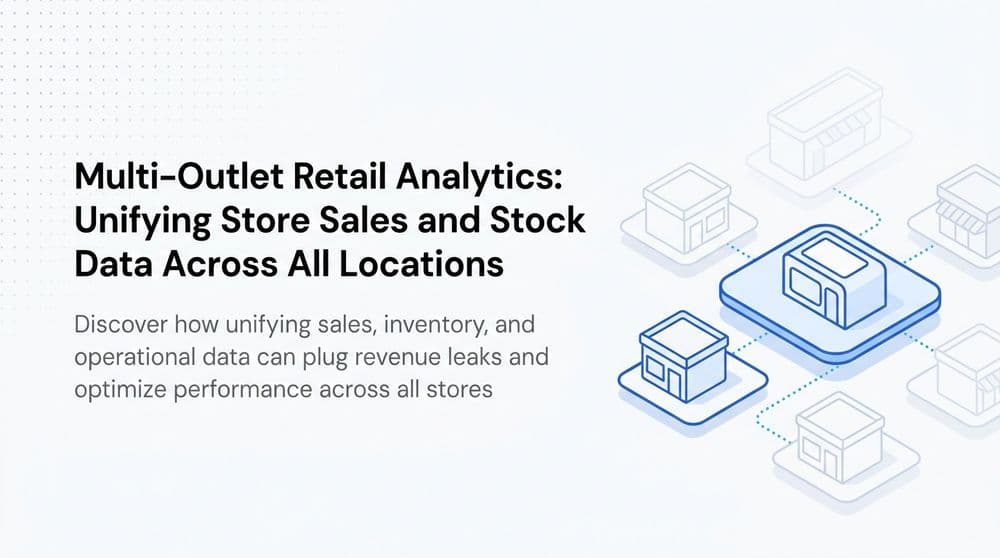
Multi-Outlet Retail Analytics: Track Store Sales
Track sales, stockouts, and staff performance across all stores. Learn how multi-outlet retail analytics can find the root cause of revenue leaks.