

Quick answer
Yes, AI can forecast seasonal FMCG demand from DMS and sell-out history by learning calendar effects, festivals, and category seasonality. On rich, promotion-tagged data, machine learning often beats univariate time series for peak weeks, while new SKUs and sudden schemes need human input. FireAI uses this data to build forecasts, scenarios, and dashboard monitoring for supply teams.
Yes. AI is used widely to forecast seasonal demand in FMCG, especially where weekly or daily volumes swing with festivals, summer heat, and trade promotions. The question is not whether algorithms can see seasonality, but which models fit your data depth, how promotions are recorded, and how planners will override the forecast when a scheme lands late.
This page contrasts AI with traditional statistical methods, what improves accuracy for Indian distributors and brands, and how FMCG supply chain analytics ties into planning. For a definition-first take, see what is demand forecasting.
What “seasonal” means for FMCG in India
- Calendar seasonality: Summer beverages, ghee and sweets around festivals, school-season packs, and category-specific peaks (e.g., oral care, home care) repeat year on year in many states.
- Festival and event spikes: Diwali, Eid, Onam, and regional events can dwarf a normal week. Spikes are sharp and short, which stresses naïve moving averages.
- Trade promotion and scheme seasonality: Modern trade and general trade bursts when schemes run, not only when the calendar says so. If promotion flags are missing in the data, “seasonal” and “promo-driven” get confused in the model.
- Distributor and outlet dynamics: Secondary sales and DMS data carry sell-in and sometimes sell-out. Seasonality in primary billing can differ from true off-take if pipeline stock shifts.
Can AI do better than classical forecasting here?
Often yes, when you have enough history, clean SKU and outlet keys, and promotion metadata. Classical methods (ETS, SARIMA, croston for intermittent SKUs) still win on some sparse, stable lines because they are simple and cheap to run.
| Aspect | Traditional time series (e.g., SARIMA, ETS) | AI / ML (e.g., gradient boosting, temporal neural nets) |
|---|---|---|
| Long, stable history | Strong baselines, easy to explain | Gains are modest; risk of overfitting if data is short |
| Many SKUs and interactions | One model per series or slow hierarchy | Can share strength across products and regions |
| Promotions, price, weather | Needs manual regressors and tuning | Can ingest multiple drivers if features are built well |
| Explainability | Coefficients and error bounds familiar to planners | Needs tooling for feature importance and scenario views |
| New products | Cold start is hard for everyone | Slightly better with similar-product pooling if taxonomy is clean |
Practical takeaway: The best forecast stack in FMCG is rarely “AI only” or “statistical only.” It is a blend: ML or hybrid models for dense portfolios, simple methods for long-tail SKUs, and a governance layer so planners can adjust for intelligence the model will never have (a competitor’s sudden national drop, a regulatory change, a factory constraint).
How AI improves accuracy on seasonal peaks
- Feature-rich inputs: Lags, calendar dummies, festival calendars by state, school holidays, and temperature proxies can be fed into tree-based models or deep temporal architectures so the model learns which “summers” look like each other.
- Hierarchical reconciliation: National, region, and SKU-level signals can be combined so a peak at the right geography lifts the right child SKUs, reducing noise at the bottom of the tree.
- Ensembling: Combining a strong statistical baseline with an ML residual correction is a common pattern for seasonal surge weeks on high-volume items.
- Continuous refresh: Re-training as new DMS and POS weeks land keeps festival dates and promotion mix current. Seasonality that drifts (e.g., channel shift to eB2B) is easier to track when pipelines are automated, not three-month-old spreadsheets.
Accuracy still depends on data hygiene: de-duplication of outlet IDs, correct UOM, returns handling, and consistent scheme coding. For inventory consequences of bad forecasts, see can AI predict inventory stockouts.
How FireAI supports seasonal demand forecasting with DMS and ERP data
FireAI is built to connect to the data FMCG teams already use (Tally, DMS, ERP, and common exports) and to turn that into questions, dashboards, and forward-looking views without forcing every planner to be a data scientist.
What you can do in practice
- Sync historical offtake and billing from DMS and align it with product and geography masters so time series are consistent for forecasting and for monitoring forecast vs actuals.
- Build monitoring views for “next 4, 8, 12 weeks” by SKU or pack, with drill-down to territory and modern trade vs general trade where the data supports it.
- Ask in plain language (e.g., “Show SKU X secondary trend last three Diwalis vs this year to date in Maharashtra”) to validate assumptions before locking production or dispatch plans.
- Tie demand signals to operation plans in one place, so the same workspace that shows trade promotion performance can sit beside forward volume views for the next season.
AI here is not a black-box oracle that ships instead of a planner. It is signal compression: faster baselines, fewer blind spots in peak weeks, and a shared picture for sales, supply chain, and finance. For a broader look at the category, FMCG analytics in India summarizes how analytics fits field, supply, and finance.
When AI seasonal forecasting is not enough on its own
- Truly new SKUs with no proxy in the hierarchy: use analogous products and manual priors, not only ML.
- One-off events the history never saw: pricing wars, new entrants, or sudden regulatory moves need scenario planning, not a single number.
- Data gaps: If DMS weeks are missing or outlet coverage is partial, any model, AI or not, will inherit that bias. Fix data and definitions before chasing algorithm upgrades.
Summary: AI can and does forecast seasonal demand for FMCG when data is long enough, correctly structured, and paired with human judgment for promotions and surprises. For implementation and narrative aligned with your growth moments, also read the FMCG supply chain use case library.
Ready to act on your data?
See how teams use FireAI to ask in plain language and get analytics they can trust.
Explore FireAI workflows
Go from this topic into product features and solution paths that match what you read here.
Topic hub
AI Analytics
Guides on natural language querying, AI-powered analytics, forecasting, anomaly detection, and automated insights.
Explore hubFrequently asked questions
Can AI forecast seasonal demand better than Excel or moving averages for FMCG?
Often yes for high-volume SKUs with two or more years of weekly or daily history and clean promotion flags. Simple moving averages miss sharp festival peaks, while models that use calendar, weather, and promotion features can track those better. For sparse long-tail SKUs, simpler statistical methods or rules-based overrides may still be enough.
What data does an FMCG brand need to forecast seasonal demand with AI?
At minimum: time-stamped sales or shipments by SKU and geography, a stable product master, and consistent outlet or distributor IDs. For India, add festival calendars by state where relevant. Promotion and scheme data greatly reduce confusion between true seasonality and short-term price lifts. DMS and ERP fields should align so the same product code means the same pack everywhere.
How does machine learning differ from SARIMA or exponential smoothing for FMCG seasonality?
Classical methods model each series (or a small family) with trend and seasonality parameters. Machine learning can combine many input features, share information across products and regions, and learn non-linear interactions, for example between temperature and a cold beverage line. SARIMA can still win on very regular series; ML is stronger when many drivers and cross-series patterns matter.
How can FireAI help with seasonal demand forecasting in FMCG?
FireAI connects to sources like Tally and DMS exports so historical sales and returns feed analytics without repeated manual prep. Teams use dashboards and natural language questions to review trends by SKU and region, compare years and festivals, and align forecast discussion with supply and finance, building on the same data foundation as inventory and trade promotion analysis.
Related in this topic
What is Demand Forecasting? Methods and AI Techniques
Demand forecasting uses historical sales data and statistical or AI models to predict future product demand. Learn the key methods — time series, causal, and machine learning — and how tools like FireAI automate demand planning directly from Tally and DMS data.
FMCG Analytics in India: Sales & Distribution
FMCG analytics in India covers secondary sales tracking, distributor performance, beat coverage, and retailer segmentation. Learn key metrics for Indian FMCG companies.
Can AI Predict Inventory Stockouts?
Yes — AI can predict inventory stockouts by analysing historical sales velocity, reorder patterns, and lead times to flag at-risk SKUs before they run out. Learn how AI-powered inventory forecasting prevents stockouts and reduces lost sales.
What is Predictive Analytics? Methods and Examples
Predictive analytics uses statistical algorithms and machine learning to forecast future outcomes based on historical data. Learn how predictive modeling works, which methods are used, and how businesses apply it for sales forecasting, risk management, and strategic planning.
From the blog
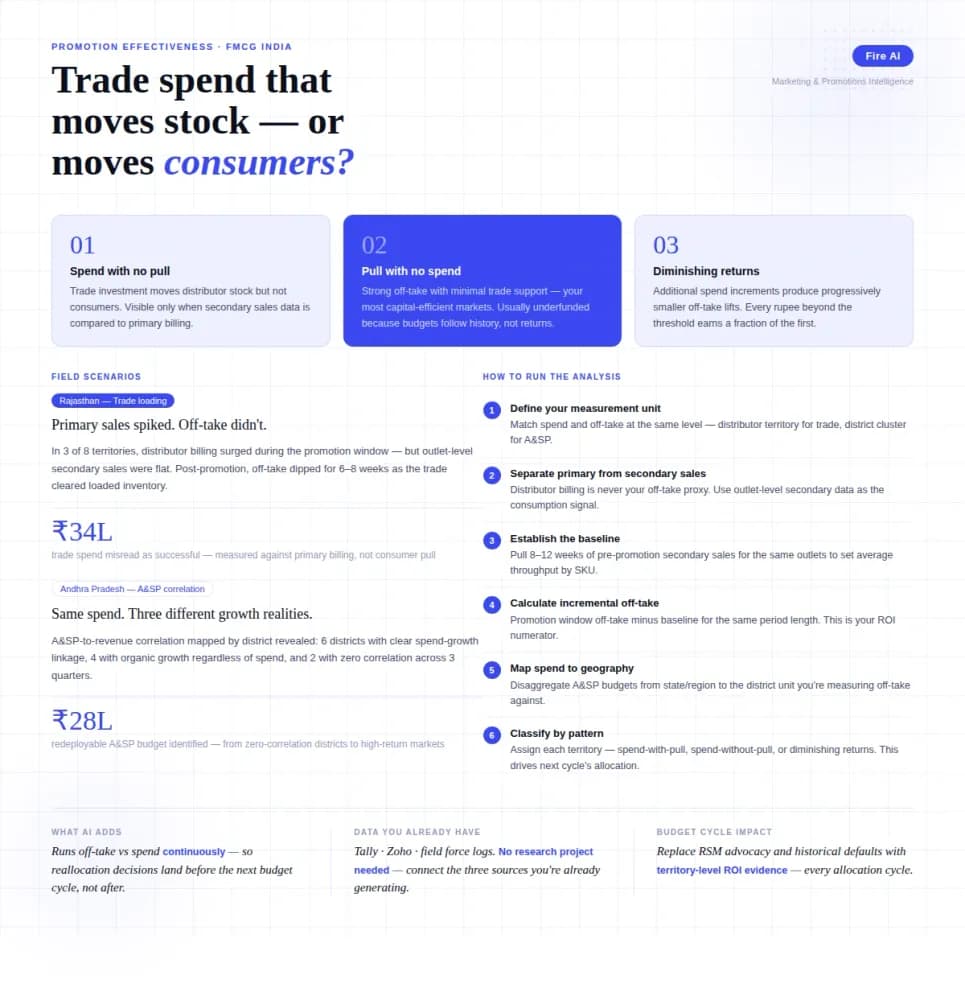
Measuring Promotion Effectiveness: A Data-Driven Guide for FMCG Marketers
FMCG brands in India spend 15–25% of gross revenue on trade promotions and A&SP (advertising and sales promotion) every year. Most can tell you how much they spent. Very few can tell you what it returned. The problem isn't a lack of data — it's that the data lives in disconnected places. Trade spend sits in finance. Off-take data lives with the distributor or field team. A&SP budgets are tracked in a marketing spreadsheet. No single view ties promotional investment to consumer pull at the outlet level. The result is a budget cycle where last year's spend allocation becomes next year's default, because no one has the numbers to argue for something different. This guide walks through how FMCG marketing and trade teams can build a promotion effectiveness framework that actually connects spend to outcome — not just channel-level assumptions.
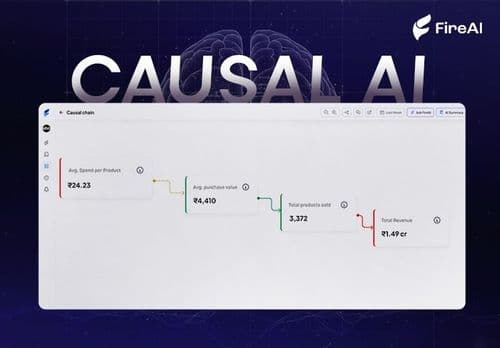
Causal AI Explained: Uncovering the “Why” in Data with Machine Learning
Causal AI reveals not just what will happen, but why — and exactly what changes if you act differently. It turns predictions into high-ROI decisions by uncovering true cause-and-effect in your data.
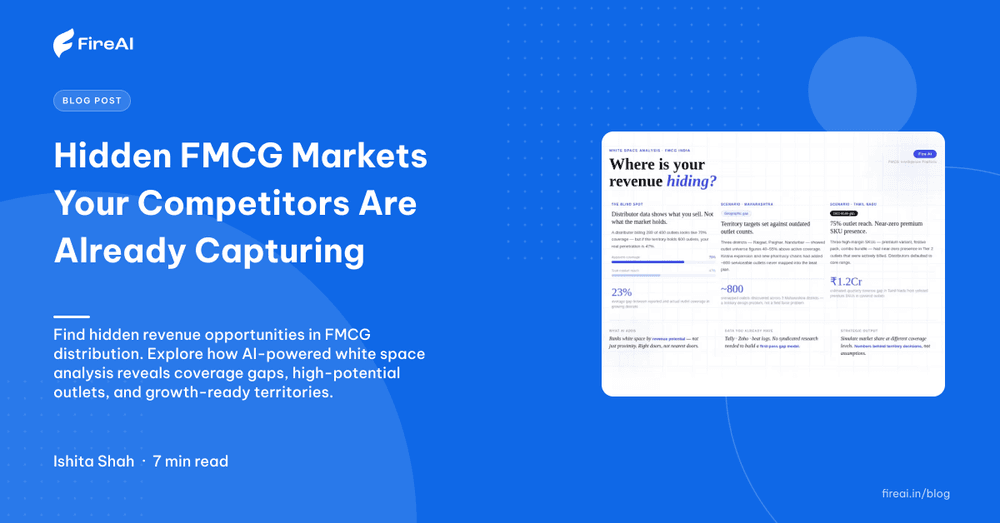
White Space Analysis for FMCG: Finding Untapped Markets with AI
Most FMCG sales leaders assume their coverage gaps are known. They're not — they're estimated. Based on distributor claims, field rep feedback, and the occasional market visit. The outlets you aren't reaching don't appear in your Tally data. The SKUs your distributors aren't pushing don't show up on beat reports. What's missing is, by definition, invisible. That invisibility is expensive.