

Quick answer
Yes. Modern self-service BI tools like FireAI let startup founders connect Tally, databases, or CRMs in minutes — then build dashboards and ask analytics questions in plain Hindi or English without writing SQL. At ₹4,999/month with zero-code setup and 700+ connectors, startups get enterprise-grade BI without hiring a single data analyst.
The biggest misconception about BI is that you need a data team to use it. Ten years ago, this was largely true — BI tools required SQL expertise, database administration, and dedicated infrastructure. Today, the best BI tools are designed for business users first.
What Startups Actually Need from BI
Startup founders and operators need answers to simple but important questions:
- What's our revenue trend this month vs last month?
- Which customers are churning or declining?
- What's our burn rate and cash runway?
- Which products or channels are growing vs stagnating?
- Are we on track to hit our targets?
None of these questions require a data analyst to answer — they require the right tool connected to the right data.
What Modern Self-Service BI Enables
No-code dashboard building: Drag-and-drop interfaces for creating charts, tables, and dashboards without writing code.
Pre-built templates: Most BI tools include templates for common startup dashboards (revenue, growth, unit economics) that require only data connection to work.
Natural language querying: Ask questions in plain language — "Show me revenue by channel this quarter" — and get immediate answers without SQL.
Automated reporting: Set up daily or weekly reports to be sent automatically to founders and investors.
Alerts and anomalies: Get notified when something significant changes, without manually monitoring dashboards.
What a Startup Still Needs Before Self-Serve BI Works
While you don't need a data team for day-to-day analytics, some initial setup is required:
Data connections: Someone needs to connect your data sources (database, Tally, Stripe, HubSpot) to the BI tool. This typically takes a few hours and requires knowing database credentials or API keys — not SQL expertise.
Metric definitions: Agreeing what "revenue" means (gross vs net vs recognised) and what "customers" means (paid vs trial vs active) needs to be decided once before building dashboards.
Initial dashboard setup: Building the first set of dashboards takes a few hours using the BI tool's interface. Most BI tools for startups include guided setup.
Signs a Startup Needs a Data Analyst
You don't need a data analyst until:
- You're running A/B tests and need statistical analysis
- You need predictive models (churn prediction, demand forecasting)
- Data volume and complexity exceeds what self-service tools handle well
- Your data quality issues are complex enough to require full-time data engineering
For most startups below ₹10Cr ARR, a good BI tool replaces the need for a data analyst entirely.
How Indian Startups Use FireAI Without a Data Team
FireAI is purpose-built for the startup founder who wants answers, not dashboards to maintain.
Real Startup Scenario: ₹3Cr D2C Brand (Bengaluru)
A 12-person D2C skincare brand connected Shopify + Google Ads + Tally to FireAI in under an hour. The founder now asks:
- "What's my ROAS by channel this month?" — instant chart
- "Show me top 5 SKUs by gross margin" — no SQL needed
- "पिछले हफ्ते की बिक्री दिखाओ" — works in Hindi too
Result: Eliminated a ₹60K/month freelance analyst. Founder makes data decisions in team standups using a phone.
What Makes FireAI Different for Startups
| Capability | Traditional BI | FireAI |
|---|---|---|
| Setup time | 4–8 weeks + consultant | Same day, zero-code |
| Monthly cost | ₹30,000–₹50,000 | ₹4,999/month |
| Tally integration | Third-party connector extra | Native, included |
| Who can use it | SQL-literate analysts | Any founder or manager |
| Query language | SQL/DAX | Hindi, English, plain text |
| Connectors | Varies by plan | 700+ included |
3-Step Setup for Any Startup
- Connect your data (5 min): Tally, PostgreSQL, MySQL, Google Sheets, Stripe, HubSpot — 700+ connectors, no credentials beyond login
- Use pre-built templates (10 min): Revenue, burn rate, unit economics, and cash runway dashboards ready to go
- Ask questions (ongoing): Type "What's my MRR trend?" or "Which channel has the lowest CAC?" — get instant visual answers
At ₹4,999/month, FireAI costs less than a single dinner with your investor — and delivers more actionable insights than a monthly board deck.
See should startups invest in analytics early for the strategic case, our guide to the best BI tools in India for how major platforms compare, and best BI tools for startups in India for startup-focused picks.
Ready to act on your data?
See how teams use FireAI to ask in plain language and get analytics they can trust.
Explore FireAI workflows
Go from this topic into product features and solution paths that match what you read here.
Topic hub
BI Fundamentals
Foundational guides on business intelligence, analytics architecture, self-service BI, and core data concepts.
Explore hubFrequently asked questions
Do I need a data analyst to use a BI tool at my startup?
No. Modern self-service BI tools like FireAI are designed for founders and business managers, not data analysts. You can connect Tally, Stripe, or your database in minutes, build dashboards with drag-and-drop, and ask questions in plain Hindi or English. A data analyst adds value for complex statistical models, but is not required for standard startup dashboards.
What is the cheapest BI tool for Indian startups without a data team?
FireAI at ₹4,999/month is the most affordable full-featured BI tool for Indian startups. It includes 700+ native connectors (including Tally), natural language querying in Hindi and English, zero-code dashboard building, and pre-built startup templates — all without needing SQL skills or a data team. Comparable Power BI setups cost ₹30,000–₹50,000/month after connectors.
How long does it take a startup to set up analytics without a data team?
With FireAI, the entire setup takes under an hour: 5 minutes to connect your data sources (Tally, database, Google Sheets), 10 minutes to customise pre-built dashboard templates for revenue, burn rate, and unit economics, and you are immediately ready to ask questions in plain language. No consultant, no training, no SQL required.
Can a non-technical founder build business dashboards without coding?
Yes. FireAI provides drag-and-drop dashboard building and natural language querying — you type "Show me revenue by channel this quarter" and get an instant chart. Pre-built templates for SaaS metrics, e-commerce KPIs, and financial dashboards mean you can have investor-ready dashboards within an hour of signing up.
At what stage should a startup hire a data analyst instead of using self-service BI?
Most startups don't need a data analyst until ₹10Cr+ ARR. Below that, a self-service tool like FireAI handles standard analytics: revenue tracking, cohort analysis, churn monitoring, and financial reporting. Consider hiring when you need A/B test statistical analysis, custom ML models, or data quality engineering for complex multi-source pipelines.
Related in this topic
What is No-Code Analytics? Definition, Tools, and Benefits
No-code analytics lets business users analyse data, build dashboards, and generate insights without writing SQL or code. Learn what no-code analytics tools are, how they work, and which platforms offer no-code BI for Indian businesses.
What is Self-Service BI? Benefits and Tools
Self-service BI empowers business users to analyze data independently without IT assistance. Learn how self-service BI works, which tools enable it, and how to implement it to democratize data access and accelerate decision-making.
Why Startup Founders Need Analytics from Day One
Startup founders who use analytics make faster decisions, avoid costly mistakes, and build more fundable businesses. Learn why analytics is a competitive advantage for founders and which metrics matter most at each growth stage.
Analytics for Indian SMBs: What Works & What to Avoid
Most Indian SMBs struggle with analytics because enterprise tools are too expensive, complex, and don't support Tally. Here's what actually works — and how to start for under ₹10K/month.
From the blog
Measuring Promotion Effectiveness: A Data-Driven Guide for FMCG Marketers
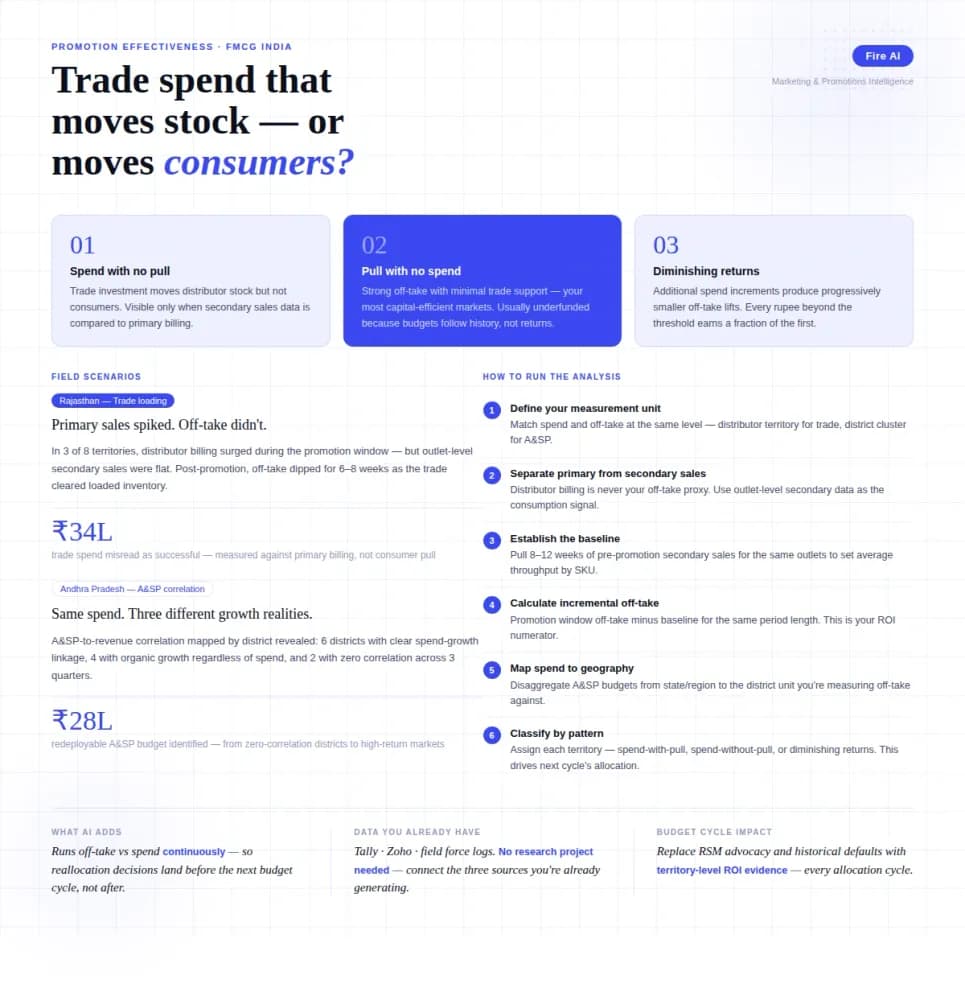
FMCG brands in India spend 15–25% of gross revenue on trade promotions and A&SP (advertising and sales promotion) every year. Most can tell you how much they spent. Very few can tell you what it returned. The problem isn't a lack of data — it's that the data lives in disconnected places. Trade spend sits in finance. Off-take data lives with the distributor or field team. A&SP budgets are tracked in a marketing spreadsheet. No single view ties promotional investment to consumer pull at the outlet level. The result is a budget cycle where last year's spend allocation becomes next year's default, because no one has the numbers to argue for something different. This guide walks through how FMCG marketing and trade teams can build a promotion effectiveness framework that actually connects spend to outcome — not just channel-level assumptions.

Democratizing Data: How AI Analytics Levels the Playing Field for Small Businesses and Freelancers
For decades, data-driven decision making was a luxury that only enterprises could afford. Big companies hired data scientists, purchased expensive BI tools, and built complex data warehouses. In exchange, they received precise insights that guided budgets, strategy, and growth.
Tally Analytics Dashboards for Indian Businesses
80% of Indian SMBs use Tally. Fewer than 5% have dashboards. Learn how to build real-time P&L, cash flow, and receivables analytics from your Tally Prime data.