

Quick answer
Pharma companies should invest in AI for field force management when MR productivity, territory coverage, and prescription outcomes are tracked in SFA silos with no joined analysis. AI surfaces call efficiency, doctor coverage gaps, and scheme ROI in one view. The decision depends on MR headcount, data readiness, and whether productivity variance is costing more than the platform.
Pharma companies should invest in AI for field force management once the number of MRs, territories, and doctors makes it impossible to identify who is driving prescriptions and who is just filling a call-reporting app. This page is a decision guide: the real costs of managing field force without AI, what AI can and cannot do, how to think about ROI, and the conditions under which investment makes sense. For the tactical view of what to measure, see how to track MR productivity in pharma. For pharma analytics capabilities more broadly, see pharma analytics in India and pharma sales and field force use cases.
The MR productivity problem AI is trying to solve
Most pharma field force data lives in three places that never talk to each other: the SFA app for call reporting, the DMS for secondary sales, and Tally or ERP for primary invoicing.
The result is a field force that is managed on lag indicators and gut feel:
- Call compliance (did the MR visit?) is tracked, but call effectiveness (did the doctor prescribe?) is inferred at best.
- Territory coverage is measured by beat completion, not by whether the right doctors with the right prescribing potential were covered at the right frequency.
- Scheme and sample costs are allocated centrally, but which MRs or territories generate the highest return on scheme spend is not known until the quarter closes.
- MR attrition is high in Indian pharma (25–35% annually in many companies), but the productivity signal that predicts a departing or disengaged MR often exists in the SFA data weeks before a resignation.
Without AI or joined analytics, regional managers receive weekly call reports and monthly secondary sales files, and reconcile them manually in Excel. By the time an underperforming territory is visible, three to four months of prescription-building opportunity may already be lost.
What AI field force analytics actually covers
AI field force management in pharma is not a replacement for SFA. It is an analytics layer on top of SFA, DMS, and secondary sales data that joins what MRs do to what outcomes they produce.
Key capabilities in scope:
MR productivity and call effectiveness scoring
AI scores each MR across visit frequency, doctor coverage depth, secondary sell-out per doctor visited, and sample and scheme utilization. The score identifies who is over-visiting low-potential doctors, who has prescription momentum worth protecting, and who is at risk of disengagement. For detail on these metrics, see how to track MR productivity in pharma.
Territory optimization
AI maps doctor potential (estimated prescribing value by specialty and geography) against actual MR coverage to surface gaps. It identifies territories where visit frequency is too thin for prescription-building and where an MR is over-invested in doctors who have stopped prescribing. This is distinct from beat planning, which optimizes travel time; territory optimization asks whether the right doctors are in the beat at all.
Prescription correlation
When secondary DMS data or prescription audit data is available (IMS, AWACS, or distributor sell-in by brand), AI correlates MR visit patterns with prescription movement. It answers: after an MR visits a doctor, does the brand's prescription share in that doctor's outlet move? This correlation is the closest a pharma company can get to call effectiveness without independent audit data.
Scheme and sample ROI
AI tracks promotion spend (samples, POB, and literature) by MR and territory and correlates it with secondary sell-out uplift. It flags whether scheme spend in a territory is returning incremental prescriptions or being consumed without a measurable effect. This connects to pharma HR use cases when performance-linked scheme allocation or incentive structure decisions are involved.
The ROI case for AI field force in pharma
A useful ROI starts with two questions: what does field force underperformance cost today? and what would a 5 to 10% improvement in productive coverage be worth?
| Cost of no AI | Typical impact |
|---|---|
| Undetected low-productivity MRs | 15–20% of MR base may show consistent low secondary sell-out with no intervention |
| Over-coverage of low-potential doctors | Visit cost (travel, sample, time) without prescription return |
| Slow attrition detection | An MR disengaging 60 days before resignation degrades territory continuity |
| Scheme leakage | Promotions allocated to territories that show no secondary uplift |
| Missed territory gaps | High-potential doctors without adequate coverage in the same territory as covered but non-prescribing doctors |
A concrete framing: If a pharma company has 500 MRs and identifies 15% (75 MRs) as systematically under-productive through AI field force scoring, the question is whether reallocating territory or changing visit patterns for those 75 produces even a 5% average secondary sell-out improvement. At average secondary sales of ₹4–6 lakh per MR per month, a 5% improvement across 75 MRs is ₹15–22 lakh in monthly secondary sell-out, which against a typical AI analytics platform cost makes the ROI math straightforward.
This calculation is directional, not a guarantee. The actual benefit depends on how well the secondary data maps to field behavior and how responsive the sales management system is to analytical signals.
When pharma AI field force investment is justified
Invest when:
- You have 50 or more MRs and regional managers are managing performance primarily from call compliance and monthly secondary sales files.
- MR attrition is above 25% annually and exit interviews are not enough to identify productivity patterns before the MR resigns.
- Secondary sales data from DMS is available at stockist or outlet level, which makes prescription correlation possible. Without secondary data, AI field force is limited to call pattern analysis only.
- You are launching a new brand or division and need to measure territory response to early-stage investment, not wait for a quarterly review.
- Scheme spends are rising but their ROI is not measured at territory level.
It can wait when:
- Your field force is fewer than 30–40 MRs and the first-line managers still have direct visibility into each MR's territory.
- SFA adoption is below 70%. AI on top of incomplete call data produces misleading scores. Fixing SFA discipline is a prerequisite.
- Secondary DMS data is unreliable or more than 3 weeks stale. Prescription correlation requires current sell-out; stale data yields correlation noise, not insight.
- Your highest business constraint is product access or pricing, not field force productivity. AI field force analytics solves a productivity and allocation problem, not a product portfolio problem.
How FireAI supports pharma field force analytics
FireAI connects SFA call data, DMS secondary sales, and Tally primary invoicing to build joined MR productivity dashboards without manual reconciliation.
What FireAI covers:
- MR and territory scorecards updated daily from SFA and secondary sell-out feeds, filterable by region, brand, and specialty
- Coverage gap analysis that maps doctor potential against actual call frequency to identify under-serviced high-potential doctors
- Scheme impact overlays that tie POB and sample spend to secondary sell-out movement by MR and territory
- Attrition risk signals from call pattern anomalies, for example consistent early check-outs or declining doctor diversity in visits
- Plain-language queries so field managers can ask "Which MRs in South Zone had the highest secondary sell-out per doctor visited last month?" without building a filter manually
For pharma companies in India managing both MR productivity and HR analytics around field force retention, FireAI ties these two views together. See pharma HR use cases for how field force analytics integrates with workforce planning and incentive design.
Ready to act on your data?
See how teams use FireAI to ask in plain language and get analytics they can trust.
Explore FireAI workflows
Go from this topic into product features and solution paths that match what you read here.
Topic hub
Industry Analytics In India
Comparison pages and implementation guidance for industry-specific BI, dashboards, and analytics use cases in India.
Explore hubFrequently asked questions
Should pharma companies use AI for field force management?
What is the ROI of AI for pharma field force?
What data is needed for AI pharma field force analytics?
Can AI replace field managers in pharma?
Related in this topic
Measure MR Productivity Beyond Visits | FireAI
Visit counts don't tell you if MRs are driving prescriptions or just showing up. Follow practical steps, key metrics and examples for better decisions.
Can AI Track Pharma Field Force Productivity?
Yes: AI can track medical representative productivity by unifying GPS or visit logs, CRM calls, and prescription or sales outcomes. Learn how machine learning scores territory coverage and engagement, and how FireAI connects pharma CRM and Rx data for Indian sales teams.
Pharma Analytics in India: MR Performance & Compliance
Pharma analytics in India covers MR productivity, territory management, prescription tracking, and regulatory compliance.
Why Pharma Companies Need AI Analytics in India
Pharmaceutical companies face strict compliance, complex field force operations, batch-level supply risk, and volatile market share. Learn why AI-powered analytics is essential to unify data, surface risk early, and speed decisions across regulatory, sales, and supply workflows.
From the blog
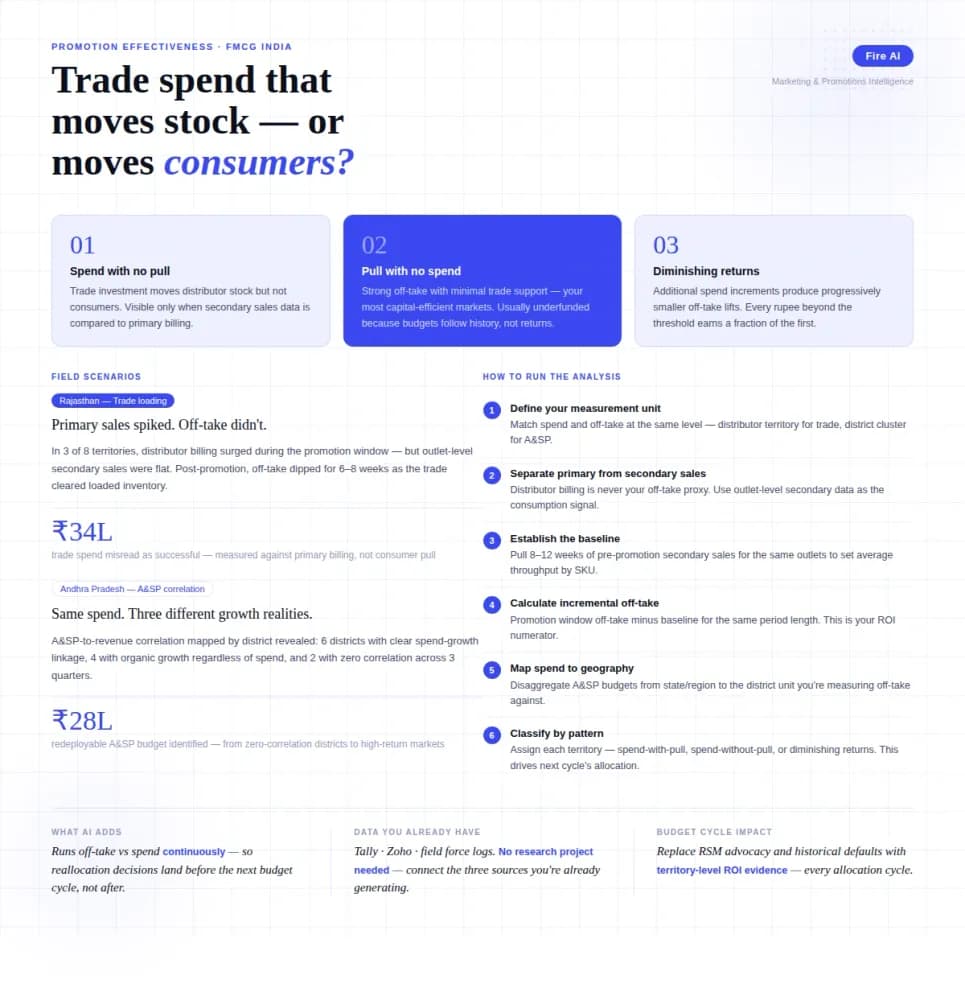
Measuring Promotion Effectiveness: A Data-Driven Guide for FMCG Marketers
FMCG brands in India spend 15–25% of gross revenue on trade promotions and A&SP (advertising and sales promotion) every year. Most can tell you how much they spent. Very few can tell you what it returned. The problem isn't a lack of data — it's that the data lives in disconnected places. Trade spend sits in finance. Off-take data lives with the distributor or field team. A&SP budgets are tracked in a marketing spreadsheet. No single view ties promotional investment to consumer pull at the outlet level. The result is a budget cycle where last year's spend allocation becomes next year's default, because no one has the numbers to argue for something different. This guide walks through how FMCG marketing and trade teams can build a promotion effectiveness framework that actually connects spend to outcome — not just channel-level assumptions.
Democratizing Data: How AI Analytics Levels the Playing Field for Small Businesses and Freelancers
For decades, data-driven decision making was a luxury that only enterprises could afford. Big companies hired data scientists, purchased expensive BI tools, and built complex data warehouses. In exchange, they received precise insights that guided budgets, strategy, and growth.

Calculating ROI on AI Analytics Tools: Are They Worth the Investment?
A practical breakdown of how AI analytics delivers real, measurable ROI across speed, accuracy, forecasting, and decision-making. This guide helps leaders evaluate true impact beyond costs to understand why AI is now a business-critical investment.