

Quick answer
To track MR productivity in pharma, define six core metrics: calls per day, doctor coverage, call frequency compliance by doctor class, new doctor additions, sales per MR, and input cost per call. Connect SFA visit logs to secondary sales data, score each MR against territory benchmarks, and review weekly at field level and monthly at national level.
Tracking MR productivity in pharma means measuring whether medical representatives are reaching the right doctors, at the right frequency, with the right messages, and whether that activity translates into prescription movement and sales outcomes. Activity alone does not determine productivity. The link between field effort and business results is what makes MR tracking useful.
Indian pharma companies deploy large field forces, from a few hundred MRs in mid-size generics firms to 10,000-plus in major companies. Without structured tracking, managers rely on self-reported call data, monthly sales numbers, and gut feel. With it, they can identify coverage gaps early, coach underperformers against specific metrics, and deploy resources toward high-potential territories. For an overview of the full pharma analytics landscape, see pharma analytics in India.
Step 1: Define the six MR productivity metrics
Before tracking anything, align on exactly what you will measure. These six metrics form the standard MR productivity framework used by Indian pharma companies.
1. Calls per day
Calls per day is the number of doctor or chemist visits an MR completes in a working day.
- Indian pharma benchmark: 8 to 12 calls per day for most therapy areas
- Separate field calls (doctor visits) from back-office or admin time
- Track planned versus actual calls to reveal whether beat schedules are realistic or whether compliance is weak
2. Doctor coverage
Doctor coverage is the percentage of the target doctor universe that the MR actually visits in a period (typically one month).
- A-class doctors (highest prescribers): weekly visits
- B-class doctors: fortnightly visits
- C-class doctors: monthly visits
Coverage gaps by doctor class show where MR time is going versus where it should go.
3. Call frequency compliance
Call frequency compliance measures whether MRs are visiting each doctor at the planned cadence, not just hitting a total call count.
An MR may complete 250 calls in a month but spend 80% of them on easy C-class doctors while A-class doctors are under-visited. Frequency compliance catches this pattern by tracking visits per doctor against the classification target.
4. New doctor additions
New doctor additions tracks how many net-new prescribers the MR brings into the prescriber base each month.
- Benchmark: 5 to 10 new doctors per MR per month, depending on product lifecycle and therapy area
- New doctor additions are a leading indicator for brand growth, especially for recently launched products
5. Sales per MR
Sales per MR is the monthly revenue attributed to each representative's territory, measured at primary or secondary level depending on what your company tracks at MR level.
It is the headline metric for manager reviews but must be read alongside coverage and call frequency. A high sales figure may reflect an inherited strong territory rather than genuine productivity.
6. Input cost per call
Input cost per call is the total field cost (travel, samples, promotional material, salary allocation) divided by calls completed in a period.
It tracks whether productivity is improving or whether cost is rising faster than output, and enables cost-efficiency comparisons across regions and therapy divisions.
Step 2: Map your data sources
Accurate MR tracking requires three data streams working together.
SFA or CRM
The SFA system is the primary source for field activity: visit records, sample distribution, call notes, and the doctor master. Indian pharma SFA platforms include Medismart, Compass (Cegedim), Veeva CRM (used by MNCs), and custom-built mobile apps. SFA data gives you calls per day, frequency compliance, and doctor coverage.
Secondary sales from DMS or stockists
Distributor management system (DMS) data or stockist billing reports show territory-level offtake from the trade. This is the output you correlate with MR activity. Without secondary sales, you can only track effort, not outcomes.
ERP for primary billing
Primary billing from your ERP (SAP, Tally, or custom) shows what left the company to the C&F and stockist network. Primary is easier to track but lags behind prescription demand. Use it alongside secondary for a complete view of sales per MR.
Optional: IQVIA or AIOCD data
For companies with access to syndicated market data, Rx trend data from IQVIA or AIOCD can be linked at territory level. This identifies which MR activities drive actual prescription change, not just secondary billing movement.
Step 3: Build the MR scorecard
An MR scorecard combines the six metrics into a single performance view at territory and individual level.
Sample scorecard structure:
| Metric | Target | Actual | Score |
|---|---|---|---|
| Calls per day | 10 | 9.2 | 92% |
| A-class doctor coverage | 90% | 78% | 78% |
| Call frequency compliance | 85% | 72% | 72% |
| New doctors added | 8 | 11 | 100% |
| Sales vs target | ₹3.5 L | ₹3.1 L | 89% |
| Input cost per call | ₹220 | ₹245 | 89% |
Weighted scoring: Companies typically weight sales achievement and call frequency compliance most heavily (25 to 30% each), with the remaining metrics sharing the balance. The weighting should reflect your business priorities.
Territory adjustment: Compare MR scores within the same regional pool (similar doctor density, therapy category, and territory potential), not across structurally different geographies. An MR in a tier-1 city and one in a rural territory face different conditions.
Step 4: Set review cadence by management level
MR productivity data is only useful if it drives consistent action.
Daily (field manager level): Check SFA call counts and flag MRs who fell below 6 calls the previous day. This is an exception signal, not a punishment mechanism. Investigate before acting.
Weekly (ZSM and first-line manager level): Review weekly coverage compliance and call frequency by doctor class. Identify territories consistently underperforming on A-class coverage and arrange joint field working.
Monthly (RSM and NSM level): Full MR scorecard review. Rank MRs within each zone. Link productivity scores to sales outcomes to assess whether activity is converting. Adjust territory plans or call frequency targets if data shows structural mismatches.
Quarterly (sales head and analytics team): Cohort analysis of new doctor additions against prescription ramp-up. Evaluate whether input cost per call is improving. Review territory potential versus actual MR deployment.
Step 5: Address data quality before it corrupts tracking
Two data quality problems consistently undermine MR tracking in Indian pharma.
Inflated call reporting. MRs sometimes over-report calls when targets are evaluated on call counts. Geo-tagged SFA apps reduce this by requiring location verification at the time of call entry. Pair with joint field working audits to validate sample reports.
Doctor master quality. If the doctor database is incomplete, stale, or mapped to wrong territories, coverage metrics become meaningless. Assign ownership for doctor master maintenance to the ZSM or a dedicated field ops team, and review it quarterly.
Secondary data lag. Stockist billing data is often two to three weeks behind. Build review schedules to account for this lag rather than comparing real-time call data against month-old secondary numbers.
How FireAI helps pharma teams track MR productivity
Most pharma analytics teams spend hours each month merging SFA exports, DMS files, and ERP data in Excel before they can run a review. FireAI connects these sources directly so the MR productivity dashboard updates without manual stitching.
What FireAI connects:
- SFA or CRM exports (calls, doctor visits, sample distribution, territory master)
- Secondary sales from DMS or stockist files
- Primary billing from ERP
- Optional: IQVIA or AIOCD territory data where your license covers it
What you get:
- MR scorecards with all six metrics, updated as data refreshes
- Territory-level comparisons with benchmarks adjusted for doctor density and potential
- Call frequency compliance by doctor class, not just aggregate call counts
- Alerts when a territory drops below coverage thresholds before the monthly review
- Natural language queries so ZSMs and RSMs can ask, for example, which territories in Maharashtra have A-class doctor coverage below 70% this month, and get an answer without waiting for a central analytics team
For more on how AI connects these data sources, see can AI track pharma field force productivity. For the full dashboard design and KPI layout, see how to build a pharma sales dashboard.
Ready to act on your data?
See how teams use FireAI to ask in plain language and get analytics they can trust.
Explore FireAI workflows
Go from this topic into product features and solution paths that match what you read here.
Topic hub
Industry Analytics In India
Comparison pages and implementation guidance for industry-specific BI, dashboards, and analytics use cases in India.
Explore hubFrequently asked questions
What are the most important MR productivity metrics in pharma?
The six core MR productivity metrics are: calls per day (Indian benchmark: 8 to 12), doctor coverage percentage by class (A, B, C), call frequency compliance per doctor class, new doctor additions per month, sales per MR versus territory target, and input cost per call. Most companies weight sales achievement and call frequency compliance most heavily in their scorecards.
How do you track call frequency compliance for pharma MRs?
Call frequency compliance measures whether each doctor was visited at the planned cadence: A-class weekly, B-class fortnightly, C-class monthly. Most SFA platforms capture visit dates per doctor, so compliance is calculated as actual visits versus required visits for each class. Aggregate call counts alone do not reveal frequency compliance — you need doctor-level visit history.
What is the benchmark for calls per day for a pharma MR in India?
The standard benchmark for calls per day for a pharma MR in India is 8 to 12 field calls. The actual target varies by company, therapy area, and territory type. Urban territories with dense doctor populations may have higher targets; rural or large-geography territories may allow fewer but longer visits. Companies set targets at zone or division level and track actual against those.
How does FireAI help track MR productivity without manual Excel work?
FireAI connects SFA or CRM data, secondary sales from DMS or stockist files, and primary billing from ERP in one analytics layer. MR scorecards with calls per day, coverage, frequency compliance, and sales versus target update automatically as data refreshes. Regional managers can also ask questions in plain language to get territory-level answers without waiting for a monthly consolidation.
Related in this topic
Pharma Analytics in India: MR Performance & Compliance
Pharma analytics in India covers MR productivity, territory management, prescription tracking, and regulatory compliance. Learn key dashboards for Indian pharmaceutical companies.
Can AI Track Pharma Field Force Productivity?
Yes: AI can track medical representative productivity by unifying GPS or visit logs, CRM calls, and prescription or sales outcomes. Learn how machine learning scores territory coverage and engagement, and how FireAI connects pharma CRM and Rx data for Indian sales teams.
How to Build a Pharma Sales Dashboard: KPIs, Data & Layout
Step-by-step guide to building a pharmaceutical sales dashboard: Rx and territory KPIs, CRM and distributor data, layout for national to MR views, and how FireAI helps Indian pharma teams with live analytics and natural language.
What Is Sales Force Effectiveness (SFE) Analytics?
Sales force effectiveness (SFE) analytics measures whether field and inside sales teams turn effort into revenue and coverage goals. Learn visit frequency, call effectiveness, territory alignment, and incentive design, and how FireAI unifies CRM, DMS, and Rx data for pharma and FMCG teams in India.
From the blog
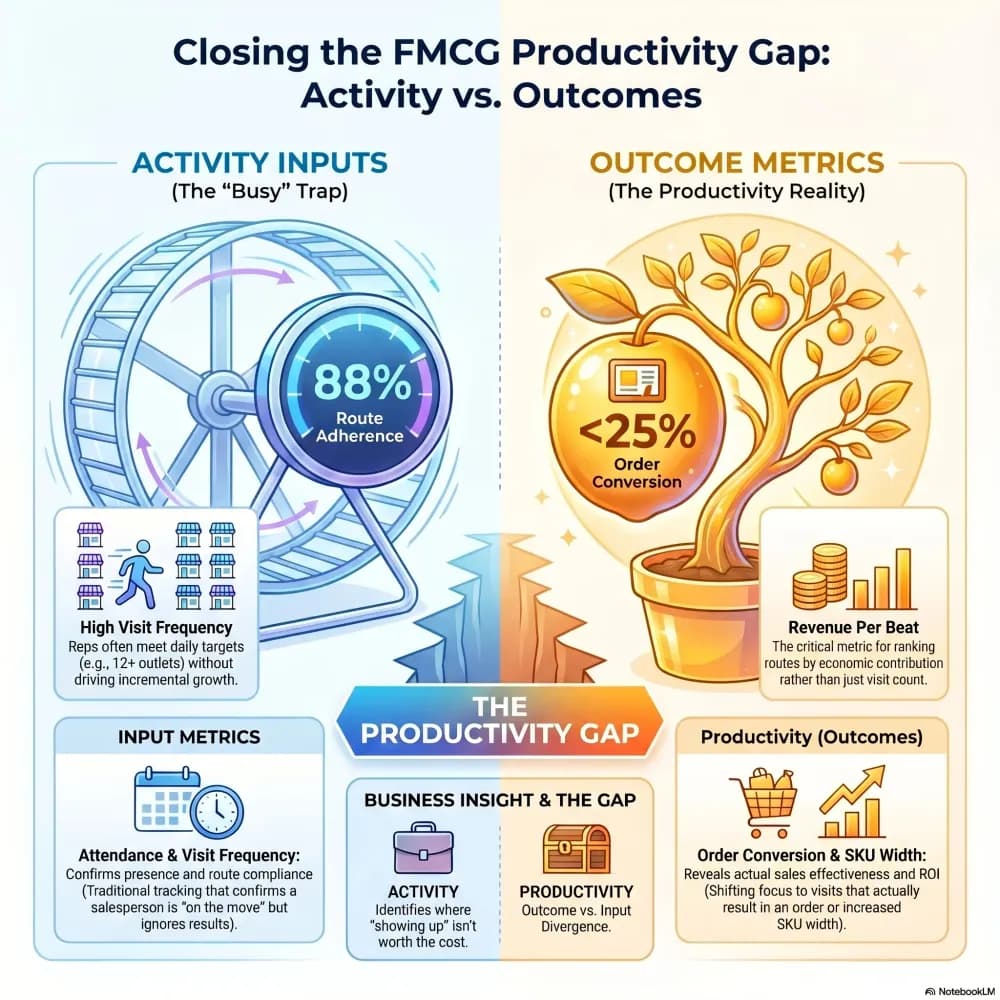
Beat Productivity Analysis: How Top FMCG Brands Optimize Field Force ROI
Your sales team is covering 300 beats a month. But how many of those beats are actually driving orders — and how many are just burning fuel? Here's how the sharpest FMCG brands are figuring that out.

Top 7 Marketing Metrics to Track in 2026 and How AI Simplifies Them
In 2026, track these 7 critical marketing metrics — CLV, CAC, ROAS, Conversion Rate, Engagement, Brand Awareness, and ROI — to prove real business impact instead of vanity stats.

Data-Driven Customer Success: How Real-Time Metrics Reduce Churn
Discover how data-driven customer success teams use real-time metrics, causal analytics, and tools like FireAI to predict churn before it happens and turn insights into retention.