

Quick answer
Marketing teams use analytics to measure channel ROI, track lead quality and cost, optimise budget allocation, and prove marketing's revenue contribution. FireAI connects Google Ads, Meta, CRM, and Tally revenue data into one full-funnel dashboard — with 700+ connectors, NLQ in Hindi/English, and zero code at ₹4,999/month for Indian businesses.
Marketing without analytics is guessing. Marketing with analytics is investing. The difference is whether you know which half of your budget is working — and can act on it.
The Marketing Analytics Hierarchy
Level 1 — Activity metrics (vanity): Impressions, clicks, followers, website visitors. Important for optimisation but meaningless without conversion context.
Level 2 — Engagement metrics (directional): CTR, bounce rate, session duration, scroll depth. Shows what content resonates but not what drives revenue.
Level 3 — Conversion metrics (meaningful): Lead generation rate, cost per lead, lead quality score, proposal requests. Connects marketing activity to sales pipeline.
Level 4 — Revenue metrics (definitive): Cost per acquisition (CPA), marketing-attributed revenue, marketing ROI. Connects marketing directly to business outcomes.
Most marketing teams in India track Levels 1–2 well. Moving to Levels 3–4 is where marketing transforms from a cost centre to a growth function.
Key Marketing Analytics for Indian Businesses
Channel Performance and Budget Allocation
What to track: Cost per lead and cost per acquisition by channel:
- Google Ads (search and display)
- Meta (Facebook/Instagram)
- LinkedIn (especially for B2B)
- Organic (SEO + content)
- Events and trade shows
- Partner/referral
Insight it enables: Shift budget from high-CPL channels to low-CPL channels. If LinkedIn B2B leads convert at 3x the rate of Google leads at 1.5x the cost, LinkedIn is dramatically better ROAS.
Lead Quality Tracking
Not all leads are equal. Marketing analytics should track:
- Lead-to-opportunity conversion rate by source
- Lead-to-customer conversion rate by source
- Time to close by lead source
- Average deal size by lead source
Why it matters: The cheapest lead source is rarely the best. The channel that generates the most qualified, highest-value, fastest-closing leads is the one worth scaling — even if CPL is higher.
Content Performance
What to track: Which content pieces generate leads, not just traffic:
- Content pieces with highest lead capture rate
- Blog posts → lead form conversion
- Gated content download rates and lead quality
- Video completion rate vs lead generation
Marketing Funnel Dashboards
Build a unified funnel view connecting:
- Top of funnel: Impressions, traffic, brand search volume
- Middle of funnel: Leads by source, MQL count
- Bottom of funnel: SQLs, proposals, revenue closed
- Attribution: Which channels influenced the final conversion
Analytics Tools for Indian Marketing Teams
Google Analytics 4: Essential for website and digital content analytics. Free.
Platform native analytics: Google Ads, Meta Ads Manager, LinkedIn Campaign Manager — use these for channel-specific optimisation.
BI tool consolidation: Connect all channels + CRM + revenue data in one dashboard. FireAI connects 700+ data sources — Google Ads, Meta, LinkedIn, CRM, and Tally revenue data — into a single marketing ROI view at ₹4,999/month with no per-user fees.
CRM analytics: Salesforce, Zoho CRM, or HubSpot analytics for pipeline and revenue attribution.
How FireAI Transforms Marketing Analytics for Indian Teams
Indian marketing teams face a unique challenge: ad platform data lives in Google/Meta, leads live in the CRM, and revenue lives in Tally. FireAI bridges all three:
- Full-funnel visibility: Connect Google Ads + Meta + CRM + Tally to see cost-per-acquisition from impression to closed revenue — not just cost-per-lead
- NLQ for marketers: Ask "पिछले महीने LinkedIn से कितने leads आए और उनका conversion rate क्या था?" in Hindi or English
- Zero-code dashboards: The marketing manager builds the dashboard, not the IT team
- 700+ connectors: Google Ads, Meta Ads, LinkedIn, HubSpot, Zoho CRM, Shopify, Razorpay, Tally — all in one place
- ₹4,999/month flat: No per-user multiplication as the marketing team grows
Real impact: A Bangalore-based SaaS company connected Google Ads + HubSpot + Razorpay to FireAI and discovered that their highest-CPL channel (LinkedIn at ₹2,800/lead) had 4x the conversion rate of their cheapest channel (Google Display at ₹400/lead). Shifting 30% of budget to LinkedIn increased marketing-attributed revenue by ₹45 lakhs in a quarter.
5-Step Marketing Analytics Implementation
- Define success metrics: Pick 5 KPIs that connect marketing to revenue (CAC, ROAS, MQL-to-SQL rate, pipeline contribution, marketing-attributed revenue)
- Connect data sources: Link ad platforms, CRM, and Tally to FireAI using pre-built connectors
- Build the funnel dashboard: Map impression → lead → MQL → SQL → customer → revenue
- Set attribution model: Start with last-touch attribution, graduate to multi-touch as data matures
- Weekly review cadence: Marketing + sales review the dashboard together every Monday — shared accountability drives alignment
See how to measure analytics ROI for justifying the marketing analytics investment, and analytics for sales teams to connect marketing and sales data.
Ready to act on your data?
See how teams use FireAI to ask in plain language and get analytics they can trust.
Explore FireAI workflows
Go from this topic into product features and solution paths that match what you read here.
Topic hub
BI Fundamentals
Foundational guides on business intelligence, analytics architecture, self-service BI, and core data concepts.
Explore hubFrequently asked questions
What are the most important marketing metrics to track in India?
The most important marketing metrics for Indian businesses are: cost per lead by channel, lead-to-customer conversion rate, customer acquisition cost (CAC), marketing-attributed revenue, return on ad spend (ROAS) by channel, and brand search volume trend. For B2B Indian companies, also track: LinkedIn engagement and lead quality, content downloads as lead gen, and event/webinar attendance to pipeline conversion.
How do marketing teams measure ROI in India?
Marketing ROI for Indian companies = (Revenue from marketing-influenced customers - Marketing cost) / Marketing cost × 100. The challenge is attribution — tracking which marketing touchpoints influenced a purchase. Multi-touch attribution models (tracking all touchpoints from first ad impression to closed deal) are ideal but complex. Starting with first-touch and last-touch attribution across your major channels gives a practical starting point for comparing channel ROI.
How can marketing teams connect with sales data for full-funnel analytics?
Marketing teams connect with sales data by: (1) using a CRM that both marketing and sales use (leads created in CRM by marketing, updated through pipeline by sales), (2) connecting the CRM to a BI tool like FireAI that shows the full funnel from lead source to closed revenue in Tally, (3) defining shared metrics (MQL criteria, SQL criteria) agreed between marketing and sales. The result is a single dashboard showing marketing's contribution to revenue — from awareness through to closed customer.
What is the best marketing analytics tool for Indian SMBs and startups?
FireAI is ideal for Indian marketing teams — it connects 250+ data sources including Google Ads, Meta, LinkedIn, CRM platforms, and Tally into a single full-funnel dashboard. At ₹4,999/month with no per-user fees, it's far more affordable than enterprise tools. NLQ in Hindi and English means the marketing manager gets answers without SQL. For teams already deep in the Google ecosystem, GA4 + Looker Studio is a free alternative but lacks CRM and revenue integration.
How do Indian D2C brands measure marketing ROI across channels?
Indian D2C brands measure marketing ROI by connecting ad platforms (Google, Meta, Instagram), their e-commerce platform (Shopify, WooCommerce), payment gateway (Razorpay), and Tally into a single dashboard. This shows true cost-per-acquisition including payment gateway fees and returns — not just cost-per-click. FireAI automates this with pre-built connectors, giving D2C founders a real ROAS number by channel, not the inflated numbers ad platforms report.
Related in this topic
What is Data Democratization? Benefits and Challenges
Data democratization enables all employees to access and analyze business data without technical barriers. Learn how data democratization works, which benefits it provides, and how to implement it to transform organizations into data-driven cultures.
Analytics for Sales Teams: Use Data to Hit Targets
Learn how Indian sales teams use analytics to track performance, identify at-risk accounts, prioritise territory coverage, and forecast revenue more accurately. Practical guide for sales managers and heads of sales in Indian businesses.
How to Measure Analytics ROI: A Practical Framework
Learn how to calculate the return on investment (ROI) from your business intelligence and analytics implementation. Use this framework to quantify time saved, decisions improved, and revenue impact from analytics.
What are Business Metrics? Key Metrics to Track
Business metrics are quantifiable measures used to track and assess the performance of a business or business function. Learn the most important business metrics, how to organise them in dashboards, and which ones matter most for Indian SMBs.
From the blog
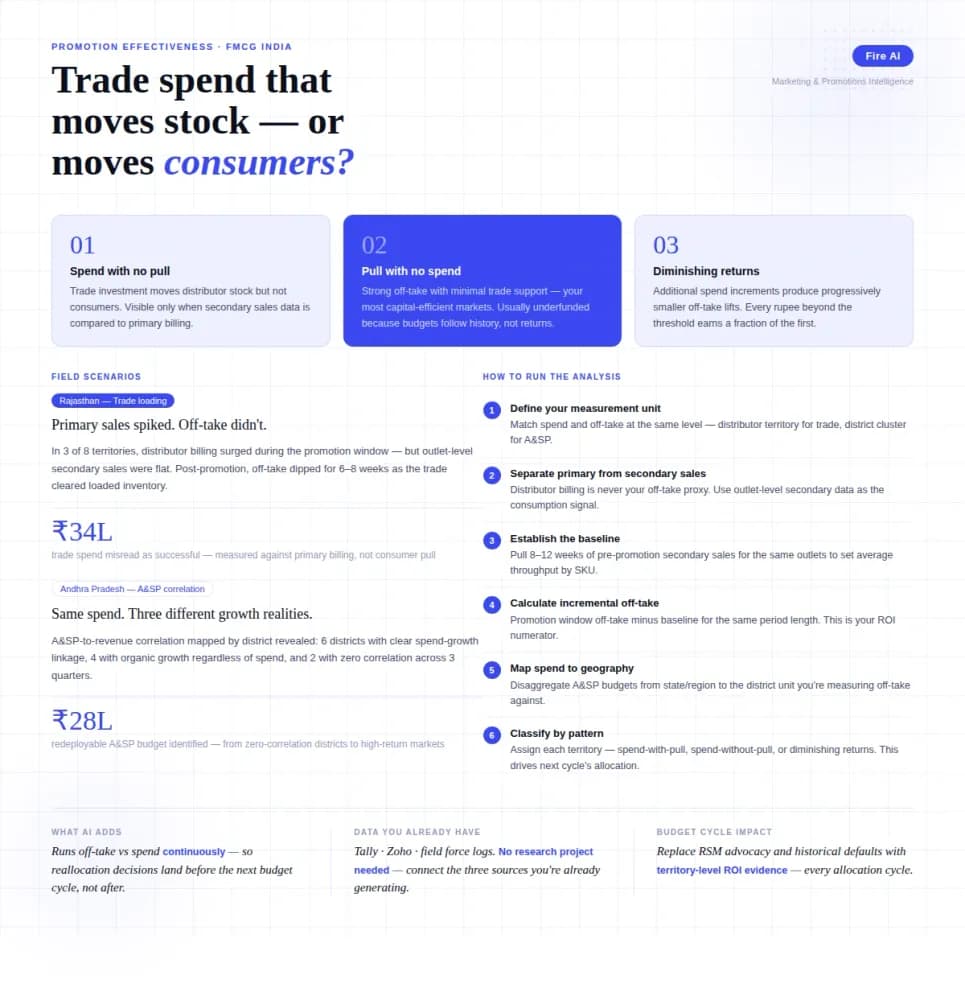
Measuring Promotion Effectiveness: A Data-Driven Guide for FMCG Marketers
FMCG brands in India spend 15–25% of gross revenue on trade promotions and A&SP (advertising and sales promotion) every year. Most can tell you how much they spent. Very few can tell you what it returned. The problem isn't a lack of data — it's that the data lives in disconnected places. Trade spend sits in finance. Off-take data lives with the distributor or field team. A&SP budgets are tracked in a marketing spreadsheet. No single view ties promotional investment to consumer pull at the outlet level. The result is a budget cycle where last year's spend allocation becomes next year's default, because no one has the numbers to argue for something different. This guide walks through how FMCG marketing and trade teams can build a promotion effectiveness framework that actually connects spend to outcome — not just channel-level assumptions.

Democratizing Data: How AI Analytics Levels the Playing Field for Small Businesses and Freelancers
For decades, data-driven decision making was a luxury that only enterprises could afford. Big companies hired data scientists, purchased expensive BI tools, and built complex data warehouses. In exchange, they received precise insights that guided budgets, strategy, and growth.
Dashboard and Data Visualization Best Practices for 2026
12 dashboard and data visualization best practices for Indian businesses: which KPIs to show, which chart to pick, layout rules and mistakes to avoid.