What is AI Forecasting? Machine Learning for Business Predictions
Quick Answer
AI forecasting uses machine learning models — including neural networks, gradient boosting, and ensemble methods — to predict future business outcomes (sales, demand, revenue, costs) with higher accuracy than traditional statistical methods. Unlike rule-based forecasting, AI models automatically learn complex patterns, seasonality, and cross-variable relationships from historical data.
AI forecasting is the application of machine learning to business prediction problems — providing more accurate, adaptive, and scalable forecasts than traditional statistical approaches like moving averages or ARIMA models.
It is a subset of predictive analytics specifically focused on time-series and future-state prediction.
What is AI Forecasting?
AI forecasting uses supervised machine learning models trained on historical business data to predict future values of key metrics:
- Revenue forecasting — what will we sell next quarter?
- Demand forecasting — how much of each product will customers want next month?
- Cost forecasting — how will raw material costs trend next year?
- Cash flow forecasting — what will our cash position look like in 90 days?
- Customer churn forecasting — which customers are at risk of leaving?
Unlike traditional statistical forecasting that applies a fixed formula to historical data, AI forecasting discovers complex patterns — including non-linear relationships, interaction effects, and context-dependent seasonality.
How AI Forecasting Works
Data Preparation
Historical data is collected and prepared:
- Time-series data (sales by day/week/month)
- Contextual variables (promotions, pricing, seasonal events)
- External data (if available — weather, economic indices)
Feature Engineering
Meaningful predictors are extracted from the raw data:
- Lag features (what happened 1 week, 4 weeks, 52 weeks ago)
- Rolling averages and statistical aggregates
- Calendar features (day of week, month, holiday proximity)
- Interaction terms between variables
Model Training
Multiple model types are trained and compared:
- Gradient Boosted Trees (XGBoost, LightGBM) — excellent for tabular business data
- Neural Networks (LSTM, Transformer) — better for complex sequential patterns
- Ensemble methods — combine multiple models for robust predictions
Validation and Calibration
Models are validated on held-out historical periods to measure accuracy (MAPE, RMSE). The best-performing model or ensemble is selected.
Continuous Learning
As new data arrives, AI forecasting models update automatically — adapting to demand shifts, new seasonality patterns, and changing business conditions.
AI Forecasting vs Traditional Statistical Forecasting
| Aspect | Traditional Forecasting | AI Forecasting |
|---|---|---|
| Method | Fixed algorithms (ARIMA, ETS) | Learned patterns (ML models) |
| Variables | 1–2 variables typically | Dozens of variables |
| Non-linearity | Limited | Handles complex non-linear patterns |
| Adaptability | Requires manual recalibration | Self-updating with new data |
| Scalability | Manageable | Handles thousands of series |
| Explainability | High | Moderate (varies by model type) |
| Accuracy | Good for simple patterns | Better for complex patterns |
Business Applications of AI Forecasting
Sales forecasting: AI predicts next quarter's revenue by salesperson, product, and region — accounting for seasonality, promotional plans, and historical win rates.
Demand planning: AI generates SKU-level demand forecasts for inventory decisions — preventing both stockouts and overstock. See demand forecasting for details.
Cash flow forecasting: AI models receivables collection timing, payables, and revenue to project cash position weeks ahead — enabling proactive treasury management.
Budget forecasting: AI provides bottom-up forecasts that integrate into the annual budget process, reducing reliance on manual estimates.
AI Forecasting for Indian Businesses
For Indian businesses, AI forecasting adds specific value:
- Festival seasonality modelling — Diwali, Holi, and regional festivals create sharp demand spikes that AI captures better than manual seasonality adjustments
- GST filing and year-end effects — March-end purchase spikes are learned by AI models
- Regional variation — AI builds separate models per region without manual configuration
Platforms like FireAI connect to Tally data and provide AI forecasting capabilities directly from your existing transaction history — no data engineering or separate forecasting tool required.
See can AI predict sales trends for the specific sales forecasting capability.
Explore FireAI Workflows
Jump from the concept on this page into the product features and solution paths most relevant to it.
AI Analytics
Guides on natural language querying, AI-powered analytics, forecasting, anomaly detection, and automated insights.
Ready to Transform Your Business Data?
Experience the power of AI-powered business intelligence. Ask questions, get insights, make better decisions.
Frequently Asked Questions
Yes, for most business forecasting applications. AI models outperform traditional methods when there are complex patterns, multiple interacting variables, or non-linear relationships in the data. For simple, stable demand with few variables, traditional methods remain competitive and are more interpretable.
AI forecasting generally requires 2–3 years of historical data to learn seasonal patterns and trend direction. A minimum of 12 months is needed, but accuracy improves significantly with more data. For new products or markets without history, AI models use analogous product data or hybrid approaches.
Predictive analytics is the broader category — using any data-based method to predict future outcomes. AI forecasting is a specific technique within predictive analytics that uses machine learning models (as opposed to statistical regression or rule-based methods) to generate forecasts.
Yes. AI models trained on sufficient historical data learn India-specific patterns including Diwali demand spikes, Holi seasonality, post-monsoon recovery, and March year-end effects. These seasonal patterns are automatically incorporated into forecasts without manual configuration.
Related Questions In This Topic
What is Predictive Analytics? Methods, Examples, and Business Applications
Predictive analytics uses statistical algorithms and machine learning to forecast future outcomes based on historical data. Learn how predictive modeling works, which methods are used, and how businesses apply it for sales forecasting, risk management, and strategic planning.
What is Demand Forecasting? Methods, Benefits, and How AI Improves It
Demand forecasting predicts future customer demand for products or services using historical data, statistical methods, and AI. Learn the types of demand forecasting, which methods work best, and how AI improves forecast accuracy for Indian businesses.
Can AI Predict Sales Trends? Accuracy, Methods, and Use Cases
Yes, AI can predict sales trends by analyzing historical sales, seasonality, customer behavior, and external signals. Learn how AI sales forecasting works, which models are used, and how accurate predictions can be.
What is Agentic Analytics? AI Agents for Autonomous Business Intelligence
Agentic analytics uses autonomous AI agents to proactively analyze data, surface insights, trigger alerts, and take actions without human prompting. Learn how agentic AI differs from traditional BI, and what it means for business decision-making.
Related Guides From Our Blog
Power BI Alternatives: 5 AI-Driven BI Tools for Smarter Insights in 2025
This 2025 blog compares 5 AI-powered alternatives to Power BI, showing why traditional dashboards are no longer enough for fast, confident decisions. It positions Fire AI as the leading “decision intelligence” layer that delivers natural-language answers, root causes, predictions, and actions — without analyst bottlenecks.
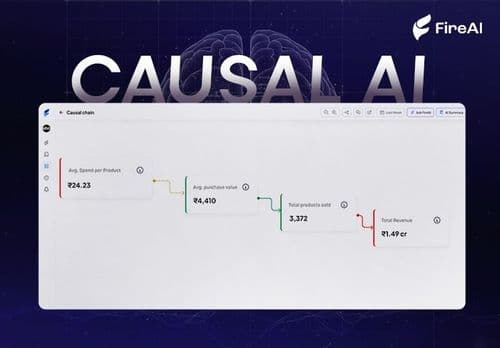
Causal AI Explained: Uncovering the “Why” in Data with Machine Learning
Causal AI reveals not just what will happen, but why — and exactly what changes if you act differently. It turns predictions into high-ROI decisions by uncovering true cause-and-effect in your data.

Key Trends Shaping the Future of AI-Powered Business Intelligence
Discover how AI-enabled analytics like Fire AI are transforming business intelligence with real-time dashboards, anomaly detection, and decision intelligence.