

Quick answer
Outlet-level analytics measures sales, stock, service, and compliance for each store or trade outlet, then compares locations and rolls results up by route, territory, or region. It uses POS, distributor (DMS), or field-visit data so teams see which outlets over- or under-perform instead of hiding weak units in national averages.
Outlet-level analytics is the discipline of treating every store, kiosk, or trade counter as its own unit of performance: score the location, compare it to peers, and aggregate upward into routes and territories. Company-level revenue can look fine while a large share of outlets drags margin, stock, or compliance. Outlet analytics makes that visible with consistent metrics and hierarchies (outlet → beat → territory → region) so sales, supply chain, and operations act on the same picture.
This page defines what to measure at the outlet, how benchmarking works, and how results roll into territory views. For FMCG and general trade, pair it with FMCG sales and distribution use cases. For chains and franchise networks, see food and beverage multi-outlet analytics.
What “Outlet” Means Across Retail and FMCG
An outlet is the point where the customer or retailer transaction happens: a branded store, a modern trade shelf, a distributor-serviced shop, or a franchise unit. The data source changes (POS, billing, DMS stockist sell-out, van sales) but the analytical idea is the same: attribute volume, margin, and behavior to the location that generated them.
In India, outlet analytics often combines:
- Modern trade and retail chains where POS or ERP captures SKU-level sales by store
- General trade and distributor-led FMCG where secondary sales, stockist, and beat data represent “outlet” performance
- Food and beverage where each physical or virtual kitchen location is an outlet in a multi-brand or franchise network
Without outlet grain, teams answer “how is the company doing?” but not “which 20% of outlets drive 80% of the problem?”
Core Store and Outlet Performance Metrics
Outlet scorecards blend revenue, productivity, inventory, and execution so one number does not dilute another.
Typical measures include:
- Net sales and growth by outlet, normalized for seasonality or local events where data allows
- Volume, value, and mix (category and SKU contribution) to see whether an outlet wins on traffic, ticket size, or specific products
- Inventory and availability such as days of cover, out-of-stock rate, and expiry risk for perishables
- Productivity: sales per square foot, transactions per day, or sales per field visit in controlled-distribution models
- Margin contribution when cost and scheme data exist at outlet or route level
Point of sale and billing data anchor many of these metrics. For a broader retail context, retail analytics in India covers the national landscape; this page stays on the outlet as the atomic unit.
Benchmarking Outlets Fairly
Benchmarking ranks or clusters outlets on comparable bases so “best” and “worst” lists reflect management, not structural luck.
Strong outlet-level analytics:
- Segments outlets by format (flagship vs compact), catchment (mall vs high street), or region before comparing KPIs
- Uses peer groups such as same city tier, similar store age, or same distributor cluster for FMCG
- Tracks variance from target or from the median of the peer group, not only from last year’s number
Fair benchmarks prevent punishing a small rural outlet for lower absolute sales when its share of local potential is strong, and they stop noisy single-metric rankings (for example, sales up but margin down).
Territory and Hierarchy Aggregation
Territory aggregation rolls outlet results into beats, routes, ASM or RSM views, and regions so leadership can coach and allocate resources.
Common patterns:
- Roll-up rules that sum sales, average rates, or weighted KPIs correctly when outlets change hands or split
- Coverage and visit metrics from field force systems that tie field force analytics to outlet outcomes
- Exception queues that list outlets breaching thresholds (stock, scheme, SLA) for the territory owner
Franchise and multi-outlet operators often add same-store or like-for-like logic so new openings do not mask weak existing outlets. Franchise analytics goes deeper on franchised F&B networks; the outlet lens here applies to any multi-location retail or distribution model.
How FireAI Supports Outlet-Level Analytics
FireAI connects POS, Tally or ERP, DMS, and CRM or field data so outlet and territory dashboards stay current without manual consolidation.
Typical outcomes:
- Outlet and store scorecards with filters for format, region, and time period
- Benchmark and peer-group views that reduce unfair comparisons
- Territory roll-ups aligned to how your organization defines beats and regions
- Conversational questions in plain language, for example which outlets dropped below median sell-out for two consecutive weeks in a territory
Teams use this to prioritize visits, stock, trade spend, and corrective action where the data says the pain is, not only where reporting is easiest.
Outlet Analytics vs Only National or Brand Dashboards
National or brand-level dashboards answer executive questions at a high level. Outlet-level analytics answers which locations need intervention, which routes to re-segment, and where inventory or schemes leak. Both are useful; they answer different decisions. If you only have the first, you optimize headlines while the floor still has silent underperformers.
Ready to act on your data?
See how teams use FireAI to ask in plain language and get analytics they can trust.
Explore FireAI workflows
Go from this topic into product features and solution paths that match what you read here.
Topic hub
Industry Analytics In India
Comparison pages and implementation guidance for industry-specific BI, dashboards, and analytics use cases in India.
Explore hubFrequently asked questions
What is outlet-level analytics?
Outlet-level analytics measures performance for each store, trade counter, or serviced location using sales, inventory, productivity, and execution data. It compares outlets to peers and aggregates results into routes and territories so weak or strong units are visible instead of blended into company averages.
Why is outlet analytics important for FMCG and retail?
FMCG and retail margin and growth often depend on a long tail of outlets. Analytics at outlet grain shows stockouts, scheme effectiveness, and sell-out quality by location, which national totals cannot. That drives where to send the field force, inventory, and trade investment.
How do you benchmark retail outlets fairly?
Fair benchmarking uses peer groups with similar format, region, and catchment, then compares KPIs like growth, margin, and availability within those groups. It avoids ranking a small rural outlet only on absolute sales when a fairer measure is share of local potential or performance versus peer median.
How can FireAI help with outlet and territory reporting?
FireAI brings together POS, billing, Tally, DMS, and field data into dashboards and natural-language analytics so teams build outlet scorecards, benchmark stores, and roll up to territory hierarchies without rebuilding spreadsheets each cycle.
Related in this topic
Retail Analytics in India: Key Metrics & Dashboards
Retail analytics in India covers store-level sales tracking, footfall conversion, inventory turns, and category management. Learn key metrics and dashboards for Indian retail.
What Is Franchise Analytics for F&B Chains?
Franchise analytics helps food and beverage chains track same-store growth, benchmark outlets, monitor royalties, and allocate central kitchen costs. Learn what to measure and how FireAI supports multi-outlet F&B analytics in India.
What Is Field Force Analytics in FMCG? Metrics & Meaning
Field force analytics in FMCG measures how sales teams perform in the field: visits, outlet coverage, orders per call, and productivity. Learn the core metrics and how FireAI builds dashboards from DMS and CRM data.
FMCG Analytics in India: Sales & Distribution
FMCG analytics in India covers secondary sales tracking, distributor performance, beat coverage, and retailer segmentation. Learn key metrics for Indian FMCG companies.
From the blog
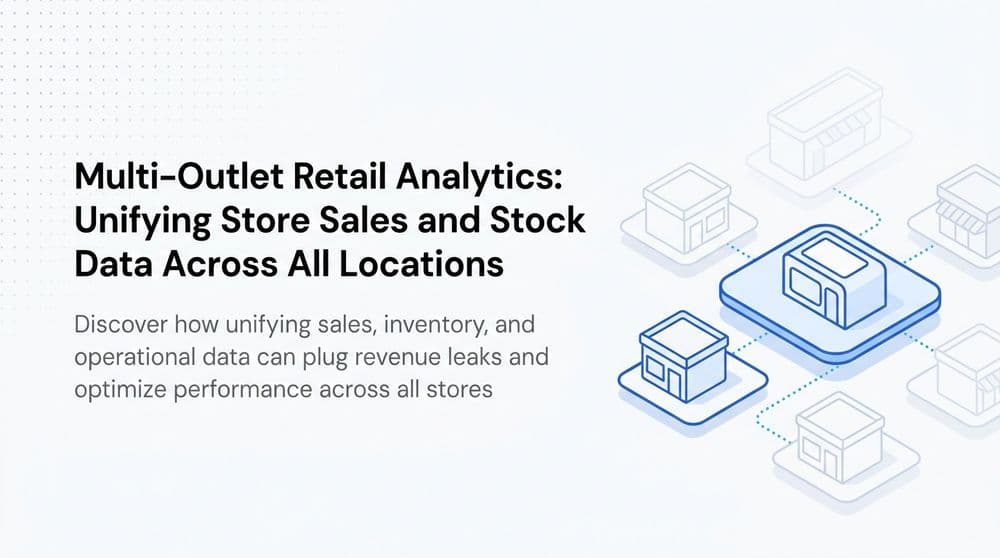
Multi-Outlet Retail Analytics: Track Store Sales
Track sales, stockouts, and staff performance across all stores. Learn how multi-outlet retail analytics can find the root cause of revenue leaks.
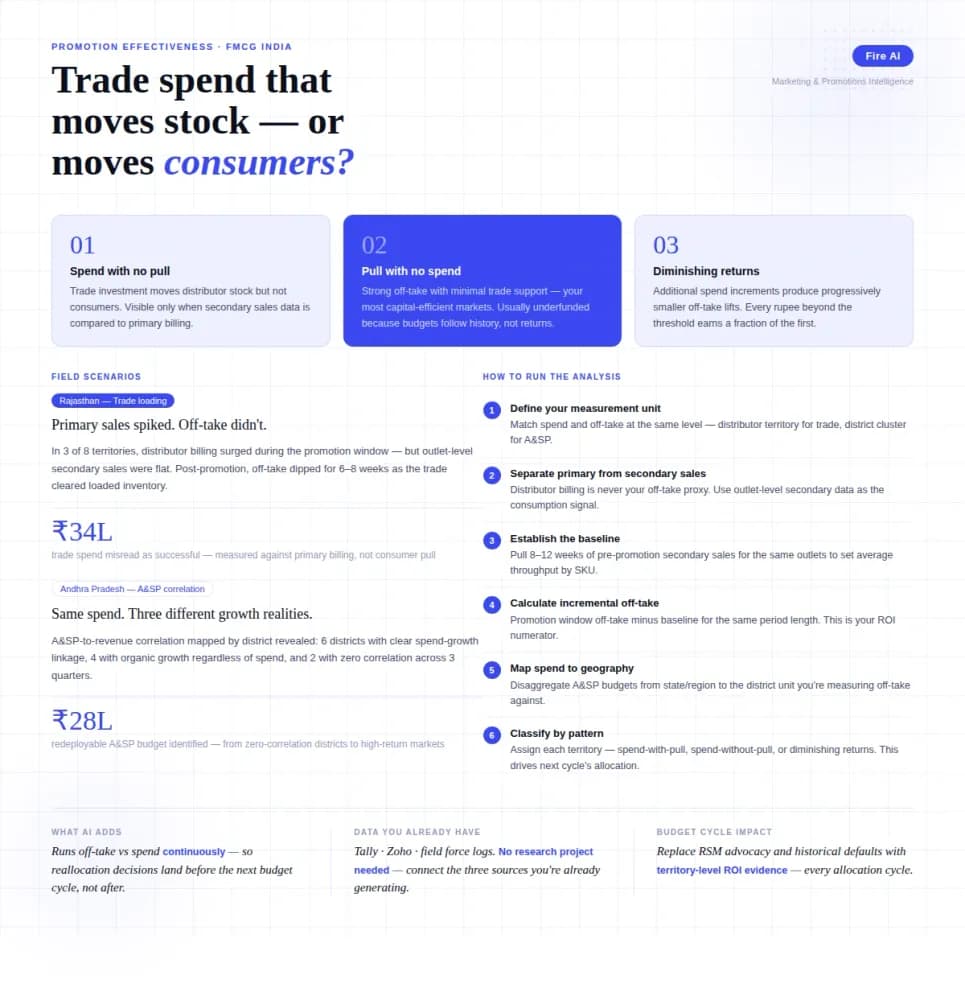
Measuring Promotion Effectiveness: A Data-Driven Guide for FMCG Marketers
FMCG brands in India spend 15–25% of gross revenue on trade promotions and A&SP (advertising and sales promotion) every year. Most can tell you how much they spent. Very few can tell you what it returned. The problem isn't a lack of data — it's that the data lives in disconnected places. Trade spend sits in finance. Off-take data lives with the distributor or field team. A&SP budgets are tracked in a marketing spreadsheet. No single view ties promotional investment to consumer pull at the outlet level. The result is a budget cycle where last year's spend allocation becomes next year's default, because no one has the numbers to argue for something different. This guide walks through how FMCG marketing and trade teams can build a promotion effectiveness framework that actually connects spend to outcome — not just channel-level assumptions.
Best AI Analytics Platforms in India (2026): An Honest Comparison
An honest comparison of 7 AI analytics platforms for Indian businesses: FireAI, Power BI Copilot, ThoughtSpot, Tableau, Zoho Analytics, Tellius and Julius AI.