

Quick answer
D2C brands need unit economics tracking because rising acquisition costs, hidden fulfilment and returns costs, uneven channel profitability, and fast scaling can turn revenue growth into cash burn. Measuring CAC, LTV, payback period, and order-level contribution margin shows whether each customer strengthens the model. Tracking before scaling spend or channels protects runway.
Direct-to-consumer brands live in a paradox: dashboards show revenue climbing while profit and cash quietly deteriorate. Unit economics tracking makes the causal link visible. It connects every rupee spent on acquiring and serving customers to the margin returned, so founders and finance teams stop mistaking GMV spikes for durable health.
This page focuses on four reasons disciplined tracking matters now in India’s D2C market, separate from defining the formulas (see what unit economics means for D2C). For tactical finance workflows, browse D2C e-commerce finance use cases.
CAC inflation: paid growth gets expensive before you notice
Acquisition costs on Meta, Google, and vertical marketplaces creep up as auctions tighten and creatives fatigue. Brands that report only blended CAC or monthly averages hide channel-level bleed until budgets are locked for the quarter.
Why tracking fixes it: When CAC updates by cohort, SKU, campaign, and week, brands reallocate creative and channel spends while there is still room to fix efficiency. Connecting ad spend exports and order attribution in one analytics layer turns “CAC feels high” into an answerable diagnosis.
Hidden costs beyond ad spend erase apparent gross margin
Fulfilment, packaging, COD failures, marketplace fees, refunds, replacements, loyalty discounts, and working capital tied to inventory can strip margin off orders that looked healthy at list price.
Why tracking fixes it: Order-level economics force every cost that travels with an order onto the contribution view. That is where “₹900 AOV feels great” collapses once returns, COD charges, and platform commissions land. Transparent waterfalls stop finance and growth from arguing past each other because the numerator and denominator align on the same fulfilled order reality.
Channel-level profitability: what wins on rankings can lose money
Marketplaces chase visibility; D2C sites chase subscriptions; quick commerce pushes velocity. Treating blended revenue masks which channels subsidize others. A channel can grow share while shrinking margin per incremental rupee sold.
Why tracking fixes it: Splitting acquisition cost, fulfilment economics, fees, and repeat behaviour by storefront (own site versus Amazon versus Flipkart versus quick commerce) shows where to tighten terms, SKU mix, or pricing. Platforms like FireAI can blend Shopify exports, marketplace payout files, and ad data so profitability is comparable across storefronts rather than stranded in spreadsheets.
Scaling without economics is how promising brands burn runway
When unit contribution is ambiguous, companies scale warehouse space, SKU count, and headcount alongside top line. Negative unit economics amplified by ops leverage turns into a funding gap faster than spreadsheets predict.
Why tracking fixes it: Payback period and LTV by cohort clarify whether doubling down on retention, organic, or a single strong channel earns back acquisition spend before liquidity tightens. It is easier to defer expansion or tighten discounting when dashboards show cumulative cash recovery per cohort, not just monthly revenue slabs.
How FireAI aligns with disciplined D2C unit economics
Many Indian D2C teams already have data in Shopify, marketplace seller centres, spreadsheets, and Tally exports. FireAI concentrates that into living dashboards so marketing, commerce, and finance share one operational truth. Business users ask questions in conversational language (“Which Pin code cohorts have LTV twelve below CAC?”) instead of stitching pivot tables nightly.
Unlike generic BI that stops at aggregates, tying orders, fees, and acquisition spend closes the gap between marketed offers and fulfilled margin outcomes. For a broader SMB angle on why measurement matters, see why Indian businesses need BI.
When prioritizing unit economics should move to the front of your roadmap
- You are opening new storefronts or going deeper on sponsored listings without separating blended from incremental margin per channel.
- CAC dashboards exist in Ads Manager but reconciliation to net orders is quarterly or manual.
- Returns or cancellation rates climbed but pricing and promotions stayed aggressive.
- You are fundraising or bridging with working capital tied to aged inventory growth.
If several bullets apply, unit economics tracking is less about investor decks and more about day-to-day survival and sustainable scale.
Ready to act on your data?
See how teams use FireAI to ask in plain language and get analytics they can trust.
Explore FireAI workflows
Go from this topic into product features and solution paths that match what you read here.
Topic hub
BI Fundamentals
Foundational guides on business intelligence, analytics architecture, self-service BI, and core data concepts.
Explore hubFrequently asked questions
Why should D2C brands track unit economics?
How is this different from reviewing monthly GMV?
What is often missed without order-level economics?
Can small D2C teams track this without analysts?
Related in this topic
What is Unit Economics? CAC, LTV & Payback Period
Unit economics measures revenue and cost per customer or order. Learn CAC, LTV, payback period and contribution margin for D2C and e-commerce.
D2C Analytics India: What Top Brands Actually Track
D2C analytics in India covers customer acquisition, retention, unit economics and attribution. Learn the key KPIs and dashboard applications.
Profitability Analytics: Product, Customer & Channel P&L
Profitability analytics explains which products, customers, channels, and geographies actually contribute margin. See key metrics and practical uses.
What Is Marketplace Analytics for D2C? GMV, Ads & Reviews
Marketplace analytics helps D2C brands track Amazon and Flipkart GMV, search rank, sponsored ad ROI, reviews and seller performance.
From the blog
Why Indian SMBs Are Switching from Excel to AI-Powered BI in 2026
Indian SMBs manage crores on Excel. Here is why 2026 is the year that changes - and what AI-powered BI gives you that no spreadsheet ever can.
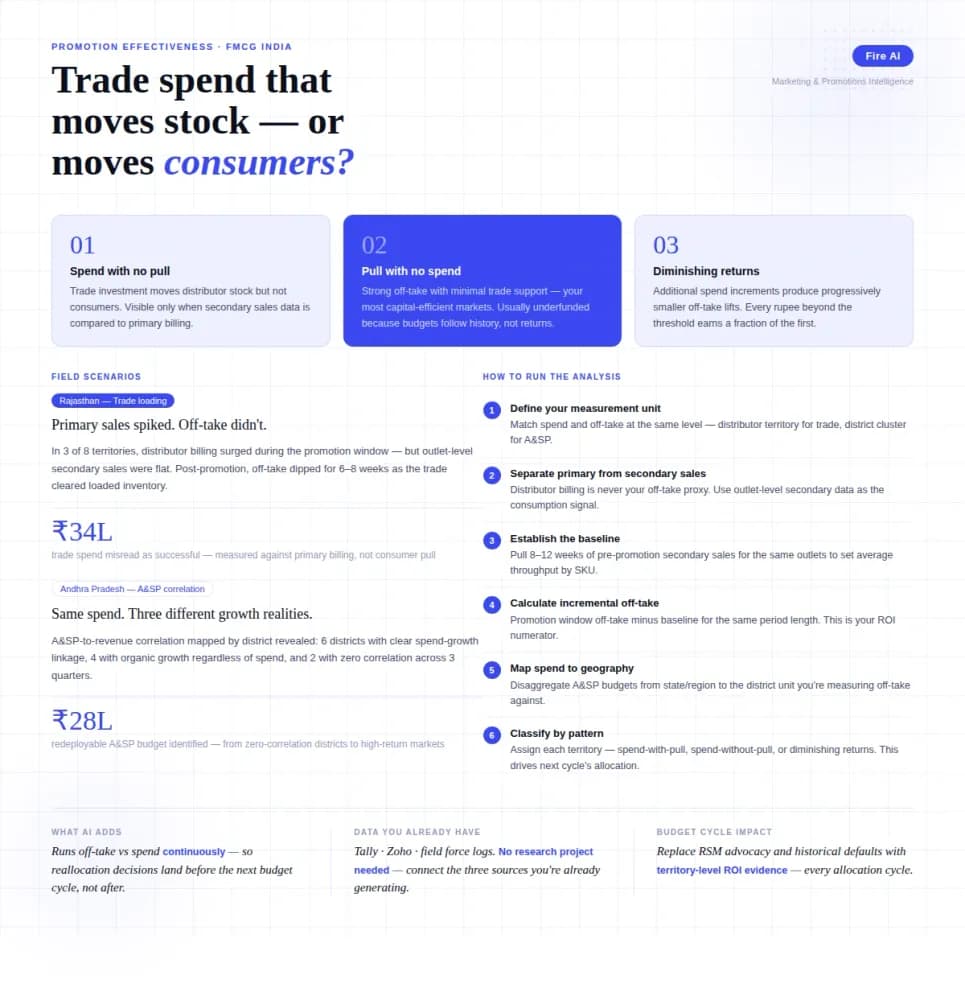
Measuring Promotion Effectiveness: A Data-Driven Guide for FMCG Marketers
FMCG brands in India spend 15–25% of gross revenue on trade promotions and A&SP (advertising and sales promotion) every year. Most can tell you how much they spent. Very few can tell you what it returned. The problem isn't a lack of data — it's that the data lives in disconnected places. Trade spend sits in finance. Off-take data lives with the distributor or field team. A&SP budgets are tracked in a marketing spreadsheet. No single view ties promotional investment to consumer pull at the outlet level. The result is a budget cycle where last year's spend allocation becomes next year's default, because no one has the numbers to argue for something different. This guide walks through how FMCG marketing and trade teams can build a promotion effectiveness framework that actually connects spend to outcome — not just channel-level assumptions.
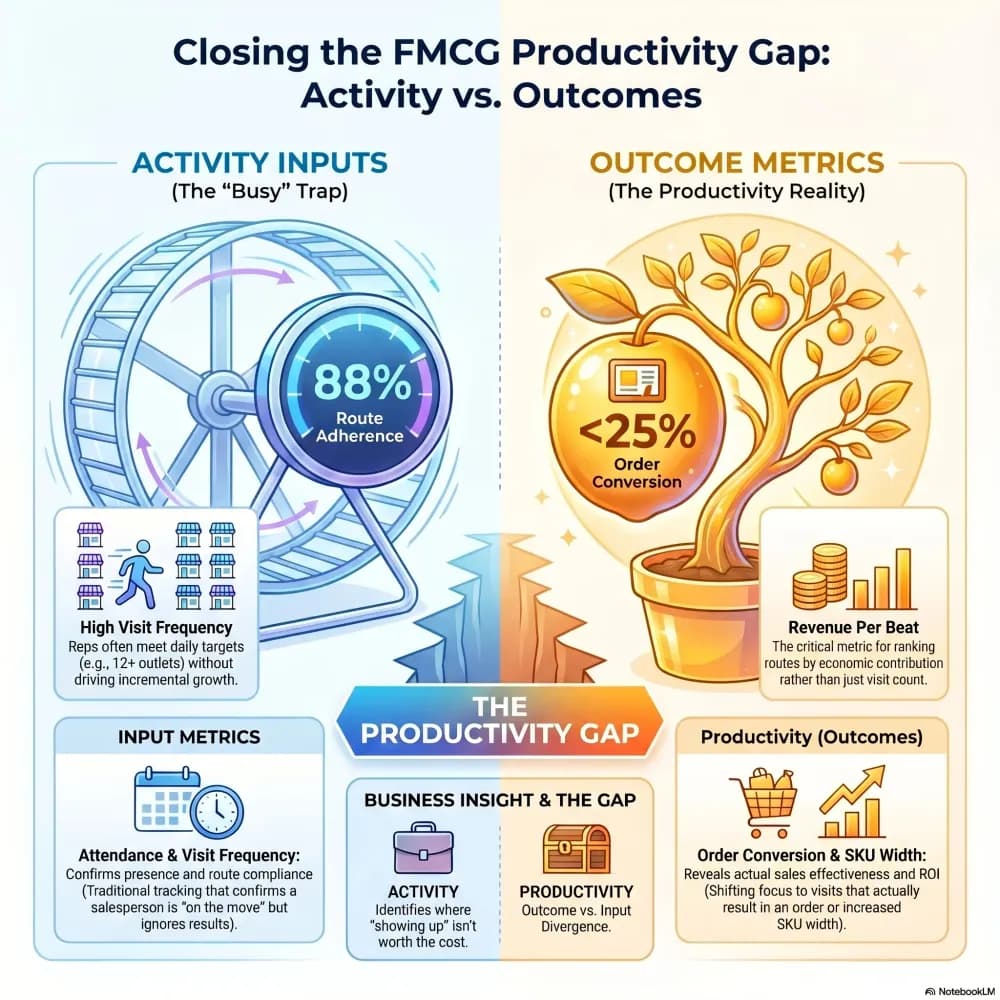
Beat Productivity Analysis: How Top FMCG Brands Optimize Field Force ROI
Your sales team is covering 300 beats a month. But how many of those beats are actually driving orders — and how many are just burning fuel? Here's how the sharpest FMCG brands are figuring that out.