

Quick answer
Yes — AI automates GST reconciliation by connecting to Tally Prime via FireAI's one-click connector, extracting purchase and sales vouchers, and matching them against GSTR-2B data automatically. Invoice mismatches, GSTIN errors, and ITC discrepancies are flagged instantly — reducing what takes 2–4 days manually to minutes of review.
Yes — AI can automate GST reconciliation from Tally data, reducing what typically takes 2–4 days of manual work to a few minutes of review. The AI matches your Tally books against GSTN portal data, flags discrepancies, and highlights ITC at risk — so your team spends time fixing issues, not finding them.
GST reconciliation is one of the most painful compliance tasks for Indian businesses. Every month, accountants must verify that the GST data in their Tally books matches what appears on the GSTN portal (GSTR-2B for purchases, GSTR-1 for sales). Any mismatch can result in ITC denial, interest, or penalties. AI makes this process dramatically faster and more reliable.
Once reconciliation is automated, finance teams can also track mismatch and ITC patterns over time with trend analysis — useful for audits and process improvement.
What GST Reconciliation Involves
The Manual Process (Without AI)
- Export GSTR-2B from the GST portal as Excel
- Export purchase register from Tally as Excel
- Manually compare each invoice — check GSTIN, invoice number, date, taxable value, CGST, SGST, IGST
- Flag mismatches — missing invoices, amount differences, GSTIN errors
- Follow up with vendors — request corrections or re-uploads
- Reconcile GSTR-1 vs GSTR-3B — verify outward supply consistency
- Document everything for audit trail
For a business with 500+ invoices per month, this takes 2–4 full working days.
The AI-Automated Process (with FireAI)
- One-click Tally connection — FireAI's native Tally connector syncs purchase and sales vouchers with GST details automatically. Zero-code setup, no ODBC drivers
- Upload or connect GSTR-2B — the AI reads GSTN data
- Automatic matching — AI matches invoices on GSTIN, invoice number, date, and amounts using real-time auto-synced data
- Instant mismatch report — categorised by type (missing, amount difference, rate difference, GSTIN mismatch) on pre-built GST dashboard templates
- ITC risk assessment — AI calculates how much ITC is at risk due to mismatches
- NLQ-powered investigation — ask "Which vendors have the most GSTR-2B mismatches?" in plain English and get instant visual answers
- Action items generated — specific follow-ups for each vendor/invoice
Total time: 15–30 minutes of review instead of 2–4 days of manual work.
Types of Mismatches AI Detects
| Mismatch Type | Description | ITC Impact |
|---|---|---|
| Missing in GSTR-2B | Invoice exists in your Tally books but vendor hasn't uploaded to GSTN | ITC at risk — cannot claim until vendor files |
| Missing in books | Invoice appears in GSTR-2B but not in your Tally purchase register | Potential unbooked purchase — investigate |
| Amount difference | Taxable value or tax amount differs between books and GSTR-2B | Partial ITC mismatch — needs correction |
| GSTIN mismatch | Vendor GSTIN in Tally doesn't match GSTR-2B | Invoice won't reconcile — verify correct GSTIN |
| Tax rate difference | CGST/SGST/IGST rate applied differently | Could indicate misclassification — review HSN |
| Duplicate invoices | Same invoice number appearing multiple times | Overstated ITC claim risk |
How AI Improves Reconciliation Accuracy
Fuzzy Matching
Human comparison is exact — if an invoice number has a leading zero in one system and not the other, a human might miss the match. AI uses fuzzy matching to identify likely matches despite minor formatting differences.
Pattern Recognition
AI learns your vendor patterns:
- Vendor A consistently uploads invoices 5 days late — the AI adjusts expectations
- Vendor B frequently has small rounding differences — the AI groups these separately from material mismatches
- Vendor C has a history of GSTIN errors — the AI flags their invoices for priority review
Historical Trend Analysis
AI tracks your reconciliation metrics over time:
- Match rate improving or declining?
- Which vendors cause the most mismatches?
- How much ITC is at risk each month?
- Average time to resolve mismatches
GSTR-1 vs GSTR-3B Reconciliation
AI also reconciles your own filings:
| Check | What AI Verifies |
|---|---|
| Total outward supplies | GSTR-1 taxable value matches GSTR-3B Table 3.1 |
| Zero-rated supplies | Export invoices in GSTR-1 match GSTR-3B Table 3.1(b) |
| Nil-rated supplies | Exempt supplies consistent across both returns |
| Tax liability | CGST + SGST + IGST in GSTR-1 matches GSTR-3B Table 3 |
| ITC claimed | ITC in GSTR-3B matches available credit from GSTR-2B |
Discrepancies between GSTR-1 and GSTR-3B are a common trigger for GST notices. AI catches these before filing.
What You Need to Get Started
From Tally Side
- Tally Prime (or ERP 9) with complete purchase and sales data
- GST details properly entered on vouchers — party GSTIN, HSN codes, tax rates
- Bill-wise details enabled for accurate invoice matching
From GSTN Side
- GSTR-2B download for the reconciliation period
- GSTR-1 data for outward supply verification
From the AI Platform (FireAI)
- One-click native Tally connector with real-time auto-sync — no middleware or manual exports
- Pre-built GST reconciliation dashboard templates ready out of the box
- GSTR-2B upload capability or direct GST portal integration
- Natural language queries (NLQ) to investigate mismatches — ask "Show ITC at risk from vendor non-compliance" and get instant answers
- Reconciliation engine with mismatch categorisation and vendor compliance scoring
Impact on Indian Businesses
Time Savings
| Business Size | Monthly Invoices | Manual Time | AI-Automated Time |
|---|---|---|---|
| Small (under ₹5 Cr turnover) | 100–300 | 1–2 days | 30 minutes |
| Medium (₹5–50 Cr) | 300–2,000 | 2–4 days | 1–2 hours |
| Large (₹50 Cr+) | 2,000–10,000+ | 1–2 weeks | Half a day |
ITC Recovery
Businesses typically discover 2–5% of ITC that was either missed or at risk through proper reconciliation. For a business with ₹50 lakh annual ITC, that's ₹1–2.5 lakh recovered.
Compliance Confidence
Automated reconciliation before filing means fewer GSTN notices, no penalty risk for ITC mismatches, and clean audit trails for departmental reviews.
Limitations to Be Aware Of
- AI matches what exists in data — if invoices are fundamentally missing from both systems, AI won't flag them
- Vendor compliance is outside your control — AI can identify that a vendor hasn't uploaded, but can't force them to
- Initial setup requires clean master data — GSTINs and HSN codes in Tally should be accurate for best results
The Bottom Line
AI doesn't just automate GST reconciliation — it transforms it from a dreaded monthly chore into a quick review process. The matching happens automatically, mismatches are categorised and prioritised, and your team focuses on resolution rather than detection. For any Indian business running Tally with 100+ monthly invoices, this is one of the highest-ROI applications of AI analytics.
Connect your Tally data to FireAI with the one-click Tally connector — your first GST reconciliation dashboard is ready the same day, with zero coding required. For a ₹20 crore trading business processing 1,000+ invoices monthly, automated reconciliation typically recovers ₹2–5 lakhs in ITC annually that manual processes miss.
Ready to act on your data?
See how teams use FireAI to ask in plain language and get analytics they can trust.
Explore FireAI workflows
Go from this topic into product features and solution paths that match what you read here.
Topic hub
Tally Analytics
Analytics for Tally Prime and Tally ERP — one of 700+ data sources FireAI connects to — including dashboards, reporting, GST, and finance workflows.
Explore hubFrequently asked questions
Can AI match Tally purchase data against GSTR-2B automatically?
Yes. FireAI's one-click Tally connector extracts purchase vouchers with GSTIN, invoice number, date, and tax amounts automatically via real-time auto-sync. It then matches this data against GSTR-2B, flagging mismatches by category — missing invoices, amount differences, GSTIN errors, and rate discrepancies — all on pre-built dashboard templates.
How much time does AI GST reconciliation save compared to manual?
For a medium-sized business with 300–2,000 monthly invoices, manual reconciliation takes 2–4 days. With FireAI's automated matching, this drops to 1–2 hours of review. The AI handles matching; your team only reviews and resolves flagged mismatches.
Does AI reconciliation help recover missed ITC?
Yes. Automated reconciliation typically uncovers 2–5% of ITC that was either not claimed or at risk due to vendor non-compliance. For a business with ₹50 lakh annual ITC, that's ₹1–2.5 lakh recovered per year. FireAI flags these gaps before filing so you can follow up with vendors in time.
Can I set up GST reconciliation from Tally without any coding or IT team?
Yes. FireAI's zero-code setup connects to Tally Prime in minutes — no ODBC drivers, no API configuration, no IT team required. Pre-built GST dashboard templates are ready immediately after connection. You can also use natural language queries to investigate mismatches, like "Which vendors have ITC at risk this month?"
How does AI GST reconciliation help avoid GST notices and penalties?
AI catches GSTR-1 vs GSTR-3B discrepancies, ITC claims without corresponding GSTR-2B entries, and invoice mismatches before you file — exactly the issues that trigger automated GSTN notices. For a ₹10 crore turnover business, avoiding even one penalty notice can save ₹50,000–₹2 lakhs in interest and legal costs.
Related in this topic
Tally Analytics: Turn Tally Data into Dashboards & Reports
Get AI-powered analytics and dashboards from Tally Prime data without SQL. FireAI connects to Tally for live GST, sales, inventory, and P&L—no spreadsheet exports.
Tally GST Analytics: Compliance, Returns & ITC Tracking
Use Tally GST analytics to track GSTR-1, GSTR-3B filings, ITC reconciliation, and compliance status from your Tally Prime data. Dashboards for Indian GST compliance.
GST Return Analytics: GSTR-1, GSTR-3B & ITC Tracking
GST return analytics helps Indian businesses track GSTR-1, GSTR-3B filings, ITC reconciliation, and compliance status. Dashboards for GST data from Tally, ERP, or accounting software.
Can AI Work with Tally Prime and ERP 9 Data?
Yes — AI can connect directly to Tally Prime and Tally ERP 9 to deliver instant dashboards, natural language queries, and automated insights on your financial, sales, and inventory data. Learn how AI analytics works with Tally data.
From the blog
Tally Analytics Dashboards for Indian Businesses
80% of Indian SMBs use Tally. Fewer than 5% have dashboards. Learn how to build real-time P&L, cash flow, and receivables analytics from your Tally Prime data.
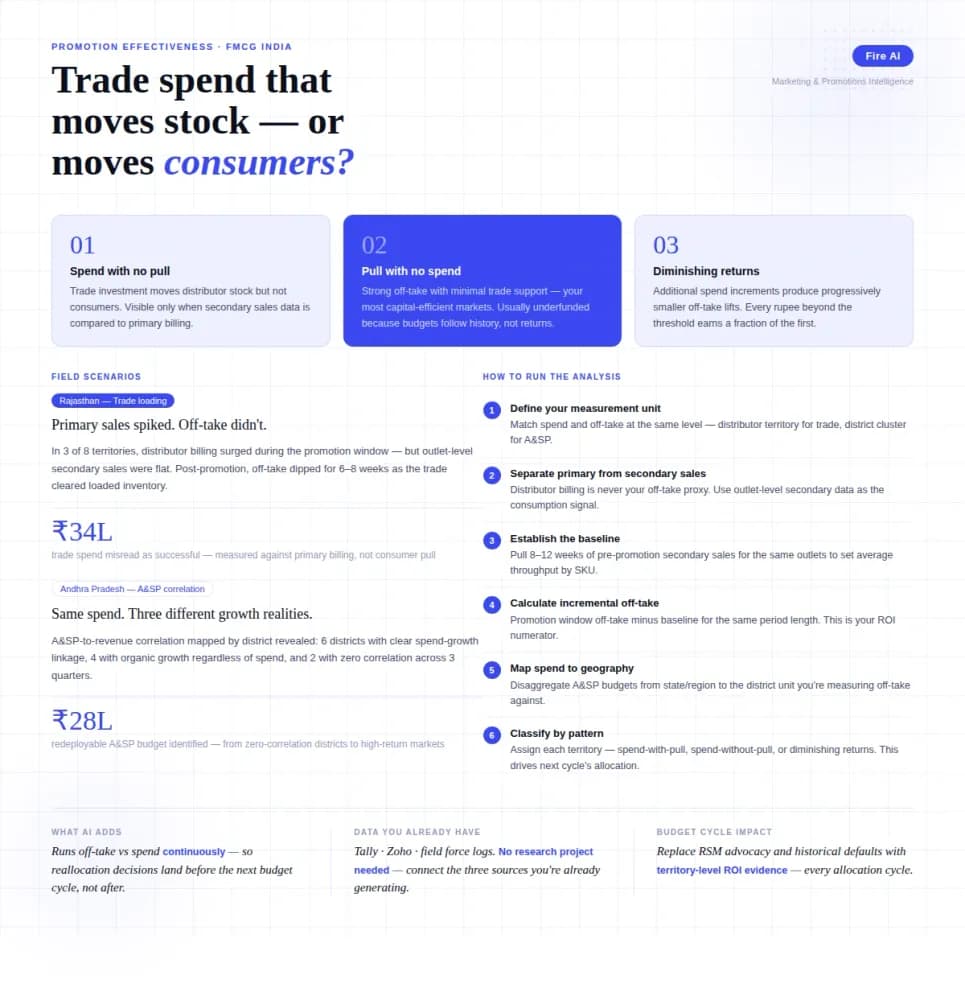
Measuring Promotion Effectiveness: A Data-Driven Guide for FMCG Marketers
FMCG brands in India spend 15–25% of gross revenue on trade promotions and A&SP (advertising and sales promotion) every year. Most can tell you how much they spent. Very few can tell you what it returned. The problem isn't a lack of data — it's that the data lives in disconnected places. Trade spend sits in finance. Off-take data lives with the distributor or field team. A&SP budgets are tracked in a marketing spreadsheet. No single view ties promotional investment to consumer pull at the outlet level. The result is a budget cycle where last year's spend allocation becomes next year's default, because no one has the numbers to argue for something different. This guide walks through how FMCG marketing and trade teams can build a promotion effectiveness framework that actually connects spend to outcome — not just channel-level assumptions.

How AI-Powered Analytics Can Transform India’s Arbitration Bottleneck?
AI-powered analytics can transform India's arbitration system by automating case classification, predicting timelines, and optimizing arbitrator allocation to cut delays.