

Quick answer
Indian distributors track beat coverage and secondary sales by connecting Tally and DMS data to a BI dashboard like FireAI — monitoring beat adherence, outlet-wise billing, secondary-to-primary ratios, and salesman productivity. With native Tally integration and NLQ in Hindi/English, distributors get real-time territory performance dashboards at ₹4,999/month without SQL or IT teams.
Distribution is the backbone of Indian FMCG, pharma, and consumer goods businesses — and the difference between a well-managed and poorly-managed distribution network can mean crores in lost revenue. Analytics helps distributors and brand principals track what is actually happening in the field.
This guide covers how Indian distributors build analytics for beat coverage, secondary sales, and overall distribution effectiveness.
Key Distribution Analytics for Indian Businesses
1. Beat Coverage Analytics
A "beat" is a pre-defined route that a salesman covers on a specific day, visiting a set of retail outlets.
What to track:
- Beat adherence — percentage of planned outlets actually visited per day
- Productive calls — visits where an order was placed vs total visits
- Coverage frequency — how often each outlet is visited per month
- Uncovered outlets — outlets not visited in the last 7/14/30 days
- Time spent per outlet — from DMS/SFA GPS data
Most Indian FMCG distributors aim for 80–90% beat adherence. In practice, many operate at 50–60% — the gap represents significant revenue leakage.
2. Secondary Sales Tracking
Secondary sales (distributor to retailer) are the true demand signal, unlike primary sales (company to distributor) which can be inflated by channel loading.
What to track:
- Daily secondary sales by beat, salesman, and territory
- Secondary-to-primary ratio — healthy ratio is 0.85–0.95; below 0.7 indicates channel stuffing
- Outlet-wise billing — average bill value, billing frequency
- Category and SKU-wise secondary sales — identifies which products are actually moving at retail
- Growth vs previous period — month-on-month and year-on-year
3. Outlet Penetration and Productivity
- Universe coverage — percentage of total addressable outlets billed in a period
- Active outlets — outlets billed at least once in last 30 days
- Billing productivity — lines per call (number of SKUs per order)
- Average bill value by outlet type (kirana, modern trade, chemist)
- New outlet additions per month
4. Salesman Performance
- Orders per day by salesman
- Revenue per salesman per month
- Collection efficiency — amount collected vs outstanding
- Return rate by salesman (high returns may indicate forced selling)
- Beat adherence by individual salesman
How to Set Up Distribution Analytics
Step 1: Identify Data Sources
Indian distributors typically have:
- Tally — billing, collections, outstanding, stock
- DMS/SFA — Bizom, BeatRoute, FieldAssist, Ivy Mobility for beat tracking and order capture
- Company portals — for primary order placement and scheme information
- Excel sheets — often for target vs achievement tracking
Step 2: Connect to a BI Platform
Choose a BI tool that can pull from Tally (for billing and financial data) and your DMS (for field activity data). FireAI's native Tally integration and ability to connect multiple data sources makes this straightforward.
Step 3: Build Core Dashboards
- Daily Sales Dashboard — secondary sales, outlet count, average bill value
- Beat Coverage Report — planned vs actual visits, productive calls
- Salesman Scorecard — orders, revenue, collections, beat adherence per salesman
- SKU Penetration Dashboard — which products are reaching which outlets
Step 4: Automate Reporting
- Morning dashboard push to distributor owner and area sales manager
- Weekly salesman ranking by productivity
- Monthly outlet penetration report
- Outstanding and collection alerts
India-Specific Distribution Challenges
Fragmented retail landscape: India has 12+ million retail outlets. Even a single distributor may serve 500–2,000 outlets across different trade channels (kirana, chemist, modern trade, HoReCa). Analytics must handle this diversity.
Cash and credit dynamics: Indian distribution runs heavily on credit. Tracking outstanding by outlet, overdue payments, and collection efficiency is as important as tracking sales. Tally integration is essential for this.
Scheme and discount complexity: Indian FMCG distribution involves complex trade schemes — buy X get Y, slab-based discounts, festival schemes. Analytics must track effective pricing after all scheme deductions.
Multi-company distribution: Many Indian distributors handle 5–15 company brands simultaneously. Analytics should show company-wise P&L, margin analysis, and relative performance.
Regional and seasonal variation: Demand patterns vary dramatically by region and season. A distributor in Kerala sees peak demand during Onam; one in Gujarat during Navratri. Beat plans and stock allocation should account for these patterns.
How FireAI Helps Indian Distribution Businesses
FireAI bridges the gap between Tally billing and field execution data:
- Native Tally integration: Auto-sync billing, collections, outstanding, and stock data. A FMCG distributor in Pune serving 1,200 outlets connected Tally to FireAI and had outlet-wise billing dashboards live within 4 hours
- DMS connectors: Pull field data from Bizom, BeatRoute, FieldAssist, and Ivy Mobility alongside Tally financial data — giving a complete view of field execution + financial performance
- 700+ connectors: Connect company portals, bank statements, Google Sheets targets, and Excel reports into one unified analytics layer
- NLQ in Hindi and English: A distributor owner types "पिछले महीने किस salesman की collection सबसे कम रही?" and gets instant analysis. No SQL, no data team
- ₹4,999/month flat pricing: The distributor owner, area sales manager, and every salesman can access dashboards for one price. No per-user fees
- Pre-built distribution dashboards: Beat compliance tracker, secondary sales monitor, salesman scorecard, outlet penetration map, and outstanding ageing — live in days
Real Indian Distribution Scenarios
- FMCG distributor in Lucknow (₹8 crore revenue, 800 outlets): Connected Tally + Bizom to FireAI. Discovered beat adherence at 52% — meaning 48% of planned outlet visits weren't happening. Improved to 78% in 3 months, secondary sales grew 22%
- Pharma distributor in Hyderabad (₹12 crore revenue, 1,500 outlets): Outstanding ageing dashboard revealed ₹45 lakh in 90+ day receivables from just 12 outlets. Focused collection drive recovered ₹32 lakh in 6 weeks
- Consumer goods distributor in Kolkata (₹6 crore revenue): SKU penetration dashboards showed top 3 SKUs reached only 40% of outlets. Targeted push increased penetration to 65%, adding ₹15 lakh/month in secondary sales
Ready to act on your data?
See how teams use FireAI to ask in plain language and get analytics they can trust.
Explore FireAI workflows
Go from this topic into product features and solution paths that match what you read here.
Topic hub
Industry Analytics In India
Comparison pages and implementation guidance for industry-specific BI, dashboards, and analytics use cases in India.
Explore hubFrequently asked questions
What is beat coverage analytics and why does it matter for Indian distributors?
Beat coverage analytics tracks salesman visits against planned routes. Poor beat adherence directly causes lost sales — an unvisited outlet cannot place orders. FireAI shows beat adherence from DMS data alongside Tally billing. Most distributors find improving adherence from 60% to 80% increases secondary sales by 15–25% without adding salesmen.
How do you track secondary sales for Indian FMCG distribution?
Connect Tally (billing data) or DMS (Bizom, BeatRoute, FieldAssist) to FireAI. Dashboards show daily outlet-wise billing, SKU-level sales, secondary-to-primary ratio, and territory performance. FireAI native Tally integration eliminates manual exports — at ₹4,999/month flat pricing with Hindi/English NLQ queries.
Can Indian distributors track outlet penetration without a DMS?
Yes. If salesmen capture orders in Tally, FireAI tracks billing frequency per outlet, active vs inactive outlets, average bill value, and SKU penetration from Tally data alone. A DMS adds GPS tracking and beat adherence, but Tally billing is a solid analytics foundation for distributors starting their analytics journey.
What is the best analytics tool for Indian FMCG distributors?
FireAI: native Tally integration (auto-sync billing, collections, stock), DMS connectors (Bizom, BeatRoute, FieldAssist), Hindi/English NLQ, pre-built distribution dashboards, and flat ₹4,999/month pricing. Unlike enterprise BI tools, no SQL or training needed — distributor owners and area managers self-serve from day one.
How do Indian distributors reduce outstanding receivables with analytics?
FireAI connects Tally outstanding data to build outlet-wise receivables ageing dashboards (0–30, 30–60, 60–90, 90+ days) with automatic alerts. A typical distributor discovers 10–15% of revenue stuck in 90+ day receivables from a handful of outlets. Focused collection drives typically recover 60–70% within 6 weeks.
Related in this topic
7 Best BI Tools in India (2026)
Compare the best business intelligence tools for Indian businesses in 2026. See pricing features and which BI platform fits SMBs mid-market and enterprise.
FMCG Analytics in India: Sales & Distribution
FMCG analytics in India covers secondary sales tracking, distributor performance, beat coverage, and retailer segmentation. Learn key metrics for Indian FMCG companies.
Tally Analytics: Turn Tally Data into Dashboards & Reports
Get AI-powered analytics and dashboards from Tally Prime data without SQL. FireAI connects to Tally for live GST, sales, inventory, and P&L—no spreadsheet exports.
What is a KPI Dashboard? Definition and Examples
A KPI dashboard is a visual display of key performance indicators that gives business leaders an at-a-glance view of performance against goals. Learn what KPI dashboards include, how to build one, and see examples across sales, finance, and operations.
From the blog
Tally Analytics Dashboards for Indian Businesses
80% of Indian SMBs use Tally. Fewer than 5% have dashboards. Learn how to build real-time P&L, cash flow, and receivables analytics from your Tally Prime data.
Multi-Outlet Retail Analytics: Track Store Sales
Track sales, stockouts, and staff performance across all stores. Learn how multi-outlet retail analytics can find the root cause of revenue leaks.
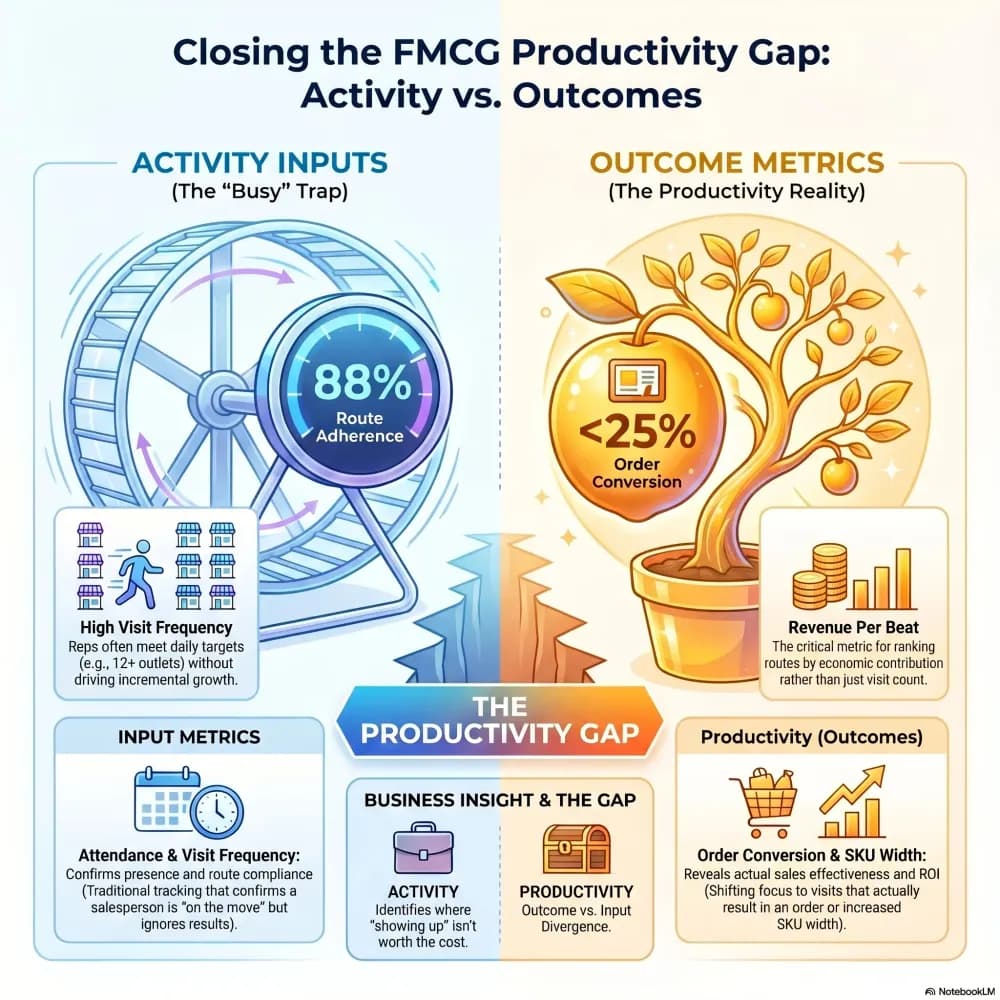
Beat Productivity Analysis: How Top FMCG Brands Optimize Field Force ROI
Your sales team is covering 300 beats a month. But how many of those beats are actually driving orders — and how many are just burning fuel? Here's how the sharpest FMCG brands are figuring that out.