

Quick answer
To build a pharma sales dashboard, define KPIs: territory attainment, Rx or proxy trends, new molecule adoption, and MR visit coverage. Connect CRM, distributor secondary, and shipment data on one hierarchy from national to MR. Layer executive and regional views with territory exceptions. FireAI unifies these feeds so Indian teams get live dashboards and plain-English answers without monthly Excel rollups.
Building a pharma sales dashboard means aligning prescription or proxy demand signals, field effort, and commercial targets in one hierarchy so national, regional, and MR leaders see the same numbers.
Indian pharma teams often have strong data in SFA, spreadsheets, and distributor files, but the dashboard fails when visit counts, secondary offtake, and primary billing use different product or territory keys. The steps below mirror how pharma sales use cases and pharma marketing use cases describe end-to-end reporting: lock metrics, unify grains, then design role-based views. For landscape context, read pharma analytics in India first.
Step 1: Lock the pharma KPIs leadership will defend in a review
Start with 8–12 metrics, not every column from the IMS export. A useful starter set:
- Demand and adoption: Rx or proxy trend versus prior period, new molecule or new brand adoption curve, share of voice in priority specialties where you track it ethically and legally
- Attainment: territory and MR attainment versus quota or plan, gap to go with weeks left in the period
- Field execution: visit frequency, coverage of priority accounts, call notes or message compliance where your SFA supports it
- Pipeline to cash: primary billing to stockists, secondary offtake where available, inventory or scheme distortion flags you already trust
Per role: leadership needs India and region heatmaps; regional managers need territory rankings; first-line managers need MR-level exceptions. If every metric sits on one page, adoption drops.
For a generic sales layout pattern (funnel, quota, pipeline), see how to create a sales performance dashboard, then tailor the KPIs to regulated pharma workflows.
Step 2: Map data sources and one commercial grain
Pick one grain for the core fact table: usually month × SKU or brand × territory × MR, or week if you run tight SFA cycles.
Typical sources:
- CRM or SFA for calls, visits, samples, and digital engagement tied to the MR and brick
- Primary sales or dispatch from ERP for what left the company to the trade
- Distributor secondary or stockist sell-out files for what moved closer to the patient, when your governance allows it
- IMS, CDM, or other market data only where license, budget, and data governance are clear; many teams start with internal proxies plus secondary
Modeling rules that save months of rework:
- One product master that maps generic names, packs, and brand codes across systems
- A territory tree that matches how incentives are paid, not only how IT org charts look
- Time zones and period closes labeled on every tile so field and finance do not argue about “the same week”
Without this, MR productivity stories in can AI track pharma field force style analytics will not match finance’s shipment view.
Step 3: Design the dashboard layout in three layers
Layer 1, executive (one screen): India attainment, top three risks (regions or brands), new launch trajectory versus plan, and a single exception count for data quality (unmapped SKUs, stale secondary).
Layer 2, region and franchise: heatmaps for attainment and Rx or proxy trend, brand × territory matrices, and scheme or campaign overlays that pharma marketing needs to see beside sales.
Layer 3, MR and account exceptions: lowest coverage versus priority lists, largest negative gaps to target, and accounts with diverging primary versus secondary patterns when both exist.
Drill path: India → region → territory → MR → account or stockist list. Match how a ZSM or RM actually resolves issues on Monday morning.
Step 4: Set refresh, ownership, and compliance guardrails
Refresh: near-real-time SFA is different from monthly IMS. Label each block with as of time and the data owner.
Ownership: name who fixes broken territory mapping, who approves a new SKU in the master, and who signs off when a proxy metric replaces a licensed feed temporarily.
Compliance: restrict patient-identifiable data, follow company policy on samples and gifts reporting, and keep role-based access aligned with commercial sensitivity. Analytics should support audit questions, not create new ones.
How FireAI helps pharma sales teams
FireAI connects CRM, commercial, and operational data so pharma organisations are not rebuilding the same merges in Excel after every month-end close. Teams can ask questions in plain English or Hindi (for example, which territories dragged down attainment for a new launch last quarter, or how MR visit coverage correlates with secondary movement in East India) and get answers without a dedicated analyst for every ad hoc request.
Dashboards can be generated and adjusted as your pharma analytics maturity grows, with comparisons to best BI tools for pharma in India when you evaluate build versus buy.
Ready to act on your data?
See how teams use FireAI to ask in plain language and get analytics they can trust.
Explore FireAI workflows
Go from this topic into product features and solution paths that match what you read here.
Topic hub
Industry Analytics In India
Comparison pages and implementation guidance for industry-specific BI, dashboards, and analytics use cases in India.
Explore hubFrequently asked questions
What KPIs belong on a pharmaceutical sales dashboard first?
Start with territory attainment versus plan, prescription or proxy demand trend, new product or molecule adoption, MR visit coverage versus priority lists, and secondary alignment where distributor data is reliable. Add market data tiles only when licensing and governance are settled.
Which systems must connect for a full pharma sales dashboard?
At minimum, connect SFA or CRM for field activity, primary billing or dispatch for company-to-trade sales, and a clean product and territory master. Distributor secondary, IMS-style feeds, or hospital data are valuable but depend on contracts and internal policy. The critical part is one consistent product and territory key across feeds.
How is a pharma sales dashboard different from a general sales dashboard?
Pharma adds long incentive cycles, strict compliance on messaging and samples, and often a mix of primary, secondary, and proxy demand signals instead of a simple revenue pipeline. Layouts still use executive, regional, and rep layers, but KPIs emphasize Rx or proxy adoption, coverage of healthcare professionals, and launch curves more than generic pipeline stages.
Can FireAI support pharma sales dashboards without a large analytics team?
Yes. FireAI is built to connect commercial sources, keep role-based views current, and answer follow-up questions in natural language so sales operations and marketing are not waiting on manual spreadsheet rollups after every period close.
Related in this topic
Pharma Analytics in India: MR Performance & Compliance
Pharma analytics in India covers MR productivity, territory management, prescription tracking, and regulatory compliance. Learn key dashboards for Indian pharmaceutical companies.
Can AI Track Pharma Field Force Productivity?
Yes: AI can track medical representative productivity by unifying GPS or visit logs, CRM calls, and prescription or sales outcomes. Learn how machine learning scores territory coverage and engagement, and how FireAI connects pharma CRM and Rx data for Indian sales teams.
Best BI Tools for Pharma in India (2026)
Compare the best BI tools for pharmaceutical analytics in India, including features for supply chain management, inventory planning, regulatory reporting, and demand forecasting. Review pricing, compliance capabilities, and fit for Indian pharma companies.
How to Create a Sales Performance Dashboard
Build a sales performance dashboard with the right KPIs, layout templates, and best practices. Cover pipeline, revenue, quota, and territory metrics in one view.
From the blog
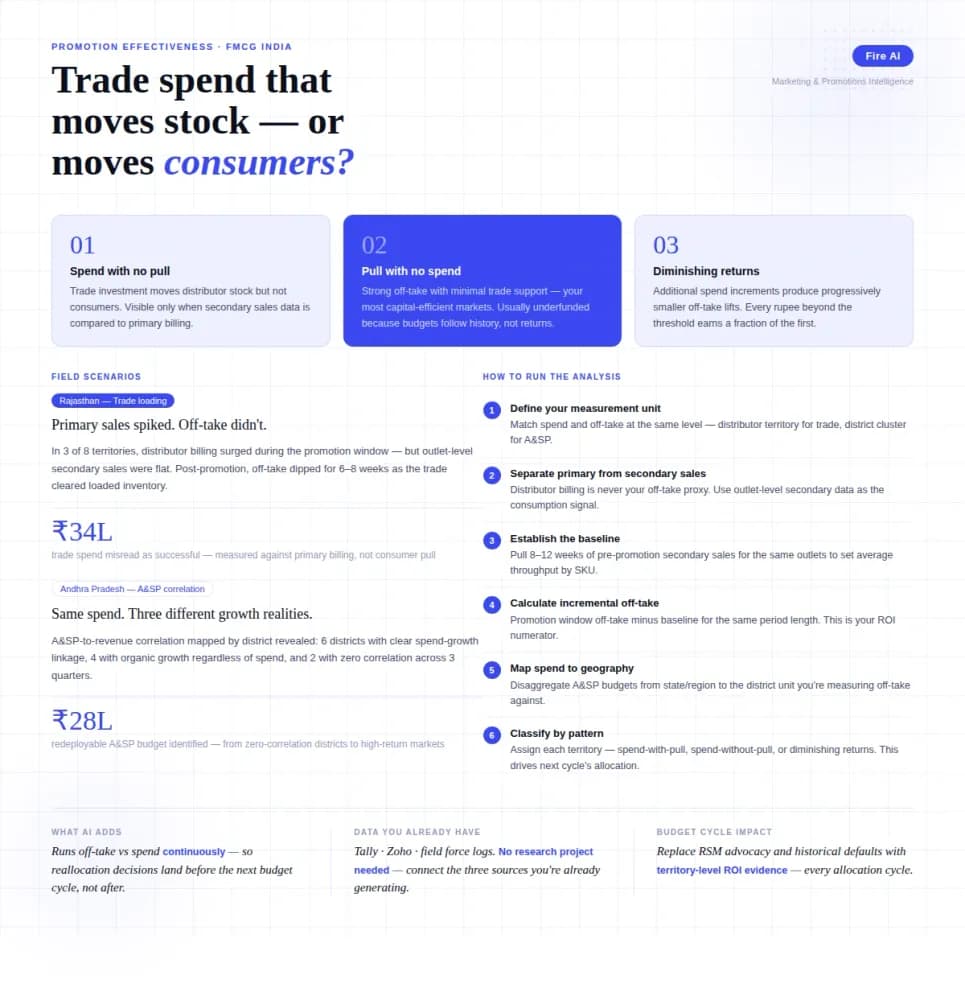
Measuring Promotion Effectiveness: A Data-Driven Guide for FMCG Marketers
FMCG brands in India spend 15–25% of gross revenue on trade promotions and A&SP (advertising and sales promotion) every year. Most can tell you how much they spent. Very few can tell you what it returned. The problem isn't a lack of data — it's that the data lives in disconnected places. Trade spend sits in finance. Off-take data lives with the distributor or field team. A&SP budgets are tracked in a marketing spreadsheet. No single view ties promotional investment to consumer pull at the outlet level. The result is a budget cycle where last year's spend allocation becomes next year's default, because no one has the numbers to argue for something different. This guide walks through how FMCG marketing and trade teams can build a promotion effectiveness framework that actually connects spend to outcome — not just channel-level assumptions.
Tally Analytics Dashboards for Indian Businesses
80% of Indian SMBs use Tally. Fewer than 5% have dashboards. Learn how to build real-time P&L, cash flow, and receivables analytics from your Tally Prime data.

Democratizing Data: How AI Analytics Levels the Playing Field for Small Businesses and Freelancers
For decades, data-driven decision making was a luxury that only enterprises could afford. Big companies hired data scientists, purchased expensive BI tools, and built complex data warehouses. In exchange, they received precise insights that guided budgets, strategy, and growth.