

Quick answer
To calculate D2C unit economics, split CAC by acquisition channel, estimate LTV from cohort gross profit over a fixed horizon, get payback by dividing CAC by monthly gross contribution per customer, and build contribution margin as revenue minus variable costs per order. FireAI connects Shopify and marketplace data so these metrics refresh without manual spreadsheets.
Calculating D2C unit economics turns vague growth narratives into channel-level math you can defend in board meetings and budget reviews. This guide walks through the same sequence most finance teams use: CAC by source, LTV by cohort, payback period, then a contribution margin waterfall. For definitions and benchmarks, start with what is unit economics for D2C. To run the math without setting up a spreadsheet, use the free D2C unit economics calculator — channels, AOV, repeat rate in, LTV : CAC and payback out.
Step 1: Calculate CAC by channel
Isolate acquisition spend and new customers for each channel so blended averages do not hide a broken paid strategy.
- Pick a time window (often monthly) and list every rupee in sales and marketing that aims to acquire customers: paid social, search, influencers, discounts attributed to first orders, and attributable tool fees.
- Count new customers in that window with a first purchase date in the period; tag each with a primary acquisition channel from your UTM or platform labels.
- Compute CAC per channel:
Channel CAC = Channel spend ÷ New customers attributed to that channel
- Reconcile unassigned traffic with a clear rule (for example, last non-direct click) so totals add up and finance trusts the split.
Indian D2C brands often underestimate CAC when organic and referral lift masks expensive Meta or marketplace programmes. Channel CAC is the input to every payback and LTV comparison.
Step 2: Compute LTV by cohort
LTV is expected gross profit from a customer group over a horizon you choose, not lifetime to infinity unless you model decay explicitly.
- Define cohorts by first purchase month (or first order week for high velocity).
- Sum cumulative revenue or gross margin per cohort over 6, 12, and 24 months so you see how curves flatten.
- Simple LTV formula for a fixed horizon:
Cohort LTV (H months) = Average cumulative gross profit per customer through month H
- Segment when behaviour differs, for example marketplace-first versus website-first, so averages do not mix incompatible curves.
If you only have order data, approximate gross profit with your average contribution margin until finance refines SKU-level cost.
Step 3: Determine payback period
Payback answers how many months of contribution it takes to recover acquisition spend.
- Use post-discount revenue minus variable costs (COGS, payment fees, shipping subsidy, marketplace fees) to get monthly gross contribution per active buyer or per order cadence.
- Payback in months:
Payback (months) = CAC ÷ Average monthly gross contribution per customer
- Compare by channel: a low blended payback can still mask a channel that never pays back within your target (often under 12 months for venture-backed D2C).
Pair this step with why D2C brands need unit economics tracking when you explain the trade-off between growth and recovery speed.
Step 4: Build a contribution margin waterfall
A waterfall shows how each rupee of revenue survives variable costs before fixed overhead and marketing.
- Start with net sales after returns on your own site and on each marketplace.
- Subtract variable costs in order: product COGS, packaging, payment gateway, outward shipping, marketplace commissions and logistics, and other per-order fees.
- Arrive at contribution margin rupees and percent; compare SKUs, categories, and channels.
- Layer CAC only at the customer or channel level so you do not double-count discounts already in revenue.
This waterfall is what bridges marketing reports to profitability analytics and board-level narratives.
How FireAI speeds up the workflow
FireAI connects Shopify, marketplace seller exports, and related finance feeds so order, fee, and customer dimensions stay joined. Instead of rebuilding pivot tables each month, teams can:
- Refresh CAC by channel and LTV curves when new cohorts close.
- Ask conversational questions (for example, payback by campaign last quarter).
- Align contribution margin views with the same definitions finance uses for unit economics reviews.
Automation does not replace clear definitions; it enforces them every cycle.
Ready to act on your data?
See how teams use FireAI to ask in plain language and get analytics they can trust.
Explore FireAI workflows
Go from this topic into product features and solution paths that match what you read here.
Topic hub
AI Analytics
Guides on natural language querying, AI-powered analytics, forecasting, anomaly detection, and automated insights.
Explore hubFrequently asked questions
Should I use revenue or gross profit for LTV?
What payback period is reasonable for Indian D2C?
Why calculate CAC by channel instead of one blended number?
How does FireAI help with D2C unit economics calculations?
Related in this topic
What is Unit Economics? CAC, LTV & Payback Period
Unit economics measures revenue and cost per customer or order. Learn CAC, LTV, payback period and contribution margin for D2C and e-commerce.
Most D2C Brands Are Scaling Losses—Unit Economics Tracking Changes That
Growing GMV while burning cash is the D2C trap. Rising CAC, hidden costs, and channel-level blind spots destroy margins fast. Learn why unit economics dashboards are the only way to tell if your growth is actually profitable.
D2C Analytics India: What Top Brands Actually Track
D2C analytics in India covers customer acquisition, retention, unit economics and attribution. Learn the key KPIs and dashboard applications.
Profitability Analytics: Product, Customer & Channel P&L
Profitability analytics explains which products, customers, channels, and geographies actually contribute margin. See key metrics and practical uses.
From the blog
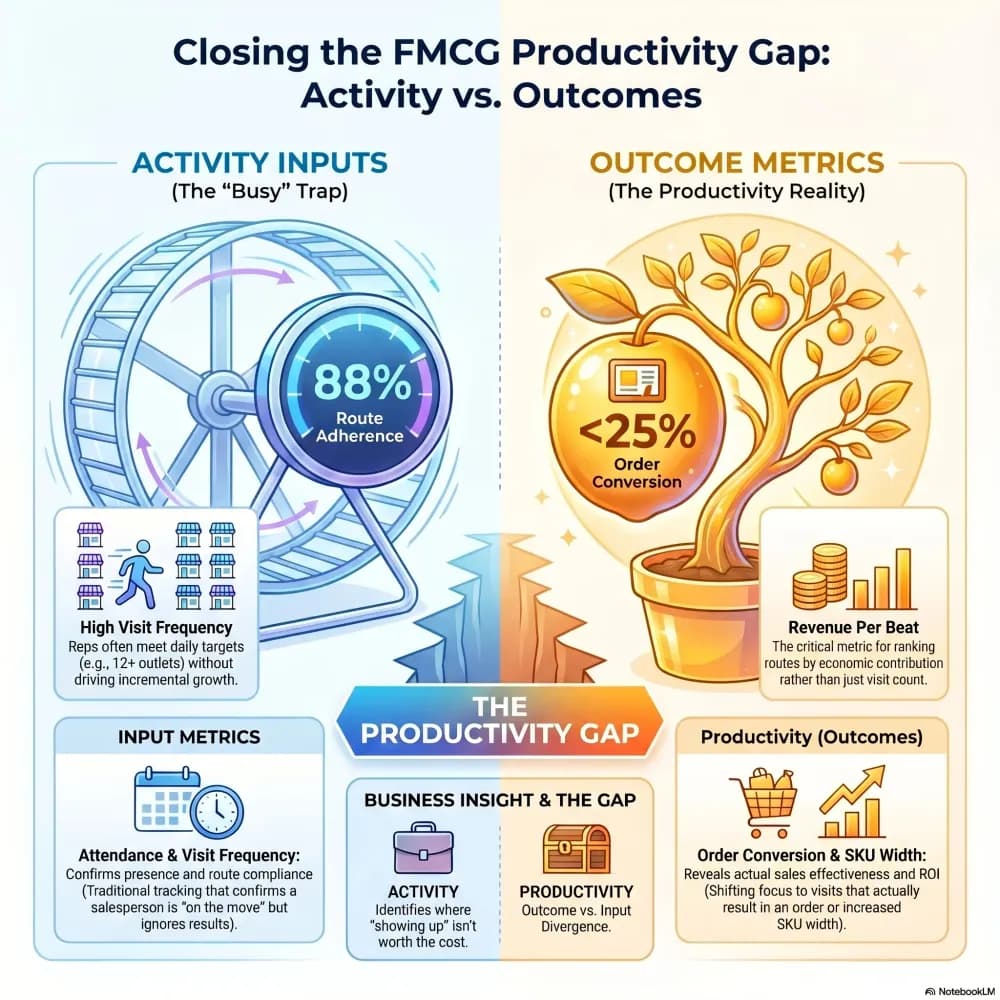
Beat Productivity Analysis: How Top FMCG Brands Optimize Field Force ROI
Your sales team is covering 300 beats a month. But how many of those beats are actually driving orders — and how many are just burning fuel? Here's how the sharpest FMCG brands are figuring that out.

How AI Is Transforming Distributor Margin Analysis for FMCG Brands
For FMCG finance teams still reconciling distributor margins on spreadsheets, there's a faster — and far more accurate — way forward.

How AI-Powered Analytics Can Transform India’s Arbitration Bottleneck?
AI-powered analytics can transform India's arbitration system by automating case classification, predicting timelines, and optimizing arbitrator allocation to cut delays.