

Quick answer
Sales force effectiveness (SFE) analytics measures how well a sales organization turns planned activity into outcomes that matter for the business: prescription or offtake lift, revenue, and profitable coverage. It combines visit or call frequency, call quality and conversion, territory and outlet reach, and whether incentives reward the right behaviors. The goal is effectiveness, not maximizing activity for its own sake.
Sales force effectiveness (SFE) analytics is the practice of measuring and improving how well your sales and field teams convert effort, time, and cost into commercial results. It sits one level above raw activity metrics: it asks whether visits, calls, and routes actually move prescriptions, secondary sales, or new outlet wins in line with strategy.
In India, SFE is a standard lens in pharma (medical representative and key account programs) and in FMCG (general trade and modern trade field teams). The same principles apply to B2B teams with hybrid inside and field coverage. This page defines SFE analytics, its core dimensions, and how it differs from a pure “how many calls did we make?” view. For FMCG-specific field metrics, see what is field force analytics in FMCG. For pharma commercial context, see pharma sales use cases and FMCG HR and field force use cases.
What “effectiveness” means in SFE
Effectiveness is the relationship between inputs (people, days in field, call capacity) and outputs (sales, coverage, margin). A team with high call counts but flat revenue is active, not necessarily effective. SFE programs therefore align metrics with the few outcomes the business actually funds: growth in priority brands, profitable outlets, or compliant, high-quality calls.
Typical building blocks include:
- Activity that matches plan (frequency, reach) but scored next to result (order, Rx trend, numeric distribution)
- Territory design so workload and opportunity are comparable across reps
- Incentives that reinforce margin, mix, and coverage goals, not only gross numbers
Core dimensions of SFE analytics
1. Visit and call frequency
Frequency analytics compares planned versus actual touchpoints (field visits, calls, video detailling) by territory, segment, and priority customer list.
- In FMCG, frequency ties to beat cycles and outlet types; under-coverage of high-potential outlets is a common gap
- In pharma, frequency must align with segmentation (A/B/C doctors) and compliance rules, not a single average across the list
SFE uses frequency as a feasibility and fairness input: are targets realistic, and are efforts going to accounts that can move the needle?
2. Call effectiveness (quality and conversion)
Call effectiveness connects effort to outcomes: prescriptions, orders per call, basket size, or next-step conversion. Raw “calls per day” without outcome linkage hides low-quality detailling or order-booking issues.
Analytics often combines:
- Conversion or hit rate where a “hit” is defined by the brand (Rx, order, display, compliance task)
- Share of voice or share of shelf proxies where direct outcome data lags
- Call quality scores from CRM or samples of joint field rides (where available)
For a practical pharma lens on tying field effort to outcomes, read can AI track pharma field force productivity and how to build a pharma sales dashboard.
3. Territory coverage and workload balance
Territory coverage measures how much of the target universe is reached with the right frequency, and whether workload (accounts per rep, travel time) is balanced so performance is comparable.
- White spaces (planned but unreached accounts) and overlap (two reps on the same pocket) both hurt SFE
- Outlet or prescriber potential weighting avoids rating a rep on revenue alone when their territory has structurally lower opportunity
This is where analytics supports fair benchmarking and redeployment decisions, not just ranking individuals on revenue.
4. Incentive and scheme alignment
Incentive analytics checks whether compensation, contests, and trade schemes push behavior that matches financial goals. Examples: rewarding high-revenue calls that destroy margin, or volume-only targets that skip compliance or mix objectives.
SFE dashboards often layer attainment, payout curves, and behavioral side effects (for example, stock-in at month-end, cherry-picking easy accounts). For FMCG field and HR policy design, FMCG HR use cases describe how field programs and analytics connect.
How SFE differs from general sales reporting
Standard sales reports show revenue and maybe target versus actual. SFE analytics adds structure and ratios: effort per outcome, coverage adjusted for potential, and incentive cost per incremental win. That is why pharma teams often use SFE as a named program, while FMCG teams may speak more directly to field force productivity (see field force analytics for that operational definition).
How FireAI supports sales force effectiveness analytics
Data silos are the main barrier: CRM or SFA for calls, DMS or distributor data for secondary, primary or shipment for supply views, and finance for margin. FireAI connects these sources so Indian pharma and FMCG teams can:
- Build role-based SFE views (national, region, territory, rep) with consistent definitions
- Blend activity, coverage, and outcome metrics in one place without monthly Excel consolidation
- Ask natural-language questions such as which territories have high call counts but flat Rx or secondary trends, or where incentive thresholds create the wrong behavior
Alerts and trends (for example, declining call effectiveness before revenue drops) help sales ops and HR act early. For a broader market view, see pharma analytics in India.
Common SFE analytics mistakes
1. Ranking on revenue alone. Territories differ in potential; SFE needs potential-adjusted or segment-weighted views.
2. Confusing activity with effectiveness. High call counts without outcome linkage flatter the wrong behaviors.
3. Ignoring channel and product mix. A rep can hit a revenue number with low-margin or easy lines; SFE should align with margin and brand priorities where data allows.
4. Static plans. Beats and territories should be refreshed as outlet and prescriber bases change; analytics should flag migration and white space, not only end-of-quarter scorecards.
Ready to act on your data?
See how teams use FireAI to ask in plain language and get analytics they can trust.
Explore FireAI workflows
Go from this topic into product features and solution paths that match what you read here.
Topic hub
Industry Analytics In India
Comparison pages and implementation guidance for industry-specific BI, dashboards, and analytics use cases in India.
Explore hubFrequently asked questions
What is sales force effectiveness (SFE) analytics?
Sales force effectiveness analytics measures how well sales and field teams convert effort into business results such as revenue, coverage, prescriptions, or orders. It combines visit or call frequency, call quality and conversion, territory coverage and balance, and alignment of incentives with strategy. The focus is outcomes per unit of effort, not activity volume alone.
How is SFE analytics different from field force analytics?
Field force analytics often emphasizes operational metrics such as visits, outlet coverage, and orders per visit, especially in FMCG. SFE analytics is a broader effectiveness framework used across industries, strongly in pharma, to link activity to outcomes, territory potential, and incentive design. The two overlap; SFE adds strategic alignment and fairness of comparison across territories.
Why is territory coverage important for SFE?
Territory coverage shows whether the right customers or outlets are reached at the planned frequency. Poor coverage or imbalanced workloads makes revenue or prescription metrics hard to compare across reps. SFE analytics uses coverage and potential weighting so leaders can see true effectiveness and fix design issues, not only coach individual performance.
How can FireAI improve SFE reporting for Indian pharma and FMCG teams?
FireAI connects CRM or SFA, DMS, and other commercial data so activity, secondary or prescription proxies, and financial lines sit in one analytics layer. Teams get dashboards and natural-language answers without merging spreadsheets each month, and can spot gaps such as high call volume with flat outcomes or incentives that pull against margin goals.
Related in this topic
What Is Field Force Analytics in FMCG? Metrics & Meaning
Field force analytics in FMCG measures how sales teams perform in the field: visits, outlet coverage, orders per call, and productivity. Learn the core metrics and how FireAI builds dashboards from DMS and CRM data.
Can AI Track Pharma Field Force Productivity?
Yes: AI can track medical representative productivity by unifying GPS or visit logs, CRM calls, and prescription or sales outcomes. Learn how machine learning scores territory coverage and engagement, and how FireAI connects pharma CRM and Rx data for Indian sales teams.
How to Build a Pharma Sales Dashboard: KPIs, Data & Layout
Step-by-step guide to building a pharmaceutical sales dashboard: Rx and territory KPIs, CRM and distributor data, layout for national to MR views, and how FireAI helps Indian pharma teams with live analytics and natural language.
Pharma Analytics in India: MR Performance & Compliance
Pharma analytics in India covers MR productivity, territory management, prescription tracking, and regulatory compliance. Learn key dashboards for Indian pharmaceutical companies.
From the blog
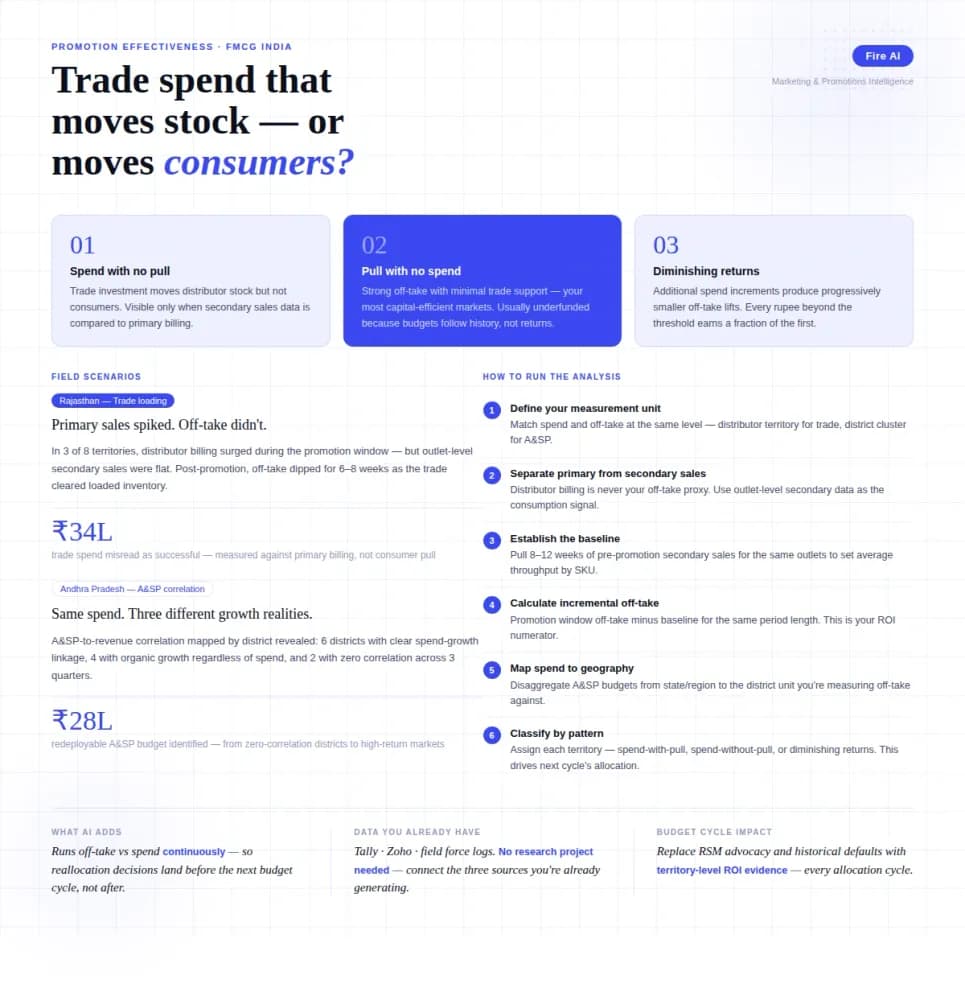
Measuring Promotion Effectiveness: A Data-Driven Guide for FMCG Marketers
FMCG brands in India spend 15–25% of gross revenue on trade promotions and A&SP (advertising and sales promotion) every year. Most can tell you how much they spent. Very few can tell you what it returned. The problem isn't a lack of data — it's that the data lives in disconnected places. Trade spend sits in finance. Off-take data lives with the distributor or field team. A&SP budgets are tracked in a marketing spreadsheet. No single view ties promotional investment to consumer pull at the outlet level. The result is a budget cycle where last year's spend allocation becomes next year's default, because no one has the numbers to argue for something different. This guide walks through how FMCG marketing and trade teams can build a promotion effectiveness framework that actually connects spend to outcome — not just channel-level assumptions.
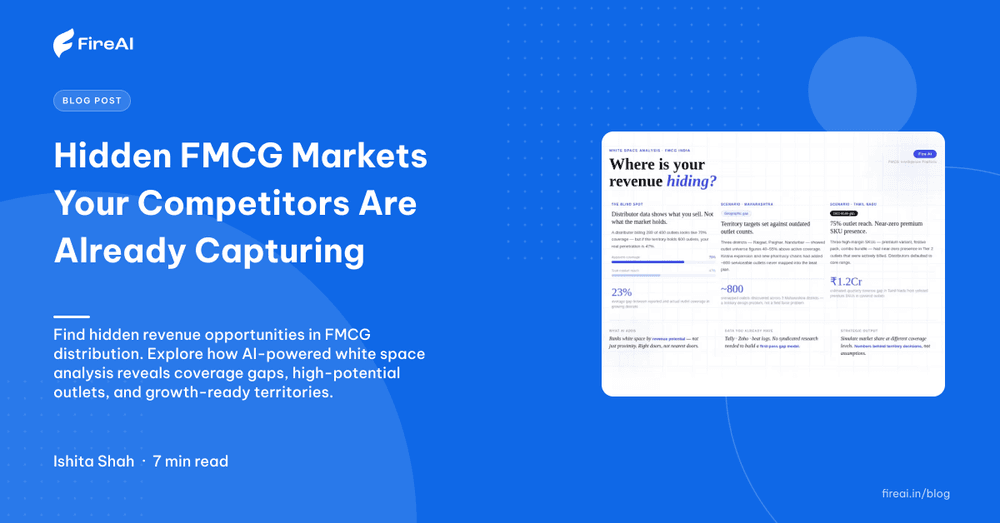
White Space Analysis for FMCG: Finding Untapped Markets with AI
Most FMCG sales leaders assume their coverage gaps are known. They're not — they're estimated. Based on distributor claims, field rep feedback, and the occasional market visit. The outlets you aren't reaching don't appear in your Tally data. The SKUs your distributors aren't pushing don't show up on beat reports. What's missing is, by definition, invisible. That invisibility is expensive.
Days Sales Outstanding (DSO): The Indian B2B Operator's Ultimate Guide
Days Sales Outstanding (DSO) explained for Indian B2B and FMCG teams: the formula, 2026 benchmarks, and what AI analytics surfaces beyond a single number.