

Quick answer
Logistics companies need analytics because thin margins, underused assets, SLA penalties, and fuel leakage are invisible until you unify trip, fleet, and billing data. Analytics shows which lanes and customers are profitable, where trucks sit idle, which routes miss on-time delivery, and where fuel spend diverges from distance. That visibility turns reactive firefighting into daily operational and pricing decisions.
Logistics and transport operators run on tight spreads, fixed assets, and customer contracts that punish failure. Without analytics, those pressures show up only as end-of-month surprises: eroded margins, half-empty fleets, SLA penalties, and fuel bills that do not match kilometers. Analytics makes the same data your dispatchers and finance team already generate (trips, PODs, fuel slips, invoices) usable for daily decisions.
This page explains the four pressures that drive the need for analytics and how measurement and dashboards address each. For product context, see cargo and logistics solutions and logistics operations use cases.
Margin pressure: why averages hide unprofitable lanes
Freight rates, fuel volatility, tolls, and driver costs squeeze contribution margin on every trip. Spreadsheets and monthly P&L roll everything into averages, so loss-making lanes or customers stay hidden behind busy corridors that look fine on paper.
How analytics helps: Allocate revenue and cost to lane, client, vehicle type, and hub. Compare realized margin per trip or per ton-km against benchmarks, spot negative contributors early, and support repricing or mix decisions with evidence instead of gut feel. Platforms like FireAI connect ERP or Tally freight billing with operational feeds so margin views update as bookings and costs land, not only at month close.
Fleet underutilization: idle capacity is a fixed-cost leak
Trucks, trailers, and hired capacity are expensive whether they move or wait. Underutilization shows up as low kilometers per day per asset, long dwell at hubs, or imbalanced return loads. Manual tracking rarely ties utilization to revenue.
How analytics helps: Dashboard vehicle utilization, turn-around time, and loaded vs empty kilometers by route and branch. Compare shifts and regions, set targets, and prioritize sales or backhaul programs where idle hours concentrate. Natural-language questions (for example, which branch had the worst utilization last week) shorten the path from data to action for ops leaders who do not live in SQL.
Delivery SLA failures: service risk becomes churn and penalties
E-commerce, manufacturing, and 3PL clients measure on-time delivery, attempt success, and POD compliance. Missed SLAs mean chargebacks, lost tenders, and reputational damage. Without live visibility, teams discover breaches after customers complain.
How analytics helps: Track on-time delivery, first-attempt success, delay reasons, and hub-level performance against contracted SLAs. Alert when trends drift before a full breach. Tie SLA views to lane and fleet metrics so root causes (capacity, routing, loading delays) surface in one place instead of in separate spreadsheets.
Fuel waste: the gap between liters purchased and productive kilometers
Fuel is both a large line item and a common leakage point: inefficient routes, harsh driving, theft, or poor reconciliation between trips and pump data. Rules of thumb and manual sampling miss systematic drift.
How analytics helps: Correlate fuel purchases and telematics distance, flag outliers by vehicle and driver, and benchmark liters per km or per ton-km. Combine with route and load data to separate legitimate variance from anomalies worth investigating. Over time, the same metrics support driver coaching and maintenance prioritization.
How FireAI fits logistics analytics in India
Many logistics teams in India already have data in Tally or other ERPs, transport management tools, GPS, and Excel. The gap is not collection but consolidation and questioning. FireAI is built for business users to ask questions in plain language, auto-build dashboards from connected sources, and keep logistics KPIs (margin, utilization, OTD, fuel) current without a dedicated data team.
For a deeper dive into vehicle and operations metrics, read what fleet management analytics is. For tool selection, see best BI tools for logistics in India.
When to prioritize logistics analytics
- You operate more than a handful of vehicles or lanes and margin is reviewed only monthly.
- Customers have formal SLAs or scorecards you cannot answer from one system.
- Fuel or maintenance cost per km varies widely across branches with no clear explanation.
- You are bidding for contracts that require historical on-time and utilization proof.
If several of these apply, analytics is not a nice-to-have; it is how you protect margin and win the next tender.
Ready to act on your data?
See how teams use FireAI to ask in plain language and get analytics they can trust.
Explore FireAI workflows
Go from this topic into product features and solution paths that match what you read here.
Topic hub
BI Fundamentals
Foundational guides on business intelligence, analytics architecture, self-service BI, and core data concepts.
Explore hubFrequently asked questions
Why do logistics companies need analytics?
Logistics runs on thin margins, expensive assets, and strict delivery commitments. Analytics turns trip, fleet, fuel, and billing data into visibility on profitable lanes, utilization, SLA performance, and fuel efficiency so operators can fix problems before they hit the P&L.
What problems does logistics analytics solve first?
Most teams start with lane or customer profitability, fleet utilization, on-time delivery against SLAs, and fuel variance versus distance. Those four areas cover the biggest leaks: unprofitable work, idle capacity, service penalties, and fuel loss.
How is logistics analytics different from monthly MIS?
Monthly MIS summarizes the past after decisions are locked. Logistics analytics breaks metrics down by lane, hub, vehicle, and client with enough frequency to change dispatch, pricing, and maintenance while the month is still in progress.
Can Indian logistics SMEs use analytics without a data team?
Yes. Modern BI and AI analytics tools connect to Tally, TMS, and GPS and let operations and finance users build dashboards and ask questions in natural language, reducing reliance on manual Excel merges and specialist analysts.
Related in this topic
What is Fleet Management Analytics? Key Metrics Explained
Fleet management analytics tracks vehicle utilization, fuel efficiency, idle time, driver performance, and maintenance costs in one dashboard. Learn the key metrics, India-specific benchmarks, and how FireAI builds live fleet dashboards from GPS, TMS, and Tally data.
Best BI Tools for Logistics Companies in India (2026)
Compare the best BI and analytics platforms for Indian logistics and transport companies. See how tools stack up on fleet management, lane profitability, delivery SLA tracking, and Tally-friendly finance dashboards.
How to Build a Supply Chain Dashboard (Step-by-Step)
Learn how to build a supply chain dashboard that tracks procurement, inventory, logistics, and supplier performance. Practical step-by-step guide for Indian manufacturers, distributors, and logistics companies.
What is Demand Forecasting? Methods and AI Techniques
Demand forecasting uses historical sales data and statistical or AI models to predict future product demand. Learn the key methods — time series, causal, and machine learning — and how tools like FireAI automate demand planning directly from Tally and DMS data.
From the blog

Democratizing Data: How AI Analytics Levels the Playing Field for Small Businesses and Freelancers
For decades, data-driven decision making was a luxury that only enterprises could afford. Big companies hired data scientists, purchased expensive BI tools, and built complex data warehouses. In exchange, they received precise insights that guided budgets, strategy, and growth.

What Is a Data Silo and Why Is It Slowing Down Your Business?
Data silos are silently costing Indian businesses time, money and decisions. Here is what they are, why they form and how to break them for good with FireAI.
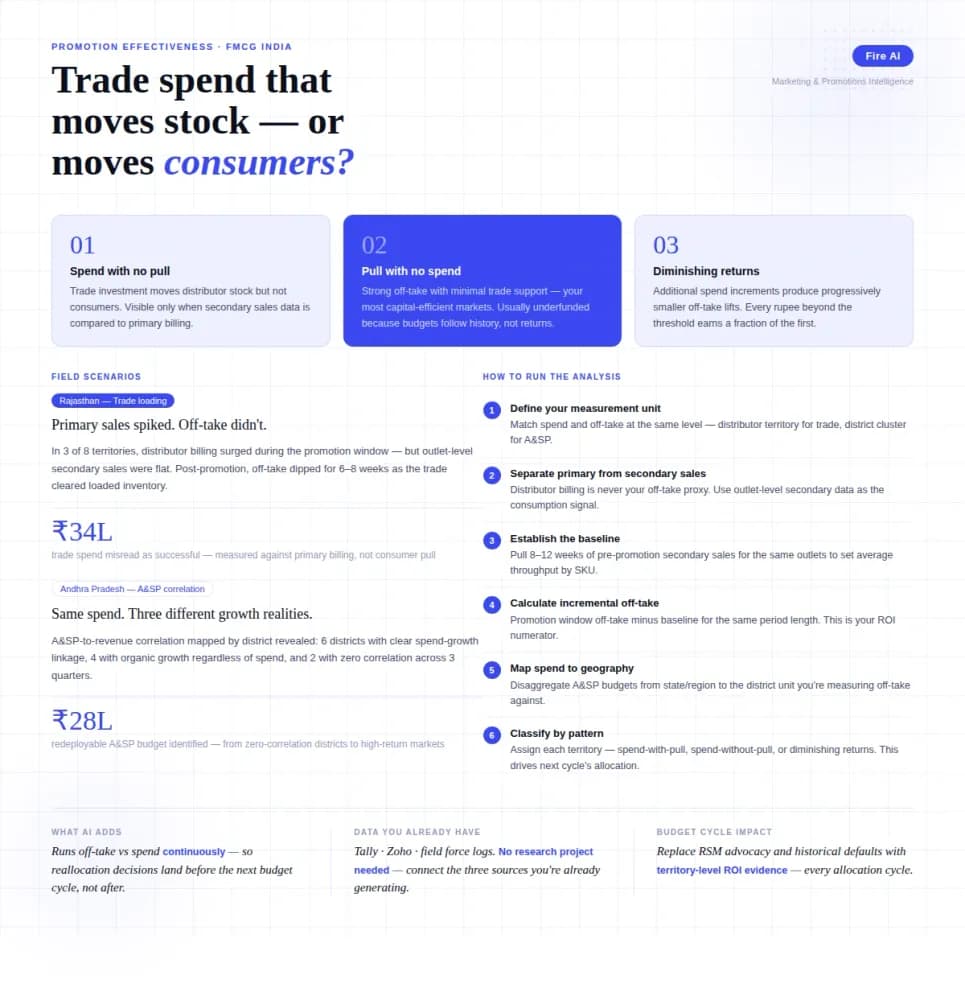
Measuring Promotion Effectiveness: A Data-Driven Guide for FMCG Marketers
FMCG brands in India spend 15–25% of gross revenue on trade promotions and A&SP (advertising and sales promotion) every year. Most can tell you how much they spent. Very few can tell you what it returned. The problem isn't a lack of data — it's that the data lives in disconnected places. Trade spend sits in finance. Off-take data lives with the distributor or field team. A&SP budgets are tracked in a marketing spreadsheet. No single view ties promotional investment to consumer pull at the outlet level. The result is a budget cycle where last year's spend allocation becomes next year's default, because no one has the numbers to argue for something different. This guide walks through how FMCG marketing and trade teams can build a promotion effectiveness framework that actually connects spend to outcome — not just channel-level assumptions.