

Quick answer
AI can analyse structured business data from WhatsApp Business API (order messages, customer inquiries, automated transaction records) but cannot reliably analyse unstructured personal WhatsApp chat conversations for business intelligence. The practical approach for Indian businesses is to use WhatsApp Business API with structured message templates — then the structured data can be extracted and analysed like any other data source.
WhatsApp is the primary business communication channel for millions of Indian businesses — orders placed on WhatsApp, customer queries on WhatsApp, sales team coordination on WhatsApp. The question of whether this data can feed into analytics is therefore very relevant.
The answer is nuanced: some WhatsApp data can be analysed; some cannot practically be.
What Can Be Analysed from WhatsApp Business Data
WhatsApp Business API — Structured Data
If you use WhatsApp Business API (the formal platform for large businesses), your interactions are logged through your WhatsApp Business Solution Provider (BSP). This data is structured and analysable:
- Message volumes (how many customers messaged today, this week)
- Response times (how long before your team responds to customer inquiries)
- Conversation outcomes (resolved, escalated, abandoned)
- Catalogue interactions (which products viewed, which added to cart)
- Template message delivery and read rates
This data is available through BSP dashboards or APIs and can be fed into a BI tool.
Order Management via Structured WhatsApp Messages
Some Indian businesses capture orders through WhatsApp using structured forms or chatbot flows:
- Customer sends a standardised order message
- Bot extracts product, quantity, and delivery details
- Structured order data is written to a database
This extracted structured data is perfectly analysable with standard BI tools.
WhatsApp Catalog Sales Analytics
WhatsApp Business Catalog shows product views, adds-to-cart, and messages for each product — this data is accessible via WhatsApp Business API analytics.
What Cannot Be Practically Analysed
Personal WhatsApp Group Chats
Unstructured group chat conversations — where team members discuss orders, customers give informal feedback, and operations are coordinated — are not easily analysable:
- Not machine-readable without custom NLP processing
- Privacy implications of processing personal communications
- No standard API to extract chat history at scale
Informal Order Messages
When a customer sends "bhai 5 boxes bhejo same as last time" — this informal, unstructured message requires human interpretation, not AI analytics.
Practical Approaches for Indian Businesses
Move to Structured Communication
Use WhatsApp Business API with structured message templates:
- Customer places order through a structured flow (product, quantity, delivery date)
- Data is captured in your CRM or order management system
- This structured data feeds into your analytics dashboard
WhatsApp-Tally Bridge
Some Indian businesses use WhatsApp as the order intake point, with orders then manually entered into Tally. The Tally data is then fully analysable — but the "lost" WhatsApp-stage analytics (inquiry volume, conversion from inquiry to order) require the structured API approach to capture.
Customer Sentiment from WhatsApp Feedback
NLP analysis of WhatsApp feedback messages (when volume is high enough) can extract sentiment and common complaint themes. This requires custom NLP processing and is generally only viable for businesses with thousands of daily WhatsApp messages.
See what is natural language processing for the underlying AI technology.
Ready to act on your data?
See how teams use FireAI to ask in plain language and get analytics they can trust.
Explore FireAI workflows
Go from this topic into product features and solution paths that match what you read here.
Topic hub
AI Analytics
Guides on natural language querying, AI-powered analytics, forecasting, anomaly detection, and automated insights.
Explore hubFrequently asked questions
Can Indian businesses analyse WhatsApp order data?
Yes, with the right setup. If orders come through WhatsApp Business API with structured message templates or chatbot flows, the resulting data is stored in your CRM or order management system and fully analysable. If orders are informal, unstructured WhatsApp messages ("send 10 boxes of X"), meaningful automated analytics require either: (1) human data entry from WhatsApp to Tally/ERP, or (2) switching to structured WhatsApp Business API flows that capture data automatically.
What analytics does WhatsApp Business provide natively?
WhatsApp Business provides native analytics for: total messages sent/received, message delivery and read rates, response time metrics, and catalog interaction data (views, add to cart). These are available through the WhatsApp Business app for small businesses or the Meta Business Suite / WhatsApp Business Platform dashboard for larger businesses using the API. More detailed analytics require integration with a BSP (Business Solution Provider) like Interakt, Wati, or Gupshup.
How do Indian businesses integrate WhatsApp with analytics tools?
Indian businesses integrate WhatsApp with analytics tools through: (1) WhatsApp Business API + BSP (Interakt, Wati, Gupshup) — the BSP typically provides webhooks or APIs to export conversation and order data to external tools, (2) WhatsApp Business CRM integrations (Zoho CRM, Salesforce have WhatsApp integrations that capture structured conversations), (3) Manual data entry — WhatsApp orders manually entered into Tally or ERP become available for analytics immediately. The third is the most common in Indian SMBs today.
Related in this topic
Can AI Do Data Analytics? Examples, Capabilities and Limits
Yes, AI can perform sophisticated data analytics including pattern recognition, predictive modeling, and automated insights generation. Learn how AI does data analytics, which capabilities it provides, and see examples of AI-powered business intelligence.
Can AI Work with Tally Prime and ERP 9 Data?
Yes — AI can connect directly to Tally Prime and Tally ERP 9 to deliver instant dashboards, natural language queries, and automated insights on your financial, sales, and inventory data. Learn how AI analytics works with Tally data.
What is Conversational Analytics? Chat with Your Data
Conversational analytics lets you query data in plain English—no SQL. Ask FireAI is a leading example: chat-style answers and charts from your connected data.
What is FireAI? AI-Powered BI Platform Overview
FireAI is a unified AI analytics platform with 700+ data connectors that transforms complex data into actionable insights. Learn about FireAI features, natural language queries, multi-source integration, and how it enables data analysis without SQL.
From the blog

How a Modern Analytics Platform Transforms Business Intelligence
Why faster decision-making, real-time analytics, and AI-driven intelligence separate market leaders from laggards—and how Fire AI closes the gap between data and action.
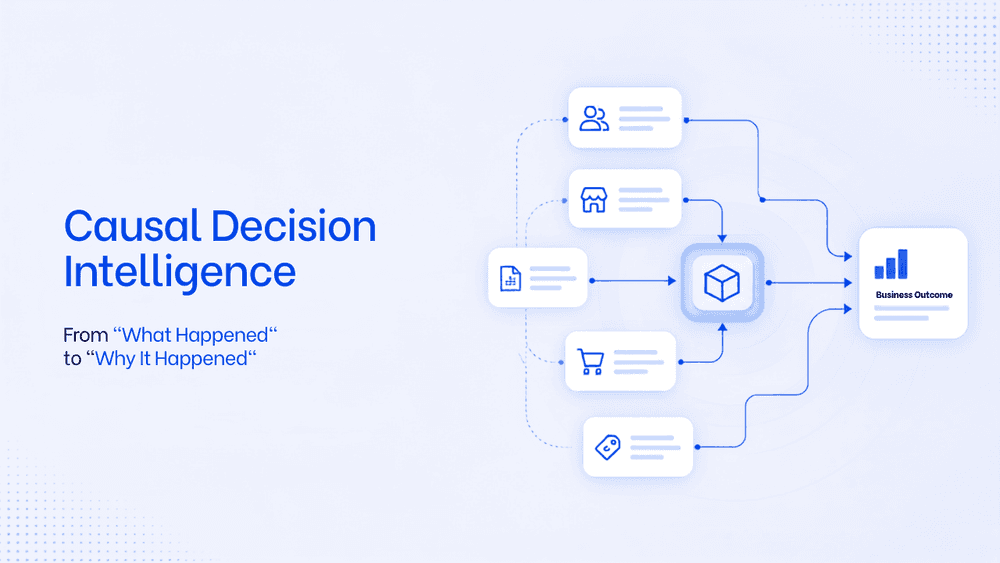
What Is Causal Decision Intelligence? A Framework To Move From "What Happened" to "Why It Happened"
Business intelligence tools are limited in their capability to find the root cause and the trigger behind it. Causal decision intelligence is the AI layer that helps business take faster, smarter decision with an auditable explanation. This will transform the way business analyse data and strategise on teh next actionable steps.
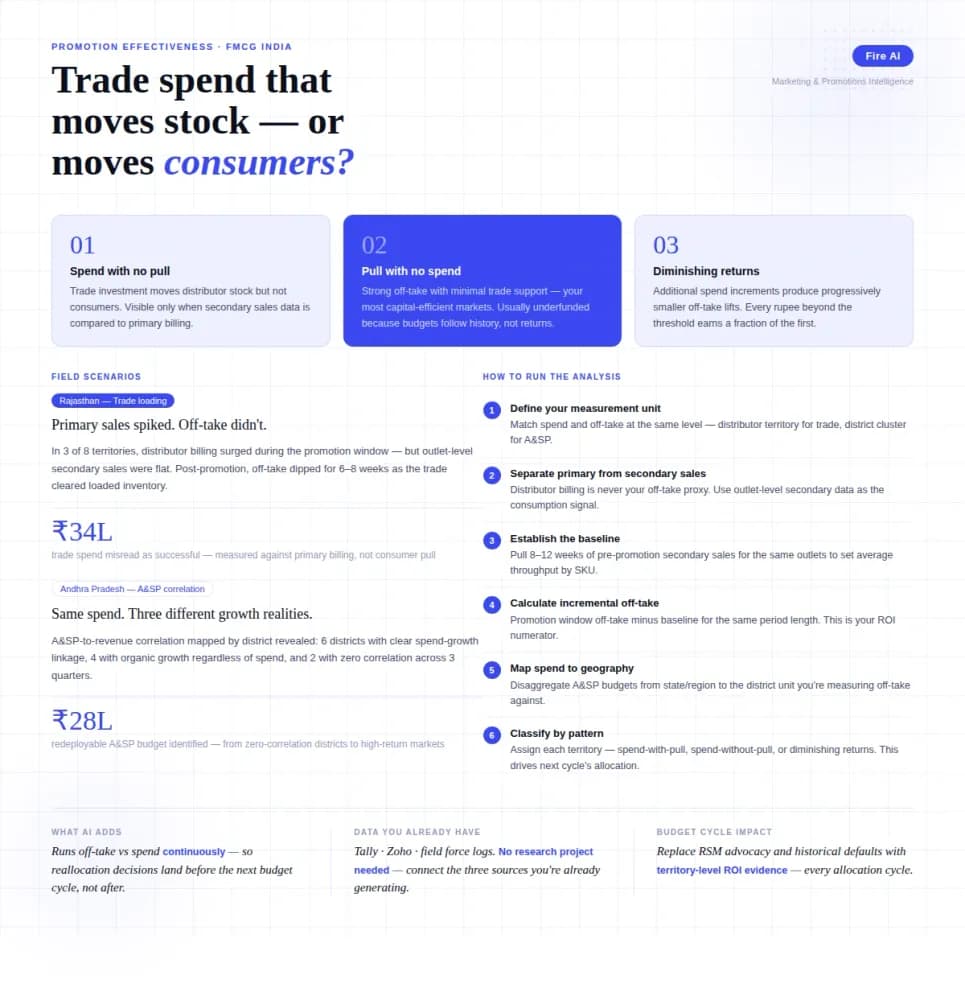
Measuring Promotion Effectiveness: A Data-Driven Guide for FMCG Marketers
FMCG brands in India spend 15–25% of gross revenue on trade promotions and A&SP (advertising and sales promotion) every year. Most can tell you how much they spent. Very few can tell you what it returned. The problem isn't a lack of data — it's that the data lives in disconnected places. Trade spend sits in finance. Off-take data lives with the distributor or field team. A&SP budgets are tracked in a marketing spreadsheet. No single view ties promotional investment to consumer pull at the outlet level. The result is a budget cycle where last year's spend allocation becomes next year's default, because no one has the numbers to argue for something different. This guide walks through how FMCG marketing and trade teams can build a promotion effectiveness framework that actually connects spend to outcome — not just channel-level assumptions.