

Quick answer
Most global BI tools handle Indian data formats poorly — defaulting to millions instead of lakhs/crores, Jan–Dec instead of April–March, and lacking native Tally or GST integration. Indian-built tools like FireAI handle lakhs/crores, ₹ formatting, April–March FY, Tally ledgers, GST dashboards, and Hindi NLQ natively — no custom DAX or third-party connectors needed.
India's data landscape has unique characteristics that global BI tools were not designed for. From Tally's ledger-based accounting structure to GST's complex filing formats, from lakhs/crores number formatting to regional language requirements — Indian businesses need BI tools that understand their context.
Indian Data Format Challenges
1. Tally Data Structure
Tally is not a standard relational database. It uses a proprietary data format with:
- Ledgers and groups — hierarchical account structure
- Cost centres — for department/project-wise tracking
- Stock items and godowns — inventory management with batch and expiry tracking
- Voucher types — sales, purchase, receipt, payment, journal, contra
Global BI tools treat Tally as just another database to connect to. They miss the semantic meaning of Tally's structure — a "sales" voucher type in Tally has specific business meaning that a generic BI tool does not understand.
Tool capability:
- FireAI: Native Tally integration — understands ledger structure, voucher types, and cost centres
- Power BI: Requires third-party Tally connector (₹5,000–₹15,000/month additional cost); treats data as flat tables
- Tableau: No native Tally support; requires manual CSV export or custom connector
- Zoho Analytics: Limited Tally integration; better with Zoho Books data
2. GST Data and Compliance
Indian businesses need GST analytics for:
- GSTR-1 filing reconciliation (sales data)
- GSTR-3B summary verification
- GSTR-2B reconciliation (purchase data and ITC claims)
- HSN-wise tax summary
- State-wise tax breakup (CGST, SGST, IGST)
- E-way bill compliance tracking
Tool capability:
- FireAI: Built-in GST dashboards with Tally data; reconciliation between billing and filing
- Power BI: Can build GST reports with custom development (no pre-built templates)
- Zoho Analytics: GST reports available if using Zoho Books for accounting
- Tableau: Requires full custom development for GST analytics
3. Indian Number Formatting (Lakhs and Crores)
Indian businesses think in lakhs (₹1,00,000) and crores (₹1,00,00,000), not thousands and millions. A revenue figure of ₹3,45,67,890 should display as ₹3.46 Cr, not $345,679 or ₹345.7M. If you regularly translate between the two systems, the free Lakhs & Crores converter handles the math (plus a live USD overlay).
Tool capability:
- FireAI: Native lakhs/crores formatting with ₹ symbol
- Power BI: Possible with custom formatting measures (DAX formulas) — not out of the box
- Tableau: Requires custom number formatting
- Zoho Analytics: Supports Indian formatting within its platform
4. April–March Financial Year
Indian businesses and tax authorities follow an April–March financial year. Most global BI tools default to January–December calendars.
This affects:
- Year-on-year comparisons (FY vs CY mismatch)
- Quarterly definitions (Q1 is April–June in India, not Jan–March)
- Budget vs actual comparisons
- Tax computation periods
Tool capability:
- FireAI: Default April–March financial year; quarterly breakdowns aligned to Indian FY
- Power BI: Configurable but requires custom date tables and DAX logic
- Zoho Analytics: Configurable
- Tableau: Configurable with custom fiscal year settings
5. Regional Language Support
India has 22 official languages. Business teams in different regions need dashboards they can read:
- Hindi for North India operations teams
- Tamil for Tamil Nadu-based businesses
- Marathi for Maharashtra manufacturing units
- Telugu for Andhra/Telangana teams
- Gujarati for Gujarat traders
Tool capability:
- FireAI: Supports Hindi and major regional languages for dashboards and AI queries
- Power BI: UI available in Indian languages; custom content localisation possible
- Zoho Analytics: Partial regional language support
- Tableau: Limited Indian language support
6. Indian Address and Geographic Data
Indian businesses need analytics by:
- State and district — not just country/region as global tools default
- Pin code — India's 19,000+ pin codes for delivery and service area analytics
- Zone classification — North/South/East/West/Central
- Tier classification — Metro, Tier-1, Tier-2, Tier-3 city analytics
Global BI tools have limited built-in Indian geographic data. Industry-specific Indian tools handle this natively.
Practical Recommendations
For Indian SMEs Using Tally
Choose FireAI or a BI tool with native Tally integration. Attempting to use Power BI or Tableau with Tally data requires significant custom development that most SMEs cannot sustain.
For Enterprises Using SAP/Oracle
Power BI or Tableau with custom Indian formatting configurations work well. These enterprises typically have BI teams that can handle the customisation.
For Businesses in the Zoho Ecosystem
Zoho Analytics is the natural choice — tight integration with Zoho Books handles Indian formats well within the ecosystem.
For Technical Teams
Open-source tools like Metabase or Superset can be configured for Indian formats but require developer effort for Tally integration, GST reporting, and localisation.
The Real Cost of "Making It Work" with Global BI Tools
Indian businesses often underestimate the hidden cost of adapting global BI tools:
| Customisation | Power BI Cost | Tableau Cost | FireAI |
|---|---|---|---|
| Tally connector | ₹5K–₹15K/month (third-party) | Manual CSV export | ₹0 (native) |
| Lakhs/crores formatting | Custom DAX measures | Custom number format | ₹0 (native) |
| April–March FY | Custom date table + DAX | Custom fiscal year config | ₹0 (default) |
| GST dashboards | Full custom development | Full custom development | ₹0 (pre-built) |
| Hindi NLQ | Not available | Not available | ₹0 (included) |
| Consultant for setup | ₹50K–₹2L one-time | ₹1L–₹3L one-time | ₹0 (zero-code) |
| Total monthly cost | ₹30K–₹60K+ | ₹40K–₹80K+ | ₹4,999 |
A ₹25Cr manufacturer in Ludhiana spent ₹3.5L on a Power BI implementation with a Tally connector. Six months later, the dashboards were unused because the finance team couldn't modify reports without the consultant. They switched to FireAI and had live Tally dashboards in a single afternoon.
The Bottom Line
Global BI tools treat India as "just another locale" — a checkbox in settings. Indian-built BI tools like FireAI treat lakhs/crores, Tally ledgers, GST compliance, and Hindi as first-class citizens. For businesses running on Tally with GST needs and regional language requirements, this is the difference between a product your team uses daily and ₹50K/month shelfware.
Actionable next step: If you run Tally, try connecting it to FireAI's free trial. You'll see your ledgers, GST data, and receivables in a live dashboard — formatted in lakhs/crores, aligned to April–March FY — within 10 minutes.
See best BI tools India for a comprehensive comparison of India-ready platforms.
Ready to act on your data?
See how teams use FireAI to ask in plain language and get analytics they can trust.
Explore FireAI workflows
Go from this topic into product features and solution paths that match what you read here.
Topic hub
Industry Analytics In India
Comparison pages and implementation guidance for industry-specific BI, dashboards, and analytics use cases in India.
Explore hubFrequently asked questions
Can Power BI display numbers in lakhs and crores format natively?
No. Power BI does not natively support the Indian numbering system (lakhs/crores). You need custom DAX measures and format strings — requiring technical expertise most Indian SME teams lack. FireAI displays lakhs/crores with ₹ symbol natively, out of the box, with zero configuration.
Which BI tool has the best native Tally integration in India?
FireAI has the deepest native Tally integration — it understands ledger hierarchies, voucher types, cost centres, godowns, and batch/expiry tracking. Connection takes 5 minutes. Power BI requires third-party connectors costing ₹5K–₹15K/month extra and treats Tally data as flat tables. Tableau has no native Tally support at all.
Can I get GST analytics and GSTR reconciliation from my BI tool?
FireAI provides pre-built GST dashboards from Tally data — GSTR-1 filing reconciliation, GSTR-2B ITC tracking, HSN-wise tax summaries, and state-wise CGST/SGST/IGST breakups. Zoho Analytics offers GST reports within the Zoho Books ecosystem. Power BI and Tableau require full custom development with no pre-built GST templates.
Do any BI tools support Hindi and regional Indian languages for querying?
FireAI supports natural language querying in Hindi and major regional languages — you can ask "पिछले महीने की बिक्री दिखाओ" and get an instant chart. Power BI has UI localisation but no Hindi NLQ capability. Tableau and Looker have limited Indian language support. For teams across India, Hindi NLQ dramatically improves adoption.
How do I set up April–March financial year in my BI dashboard?
In FireAI, April–March is the default financial year — Q1 is Apr–Jun, Q2 is Jul–Sep, etc. No configuration needed. In Power BI, you must create a custom date dimension table with DAX formulas. In Tableau, you configure custom fiscal year settings per workbook. For Indian businesses, a tool that defaults to Indian FY avoids quarterly mismatch errors.
Related in this topic
7 Best BI Tools in India (2026)
Compare the best business intelligence tools for Indian businesses in 2026. See pricing features and which BI platform fits SMBs mid-market and enterprise.
Tally Analytics: Turn Tally Data into Dashboards & Reports
Get AI-powered analytics and dashboards from Tally Prime data without SQL. FireAI connects to Tally for live GST, sales, inventory, and P&L—no spreadsheet exports.
Natural Language BI: Ask Questions, Get Charts
Discover how natural language BI lets anyone ask data questions in plain English and get instant charts and answers. No SQL, no dashboard building required.
Analytics for Indian SMBs: What Works & What to Avoid
Most Indian SMBs struggle with analytics because enterprise tools are too expensive, complex, and don't support Tally. Here's what actually works — and how to start for under ₹10K/month.
From the blog
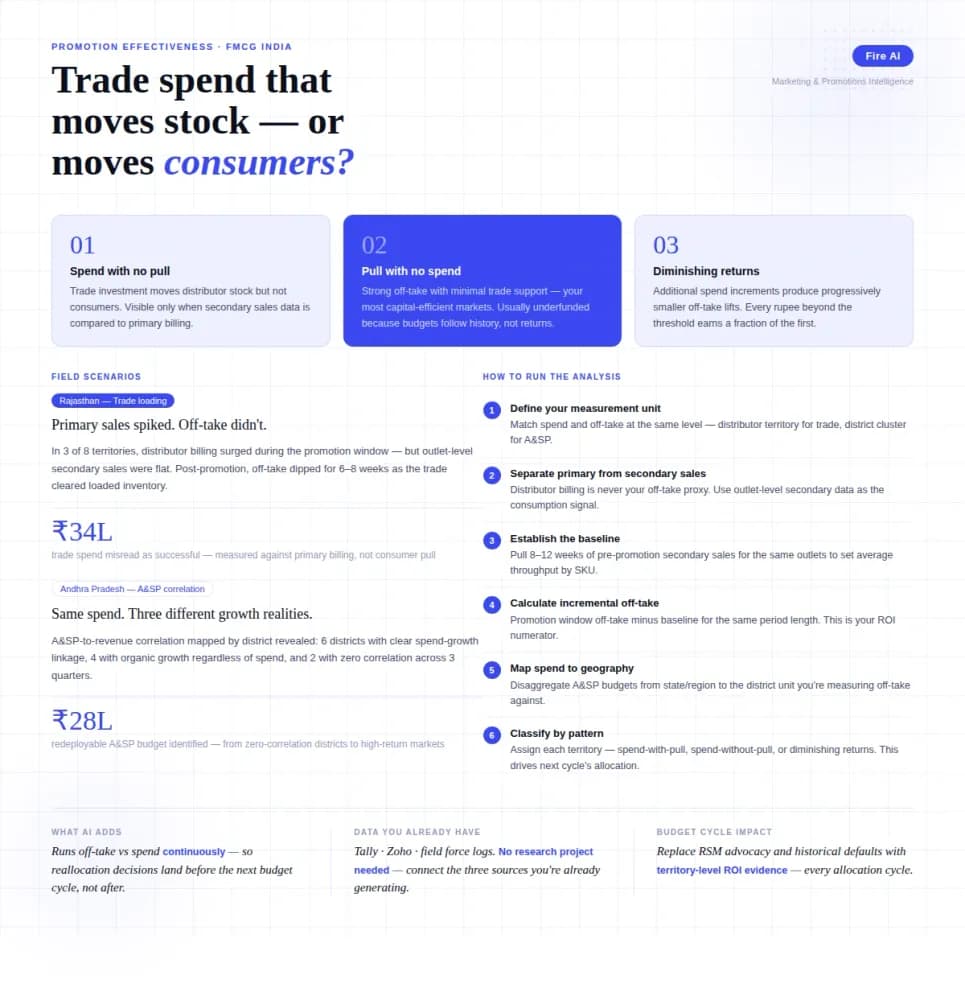
Measuring Promotion Effectiveness: A Data-Driven Guide for FMCG Marketers
FMCG brands in India spend 15–25% of gross revenue on trade promotions and A&SP (advertising and sales promotion) every year. Most can tell you how much they spent. Very few can tell you what it returned. The problem isn't a lack of data — it's that the data lives in disconnected places. Trade spend sits in finance. Off-take data lives with the distributor or field team. A&SP budgets are tracked in a marketing spreadsheet. No single view ties promotional investment to consumer pull at the outlet level. The result is a budget cycle where last year's spend allocation becomes next year's default, because no one has the numbers to argue for something different. This guide walks through how FMCG marketing and trade teams can build a promotion effectiveness framework that actually connects spend to outcome — not just channel-level assumptions.
Tally Analytics Dashboards for Indian Businesses
80% of Indian SMBs use Tally. Fewer than 5% have dashboards. Learn how to build real-time P&L, cash flow, and receivables analytics from your Tally Prime data.

Democratizing Data: How AI Analytics Levels the Playing Field for Small Businesses and Freelancers
For decades, data-driven decision making was a luxury that only enterprises could afford. Big companies hired data scientists, purchased expensive BI tools, and built complex data warehouses. In exchange, they received precise insights that guided budgets, strategy, and growth.