

Quick answer
Causal decision intelligence combines causal analysis with business decision-making. It helps teams investigate what caused a result and estimate how different actions could change it. For example, when sales fall, it helps you assess whether fixing availability, changing prices, or adjusting marketing is likely to help.
How does causal decision intelligence help your business?
Sales are down. Your team has three explanations: fewer enquiries, higher prices, or products being unavailable when customers need them.
Each explanation calls for a different response. Before spending more on advertising or offering a discount, you need to understand which explanation the evidence supports.
Causal decision intelligence brings that investigation into the decision process. It connects a business question with possible causes, actions you can take, and results you can measure.
Tools such as FireAI's Causal Chain support this work by helping teams explore relationships and candidate root causes across connected business data.
A practical example: orders rise, but revenue falls
Consider a Pune distributor using Tally alongside order and stock records. If monthly revenue falls from ₹40 lakh to ₹32 lakh despite rising orders, the business faces an ₹8 lakh monthly shortfall, or a 20% decline.
Before offering a discount, the sales manager can compare invoices, cancelled orders, stock availability, and supplier delivery dates to understand the gap.
To work through the decision, use the following breakdown of the ₹8 lakh shortfall:
- ₹5 lakh in cancelled orders following stockouts of popular products.
- ₹2 lakh in orders delayed into the next month after late purchase receipts.
- ₹1 lakh in other reductions, including lower demand for slower-moving products.
This breakdown directs attention to ₹7 lakh in cancelled or delayed orders. The team should check whether shortages preceded cancellations, compare affected products with products that stayed in stock, and account for seasonality and pricing changes. Delayed orders may shift revenue between months; they are not automatically lost sales.
If a stock-replenishment trial prevents 40% of the ₹5 lakh in cancellations, it would retain ₹2 lakh in monthly revenue. At a 20% gross margin, that is ₹40,000 in gross profit before extra costs. With ₹15,000 per month in additional stockholding and fulfilment costs, the estimated incremental contribution would be ₹25,000 per month.
The team can test an earlier reorder point and track fulfilled orders, cancellation value, inventory costs, and contribution. These calculations help compare actions; the measured trial results determine whether the change should expand.
How does causal decision intelligence work?
The process usually involves four steps:
- Define the decision. Be specific: "Should we increase stock for these products?" is more useful than "Why are sales weak?"
- Investigate possible causes. Check timing, business conditions, and competing explanations. Use diagnostic analytics to locate where the change occurred.
- Compare actions. Estimate what could happen under different choices, including the costs and assumptions behind each.
- Test and review. Where practical, trial the change and measure its effect before expanding it.
How does it fit within the four types of analytics?
Predictive analytics estimates what is likely to happen from patterns in data. Causal decision intelligence considers how an action might change that outcome.
| Approach | Example question |
|---|---|
| Descriptive | What happened to sales this month? |
| Diagnostic | Why did sales decline, and what evidence supports the explanation? |
| Predictive | What sales should we expect next month? |
| Prescriptive | What should we do to improve sales within our stock and cost limits? |
Causal decision intelligence supports prescriptive analytics by estimating how an intervention could change an outcome and comparing actions against business goals, costs, and constraints. Descriptive, diagnostic, and predictive analytics provide inputs to that decision. Together, these approaches connect business reporting with informed action.
Which techniques are used in causal decision intelligence?
- Causal mapping: Map proposed links between business drivers and outcomes, such as supplier delays, stockouts, cancellations, and revenue. Treat each link as a claim to investigate.
- Controlled experiments: Compare an intervention with a suitable control group, using random assignment where practical, to estimate the effect of a change.
- Observational causal analysis: When experiments are impractical, methods such as matching or difference-in-differences can support causal estimates if their assumptions hold. Relevant confounders and pre-existing trends must be examined.
- Counterfactual and sensitivity analysis: Compare what could happen under different actions, then vary assumptions about demand, costs, and effect size to see whether the preferred decision changes.
Why is correlation alone not enough?
Two figures moving together does not establish cause.
Stores with longer opening hours may record higher sales. But those stores might also be larger or located in busier areas. Extending the hours at every store may not deliver the same result.
Causal analysis examines alternative explanations and the assumptions needed to estimate an action's effect. Reliable conclusions depend on suitable data and methods; connecting data alone does not prove causation.
How does FireAI support this process?
FireAI connects business sources such as Tally, CRM systems, Shopify, and spreadsheets. Its Causal Chain feature helps users investigate relationships between business drivers and outcomes through natural-language questions.
Teams can explore possible explanations for a KPI change and review candidate root causes. Those findings provide a starting point for deciding what to investigate or test next.
For more background, read FireAI's guide to causal decision intelligence.
Ready to act on your data?
See how teams use FireAI to ask in plain language and get analytics they can trust.
Explore FireAI workflows
Go from this topic into product features and solution paths that match what you read here.
Topic hub
AI Analytics
Guides on natural language querying, AI-powered analytics, forecasting, anomaly detection, and automated insights.
Explore hubFrequently asked questions
Is causal decision intelligence the same as causal AI?
Causal AI refers to methods and systems used to analyse cause-and-effect relationships. Causal decision intelligence applies that analysis to business choices, including goals, costs, constraints, and follow-up measurement.
How can wholesale distributors use causal decision intelligence?
Distributors can investigate whether stockouts, supplier delays, pricing changes, or customer demand explain a sales decline. Linking orders, stock movements, delivery dates, and invoices helps teams compare actions such as changing reorder points or suppliers, then measure fulfilment, cancellations, and margin.
Can causal decision intelligence work with Tally data?
Yes. Tally data can support investigations into revenue, margins, purchases, and receivables. Questions about missed orders or delivery delays also need operational records; invoice data alone may not capture why a sale was lost.
What data and integrations are needed beyond Tally?
The sources depend on the decision: CRM records for leads and sales activity, order and inventory systems for availability, Shopify for online sales, or spreadsheets for operational records. Match records using consistent customer, product, order, and date fields. Confirm that the required connector or import method supports your systems and data fields.
Can Indian SMBs use causal decision intelligence on Tally data without a dedicated analytics team?
Yes. Owners, finance managers, and operations teams can begin with guided questions on connected Tally and operational data. They still need someone who understands the records and can validate the findings. Complex causal estimates, experiment design, or high-impact decisions may require specialist support.
Does causal decision intelligence automatically prove the root cause?
No. A suggested cause needs supporting evidence. Depending on the question, this may involve experiments, appropriate statistical methods, and checks for other explanations. Connecting data or finding a correlation does not by itself establish causation.
Related in this topic
What Is Diagnostic Analytics? Definition, Examples & Techniques
Diagnostic analytics answers WHY something happened — not just what. Learn the definition, 5 key techniques (root cause analysis, drill-down, correlation), and real business examples.
What is Prescriptive Analytics? Examples and Benefits
Prescriptive analytics uses AI and optimization algorithms to recommend specific actions for optimal results. Learn how prescriptive analytics works, which techniques it uses, and how businesses apply it for decision automation and optimization.
Can AI Work with Tally Prime and ERP 9 Data?
Yes — AI can connect directly to Tally Prime and Tally ERP 9 to deliver instant dashboards, natural language queries, and automated insights on your financial, sales, and inventory data. Learn how AI analytics works with Tally data.
What is Text to SQL? How It Works, Examples, and Tools
Text to SQL converts natural language questions into SQL queries automatically using AI. Learn how text-to-SQL works, see real examples, and discover tools that enable anyone to query databases without SQL knowledge.
From the blog
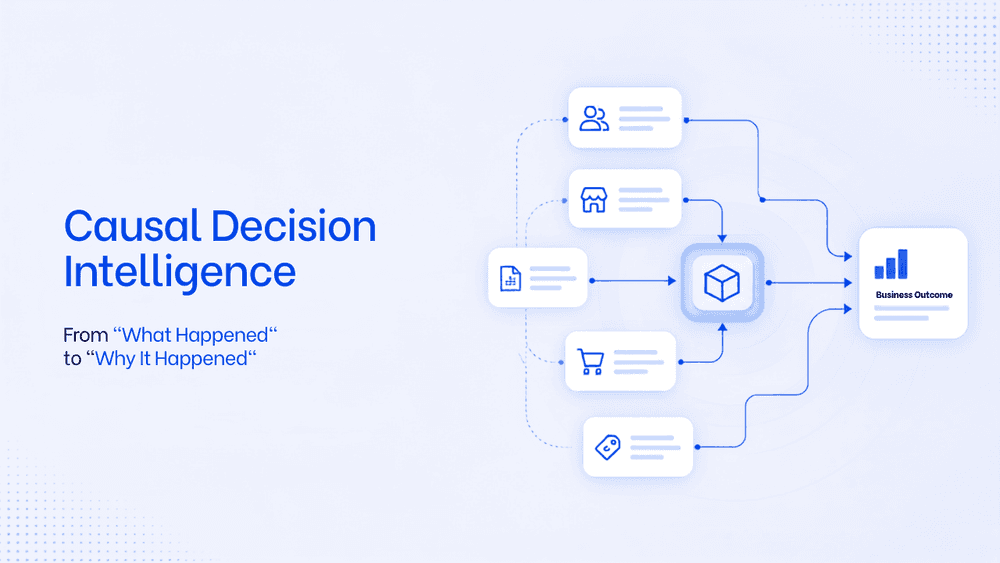
What Is Causal Decision Intelligence? A Framework To Move From "What Happened" to "Why It Happened"
Business intelligence tools are limited in their capability to find the root cause and the trigger behind it. Causal decision intelligence is the AI layer that helps business take faster, smarter decision with an auditable explanation. This will transform the way business analyse data and strategise on teh next actionable steps.
Causal Chain Analysis: Fix What's Breaking Revenue
Causal chain analysis traces metric drops to their root cause. Learn how Indian businesses use it to stop revenue leaks before they compound.

How a Modern Analytics Platform Transforms Business Intelligence
Why faster decision-making, real-time analytics, and AI-driven intelligence separate market leaders from laggards—and how Fire AI closes the gap between data and action.