

Quick answer
Generative BI uses large language models to automatically create reports, insights, visualisations, and natural language summaries from business data. Instead of building dashboards manually, users ask questions in plain language and get AI-generated analysis instantly. FireAI is a generative BI platform that works with Tally and Indian business data—ask in English or Hindi, get AI-created reports in seconds.
Generative BI uses large language models (LLMs) to automatically generate reports, dashboards, and insights from your business data — without requiring SQL, formulas, or manual report building.
It represents the next evolution of business intelligence, combining the structured data handling of traditional BI with the language understanding capabilities of modern AI models like GPT-4, Claude, and Gemini.
What is Generative BI?
Generative BI is business intelligence powered by generative artificial intelligence — specifically large language models and other generative AI technologies. Instead of requiring analysts to write SQL queries, build pivot tables, or configure dashboards manually, generative BI systems respond to natural language requests and automatically generate:
- Written insights and summaries — "Your Q3 revenue grew 18% driven by product X in the south region"
- Data visualizations — automatic chart selection and generation based on the question asked
- SQL queries — auto-generated queries from plain language questions (see text to SQL)
- Narrative reports — full analysis documents with context, trends, and recommendations
- Anomaly explanations — "Sales dropped this week because of a 3-day stock-out on SKU #42"
How Generative BI Differs from Traditional BI
| Aspect | Traditional BI | Generative BI |
|---|---|---|
| Report creation | Manual — requires analyst time | Automated — generated on demand |
| User interface | Charts, tables, dashboards | Natural language conversation |
| Query method | SQL or drag-and-drop | Plain language questions |
| Insight delivery | Descriptive (what happened) | Explanatory + prescriptive (why + what to do) |
| Speed | Hours to days for new reports | Seconds |
| User requirement | BI analyst / data team | Any business user |
How Generative BI Works
1. Data Connection
The system connects to your business data sources — databases, data warehouses, spreadsheets, ERP systems like Tally, or cloud apps. A semantic layer (business-defined metrics mapped to your tables) maps raw data to business terms (e.g., "revenue" maps to the sum of the orders table). See business intelligence for how this fits into a full BI stack.
2. Intent Understanding
When a user asks a question in natural language — "What were my top 5 products last quarter?" — the LLM interprets the business intent, identifies the relevant tables and metrics, and determines the best way to answer.
3. Query Generation
The system automatically generates the SQL or data query needed to retrieve the answer. This is the text-to-SQL component at the heart of most generative BI systems.
4. Insight Generation
Rather than just returning a table of numbers, generative BI composes a natural language response with context, trend comparisons, and sometimes recommendations.
5. Visualization
The system selects the most appropriate chart type and renders the visualization automatically, without the user needing to choose between bar charts, line charts, or tables.
Generative BI vs Conversational Analytics vs Agentic Analytics
These terms are related but distinct:
- Conversational analytics: Broad term for any analytics using natural language interaction
- Generative BI: Specifically involves generative AI (LLMs) to create new content (reports, summaries, SQL)
- Agentic analytics: Autonomous AI agents that proactively run analysis and take actions without being prompted
Generative BI is a subset of conversational analytics and a stepping stone toward fully agentic systems.
Business Benefits of Generative BI
Speed to insight: What took analysts hours to prepare can be answered in seconds. Business users get answers immediately instead of waiting for reports.
Democratized access: Non-technical employees can query data directly without needing a data analyst as an intermediary. This is the promise of true data democratization.
Reduced analyst bottleneck: Data teams spend less time on repetitive report requests and more time on strategic analysis.
Narrative context: Numbers with written interpretation are easier to act on than raw data tables. Generative BI adds the "so what" to your data.
Generative BI in India
For Indian businesses, generative BI is particularly valuable because:
- It removes the need for a dedicated SQL-literate analyst team
- Regional language support allows Hindi-speaking managers to query data directly
- It unlocks analytics for SMBs that couldn't afford or staff a traditional BI setup
Platforms like FireAI bring generative BI capabilities to Indian SMBs at accessible pricing, with native integration to Tally and Indian business data sources.
Is Generative BI Ready for Production?
Yes, with caveats. Generative BI works well for:
- Standard business questions about sales, finance, and operations
- Exploratory data analysis and trend identification
- Automatic insight summaries and reports
It still requires governance to prevent hallucinations — a validated semantic layer and data quality practices ensure the AI works with approved, accurate business definitions rather than making up answers.
How FireAI Uses Generative BI
FireAI is a generative BI platform built for Indian businesses:
Ask in English or Hindi, Get AI Reports: A business owner in Rajkot asks "मेरे टॉप 10 प्रोडक्ट्स कौन से हैं पिछली तिमाही में?" and gets an AI-generated report with charts, rankings, and commentary—directly from their Tally data.
Instant Report Generation: No more waiting days for your accountant to compile MIS reports. Ask "Generate a monthly P&L summary for the last 6 months" and FireAI creates a formatted report with trends, variance analysis, and key callouts in seconds.
Tally-Native Generative BI: Most Indian SMBs have their business data in Tally. FireAI connects natively and applies generative AI to create insights that previously required exporting data, building Excel pivot tables, and writing manual analysis.
Practical Indian Business Examples:
- A ₹25 Cr Ahmedabad chemical manufacturer asks "Why did our raw material costs increase this quarter?" and gets an AI-generated analysis identifying 3 specific suppliers with price increases totalling ₹12 lakh
- A Pune auto-parts distributor generates weekly sales reports for 8 branch managers with one question—replacing a 2-day manual process that cost ₹1.5 lakh/month in analyst time
- A Delhi FMCG company asks "Which products have declining margins?" and receives an AI report ranking all products by margin trend, flagging 5 SKUs where margins dropped below 15%
Generative BI vs Traditional Dashboard: A traditional dashboard shows you numbers you already configured. Generative BI creates new analysis on demand—answering questions you haven't pre-built dashboards for. This makes it dramatically more flexible and accessible than any traditional BI tool.
Ready to act on your data?
See how teams use FireAI to ask in plain language and get analytics they can trust.
Explore FireAI workflows
Go from this topic into product features and solution paths that match what you read here.
Topic hub
AI Analytics
Guides on natural language querying, AI-powered analytics, forecasting, anomaly detection, and automated insights.
Explore hubFrequently asked questions
How is generative BI different from traditional BI tools like Power BI or Tableau?
Traditional BI requires manually building dashboards, writing SQL, and configuring reports. Generative BI uses LLMs to create reports, visualisations, and written summaries from natural language questions. You ask "What were my top products last quarter?" and get a complete AI-generated analysis—no technical skills, no dashboard building.
Can Indian businesses use generative BI with Tally data in Hindi?
Yes. FireAI supports generative BI queries in English, Hindi, and other Indian languages directly on Tally data. A business owner in Rajkot can ask "पिछले महीने की बिक्री कितनी थी?" and get an AI-generated sales report with charts and insights from their Tally data—no English or SQL required.
Is generative BI accurate enough for financial reporting?
Accuracy depends on the semantic layer and data model quality. Well-governed generative BI platforms like FireAI validate queries against defined business metrics, preventing hallucinations. For financial reporting, FireAI maps Tally ledger structures to business terms so "revenue" always means the right thing—not an LLM guess.
What are real examples of generative BI saving time for Indian companies?
A Pune distributor replaced a 2-day manual MIS report process with one NLQ query, saving ₹1.5 lakh/month in analyst time. An Ahmedabad manufacturer gets instant AI-generated cost analysis that previously required 4 hours of Excel work. A Delhi FMCG company generates product margin reports for 200+ SKUs in seconds instead of days.
How does generative BI handle follow-up questions and drill-downs?
Generative BI platforms maintain conversational context. After asking "What were my sales last quarter?", you can follow up with "Break that down by region" or "Which products declined?" and the AI understands the context—generating new analysis that builds on the previous answer without starting from scratch.
Related in this topic
What is Agentic Analytics? AI Agents for BI
Agentic analytics uses autonomous AI agents to proactively analyze data, surface insights, trigger alerts, and take actions without human prompting. Learn how agentic AI differs from traditional BI, and what it means for business decision-making.
What is AI-Powered Business Intelligence?
AI-powered business intelligence integrates AI and machine learning with traditional BI to automate insights, enable natural language queries, and provide predictive analytics. Learn how AI BI works, which features matter, and how businesses use it.
What is Augmented Analytics? Definition and Benefits
Augmented analytics uses AI and machine learning to automate data preparation, insight discovery, and natural language generation. Learn how augmented analytics works, which benefits it provides, and see real examples of automated insights.
Natural Language BI: Ask Questions, Get Charts
Discover how natural language BI lets anyone ask data questions in plain English and get instant charts and answers. No SQL, no dashboard building required.
From the blog
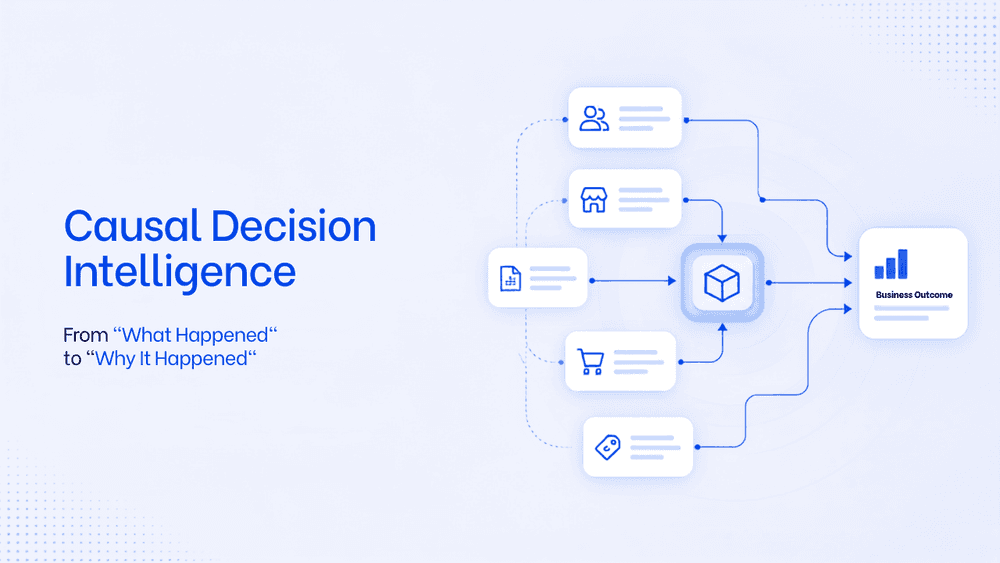
What Is Causal Decision Intelligence? A Framework To Move From "What Happened" to "Why It Happened"
Business intelligence tools are limited in their capability to find the root cause and the trigger behind it. Causal decision intelligence is the AI layer that helps business take faster, smarter decision with an auditable explanation. This will transform the way business analyse data and strategise on teh next actionable steps.

Democratizing Data: How AI Analytics Levels the Playing Field for Small Businesses and Freelancers
For decades, data-driven decision making was a luxury that only enterprises could afford. Big companies hired data scientists, purchased expensive BI tools, and built complex data warehouses. In exchange, they received precise insights that guided budgets, strategy, and growth.

What Is a Data Silo and Why Is It Slowing Down Your Business?
Data silos are silently costing Indian businesses time, money and decisions. Here is what they are, why they form and how to break them for good with FireAI.