

Quick answer
Pricing analytics is the use of data to understand list versus realized prices, how demand responds to price changes, and how promotions and schemes change margin. Teams compare channels and competitors, measure elasticity, and catch discount leakage. FireAI connects sales, scheme, and billing data so pricing intelligence stays current without manual spreadsheet merges.
Pricing analytics is the practice of measuring and explaining how prices, discounts, and market conditions show up in your net realization and margin, not just in your list price or MRP. It links commercial decisions (MRP, channel terms, trade schemes, marketplace coupons) to what customers actually pay and what the business keeps after returns and fees.
This page is definitional. For a broader top-line view, see what is revenue analytics. For FMCG trade schemes specifically, see what is trade promotion analytics. Industry playbooks: FMCG marketing use cases and D2C planning use cases.
What pricing analytics includes
Pricing analytics typically covers:
- Net realized price after discounts, cashbacks, channel fees, and returns (per SKU, pack, region, or channel)
- Price vs volume and mix so revenue moves are not misread as “pure pricing” when they are actually mix-driven
- Promotional depth and frequency, including list-funded versus brand-funded trade spend
- Competitive and channel benchmarks where market or syndicated inputs exist, plus internal parity across outlets or regions
In India, GST and state logistics differences can change effective economics even when MRP is fixed, so good pricing analytics often sits next to finance-consistent sales recognition from Tally or ERP, not only front-end list prices.
Competitive pricing and price intelligence
Competitive pricing analysis compares your realized or shelf prices to alternatives customers see, whether on Amazon, Flipkart, Meesho, or modern trade shelves. The goal is not only to match a number but to understand when matching destroys margin and when perceived parity in a category is non-negotiable.
Pricing intelligence dashboards often combine:
- Position vs market median or key competitors for hero SKUs
- Stability of price over time (frequent undercutting vs disciplined lists)
- Channel-specific gaps (D2C site vs marketplace vs distributor)
FireAI can unify marketplace exports, DMS, or POS with finance data so commercial and category teams do not debate spreadsheets when prices move weekly.
Price elasticity and scenario thinking
Price elasticity in business settings describes how sensitive volume or revenue is to a price change. You rarely need a formal econometric model on day one; many teams start with before/after tests, A/B or regional pilots, and cohort readouts when list price or a scheme changes.
Useful questions pricing analytics answers:
- Did a 5% list change move volume enough to protect margin dollars?
- Did a “₹20 off” promotion pay for itself in incremental units or only shift timing?
- Is demand more elastic in e-commerce than in general trade for the same SKU?
Deeper “why” questions on unexpected margin moves connect to diagnostic analytics and, where you invest in it, root-cause and causal review.
Promotion pricing impact and trade spend
Promotion pricing impact isolates what schemes, bundles, and coupons do to average selling price and contribution after funding. In FMCG, trade promotions and secondary schemes are a major lever; the analytics job is to tie outlet or distributor orders to funded investment and incremental offtake, not only to list discounts.
This overlaps trade promotion analytics but pricing analytics still owns the net price path: what the consumer pays, what the retailer keeps, and what the manufacturer funds. D2C teams focus more on site coupons, ad-attributed sales, and platform-funded marketplace discounts, where net realization can diverge sharply from MRP on the product page.
How FireAI tracks pricing from sales data
FireAI is built for teams whose truth lives in Tally, DMS, e-commerce and marketplace feeds, and operational exports:
- Connect transactional data so list price, discount lines, and net lines roll up to region, channel, pack, and time the way finance expects.
- Build pricing views for realized price trends, discount rate, channel comparison, and promotion overlays without hand-maintained workbooks.
- Ask in plain language, for example: net price after returns for a SKU on a marketplace last month, or discount depth by region vs prior quarter, alongside guidance from how to analyze Tally data with AI.
The outcome is pricing strategy analytics that stays tied to what actually hit the bank and the P&L, not only to a planning deck.
Pricing analytics vs other analytics domains
- Revenue analytics explains total revenue change across channels; pricing analytics stress-tests net price and margin per decision.
- Unit economics links CAC, LTV, and payback; pricing analytics feeds per-order margin and realization on the revenue side of that story.
- Trade promotion is one slice of promotion pricing in FMCG; D2C and logistics teams still need the same realized price discipline with different levers.
Ready to act on your data?
See how teams use FireAI to ask in plain language and get analytics they can trust.
Explore FireAI workflows
Go from this topic into product features and solution paths that match what you read here.
Topic hub
BI Fundamentals
Foundational guides on business intelligence, analytics architecture, self-service BI, and core data concepts.
Explore hubFrequently asked questions
What is pricing analytics in simple terms?
Pricing analytics is the use of sales and product data to understand list versus realized prices, the effect of discounts and promotions, and how price changes or competitive moves connect to margin. It helps teams set and defend prices, measure scheme ROI, and avoid revenue that looks good but erodes net realization.
What metrics are used in pricing analytics?
Common metrics include average selling price, net realized price, discount rate or depth, price index versus competitors or channels, volume and mix alongside price, and contribution margin after promotions. FMCG teams add trade spend to sales and lift metrics; e-commerce teams add coupon and ad-attribution context.
How is pricing analytics different from revenue analytics?
Revenue analytics focuses on where revenue comes from and how it changes across segments and time. Pricing analytics focuses on the price path inside that revenue: how list prices, discounts, schemes, and fees translate into net price and margin. The two are related but answer different management questions.
Can FireAI support pricing analytics for Indian companies?
Yes. FireAI integrates with sources such as Tally, DMS, and commerce or marketplace data so teams can track realized prices, discount patterns, and channel comparisons, and ask natural-language questions on pricing views without building fragile spreadsheet models.
Related in this topic
What Is Revenue Analytics? Decomposition, Channels & Pricing
Revenue analytics explains where revenue comes from, how it moves over time, and what drives it across channels and products. Learn revenue decomposition, channel mix, pricing impact, and trend analysis, and how FireAI ties Tally and commerce data into revenue intelligence.
What is Unit Economics? CAC, LTV & Payback Period
Unit economics measures the direct revenue and cost associated with a single customer or order. Learn how D2C and e-commerce brands calculate CAC, LTV, payback period, and contribution margin — and how FireAI pulls these metrics automatically from Shopify and marketplace data.
What Is Trade Promotion Analytics? FMCG Schemes & ROI
Trade promotion analytics measures how discounts, display fees, and trade schemes perform against spend and targets. Learn promotion types, ROI methods, and how FireAI tracks scheme performance from DMS and outlet data for Indian FMCG teams.
What Is Diagnostic Analytics? Definition, Examples & Techniques
Diagnostic analytics answers WHY something happened — not just what. Learn the definition, 5 key techniques (root cause analysis, drill-down, correlation), and real business examples.
From the blog
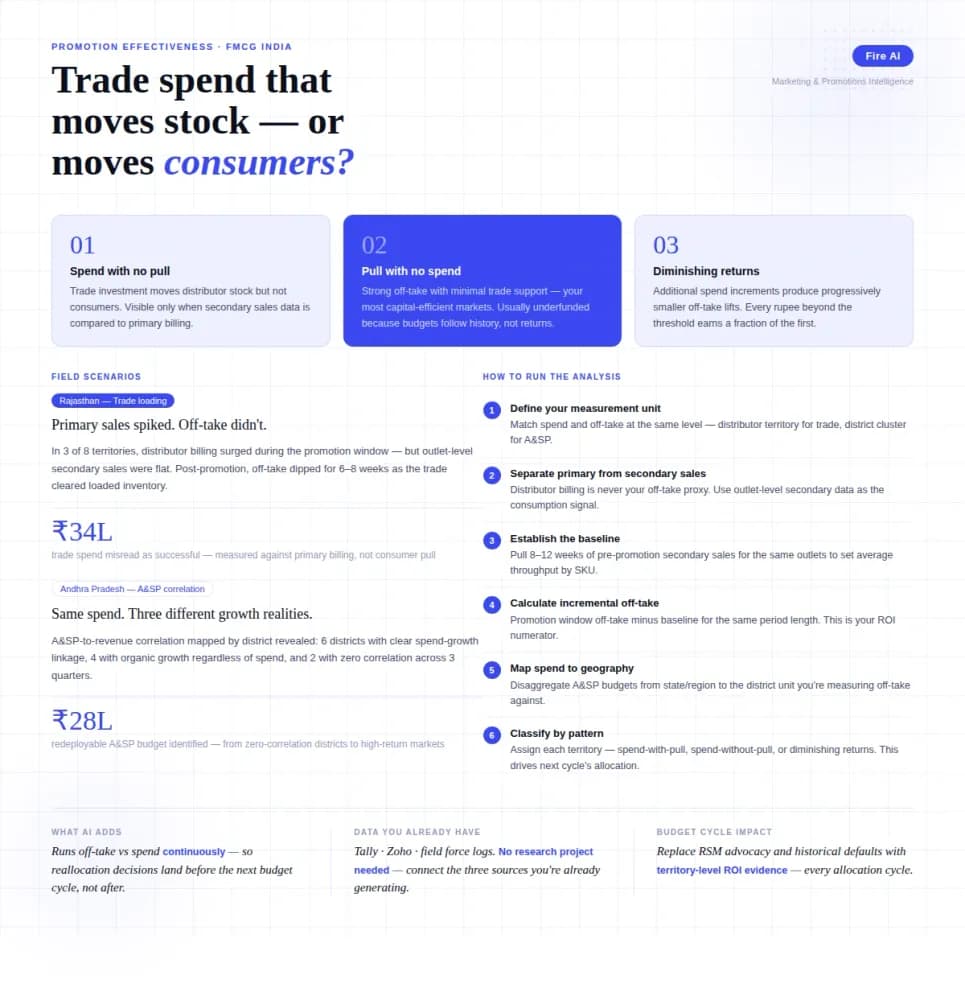
Measuring Promotion Effectiveness: A Data-Driven Guide for FMCG Marketers
FMCG brands in India spend 15–25% of gross revenue on trade promotions and A&SP (advertising and sales promotion) every year. Most can tell you how much they spent. Very few can tell you what it returned. The problem isn't a lack of data — it's that the data lives in disconnected places. Trade spend sits in finance. Off-take data lives with the distributor or field team. A&SP budgets are tracked in a marketing spreadsheet. No single view ties promotional investment to consumer pull at the outlet level. The result is a budget cycle where last year's spend allocation becomes next year's default, because no one has the numbers to argue for something different. This guide walks through how FMCG marketing and trade teams can build a promotion effectiveness framework that actually connects spend to outcome — not just channel-level assumptions.

How a Modern Analytics Platform Transforms Business Intelligence
Why faster decision-making, real-time analytics, and AI-driven intelligence separate market leaders from laggards—and how Fire AI closes the gap between data and action.

Key Trends Shaping the Future of AI-Powered Business Intelligence
Discover how AI-enabled analytics like Fire AI are transforming business intelligence with real-time dashboards, anomaly detection, and decision intelligence.