

Quick answer
Revenue analytics measures where revenue comes from, how it changes, and what drives it across channels, products, and customers. Teams split growth into volume, price, and mix, compare channels, and catch discount leakage. FireAI connects commerce and Tally data so leaders see revenue intelligence live without spreadsheet merges.
Revenue analytics turns sales and billing data into a clear picture of how money enters the business, which segments grow or shrink, and whether growth is healthy or inflated by discounts. It goes beyond a single top-line number to show channel mix, product and customer contribution, and the impact of price and volume.
This page defines revenue analytics, its main building blocks, and how platforms like FireAI help Indian teams unify data from Tally, marketplaces, and POS. For industry playbooks, see D2C e-commerce finance use cases and logistics sales use cases.
Why revenue analytics matters
Headline revenue can hide problems: a flat year might mask a dying channel propped up by promotions, or growth might come only from low-margin SKUs. Revenue analytics gives finance, sales, and founders a shared language to ask whether growth is sustainable, profitable at the unit level, and aligned to strategy. It pairs naturally with unit economics for D2C and with lane or client views for logistics operators who need to connect booked freight to realized yield.
Revenue decomposition
Revenue decomposition breaks total revenue change into explainable parts so you do not only report “up 12%” but why.
Common approaches include:
- Volume vs price: Did you sell more units, charge higher average prices, or both? A simple bridge might compare prior period revenue to current period by isolating unit growth and average selling price (ASP) effects.
- Mix effects: When product or customer mix shifts (for example, more marketplace orders vs D2C site), revenue can grow while margin pressure worsens. Mix analysis ties revenue movement to category, SKU, region, or channel slices.
- New vs repeat: Especially in e-commerce, splitting revenue by first-time vs returning buyers shows whether growth depends on expensive acquisition or durable demand.
Decomposition is the backbone of serious financial dashboards and board-ready narratives.
Channel mix and revenue attribution
Channel mix analytics compares revenue and contribution across D2C website, Amazon and Flipkart, retail distributors, inside sales, and partnerships (exact channels depend on your model). Good channel views include:
- Gross and net revenue after returns, fees, and GST-relevant adjustments where finance requires them
- Growth rate and share of total by channel
- CAC or cost-to-serve proxies where marketing and fulfilment data exist, so revenue share does not overstate profit share
For logistics and 3PL businesses, “channel” often maps to key accounts, lanes, or service lines; the same discipline applies when you read revenue from logistics sales use cases alongside operational KPIs.
Pricing impact and discount leakage
Pricing analytics links list price, discounts, schemes, and net realization to revenue. Teams watch:
- Discount depth and frequency by segment or campaign
- Realized price vs list or MRP bands, including marketplace coupons you partially fund
- Elasticity-style reads (even simple before/after tests) when you change prices or bundles
Unchecked promotions are a common source of revenue that looks strong but margin that is weak. Revenue analytics surfaces that gap early.
Trend analysis and forecasting context
Trend analysis on revenue uses time series (daily, weekly, monthly) with seasonality and event markers (Diwali, end-of-quarter pushes, monsoon for certain categories). It supports:
- Comparing YoY and MoM on a consistent calendar basis
- Separating one-off spikes from underlying run-rate
- Feeding inputs into demand forecasting and inventory or capacity planning
The goal is not only a backward-looking chart but a forward-looking conversation about pipeline, seasonality, and risk.
How FireAI supports revenue analytics
FireAI is built for teams that live in Tally, Shopify, marketplaces, and operational systems but need one place to question revenue:
- Connect accounting and commerce sources so recognized revenue, orders, and fees stay aligned to the definitions finance approves.
- Build revenue dashboards for decomposition views, channel mix, pricing and discount panels, and trend lines without waiting on spreadsheet merges.
- Ask in plain language, for example: revenue by channel last quarter vs prior year, top declining SKUs by revenue, or net realization after returns for a marketplace, similar to how to analyze Tally data with AI.
That turns revenue analytics from a monthly pack into a live operating layer for commercial and finance leaders.
Ready to act on your data?
See how teams use FireAI to ask in plain language and get analytics they can trust.
Explore FireAI workflows
Go from this topic into product features and solution paths that match what you read here.
Topic hub
Dashboard And Reporting
Practical content on KPI dashboards, executive reporting, trend analysis, charts, and reporting automation.
Explore hubFrequently asked questions
What is revenue analytics in simple terms?
Revenue analytics is the analysis of sales and billing data to understand total revenue, how it changes over time, and what drives it. That includes breaking growth into volume, price, and mix, comparing channels and products, measuring pricing and discount effects, and reading trends with context. The aim is better decisions on pricing, channel investment, and forecasting.
How is revenue analytics different from a revenue report?
A revenue report often states totals for a period. Revenue analytics adds structure: decomposition into drivers, segment and channel comparisons, pricing and discount diagnostics, and trend interpretation. It focuses on explaining movement and supporting action, not only restating the number.
What metrics are most important in revenue analytics?
Common metrics include total and net revenue, revenue by channel and product, growth rates, average selling price, volume sold, mix shares, discount rate or depth, new versus repeat customer revenue, and cohort or segment trends. The exact set depends on whether you are D2C, logistics, FMCG, or services, but decomposition and channel mix appear in almost every mature setup.
Can FireAI help with revenue analytics for Indian businesses?
Yes. FireAI integrates with sources such as Tally and commerce platforms so teams can maintain revenue views, dashboards, and natural-language questions on channel mix, trends, and related financial slices without maintaining fragile spreadsheet bridges.
Related in this topic
What is a Financial Dashboard? Metrics and Examples
A financial dashboard displays key financial metrics — revenue, margin, cash flow, and expenses — in real time on a single screen. Learn what to include in a financial dashboard and how to build one from Tally or your accounting system.
What is a Sales Dashboard? Metrics and Examples
A sales dashboard is a visual tool that displays real-time sales performance metrics — revenue, pipeline, win rate, and team performance — on a single screen. Learn what to include in a sales dashboard and how to build one.
What is Unit Economics? CAC, LTV & Payback Period
Unit economics measures the direct revenue and cost associated with a single customer or order. Learn how D2C and e-commerce brands calculate CAC, LTV, payback period, and contribution margin — and how FireAI pulls these metrics automatically from Shopify and marketplace data.
Trend Analysis: Definition, Methods & Examples (With Formulas)
Trend analysis spots patterns in sales, revenue and demand over time. Learn 6 methods (moving averages, regression, time-series), formulas, and real business examples.
From the blog

AI-Powered Analytics: From Data Overload to Decision Intelligence
The Analytics Crisis: What We’re Seeing Across Indian Businesses Across India’s mid-market segment — companies between ₹50Cr and ₹500Cr in revenue — we’re witnessing a silent crisis. Not of revenue or growth, but of **analytics inefficiency**.
Causal Chain Analysis: Fix What's Breaking Revenue
Causal chain analysis traces metric drops to their root cause. Learn how Indian businesses use it to stop revenue leaks before they compound.
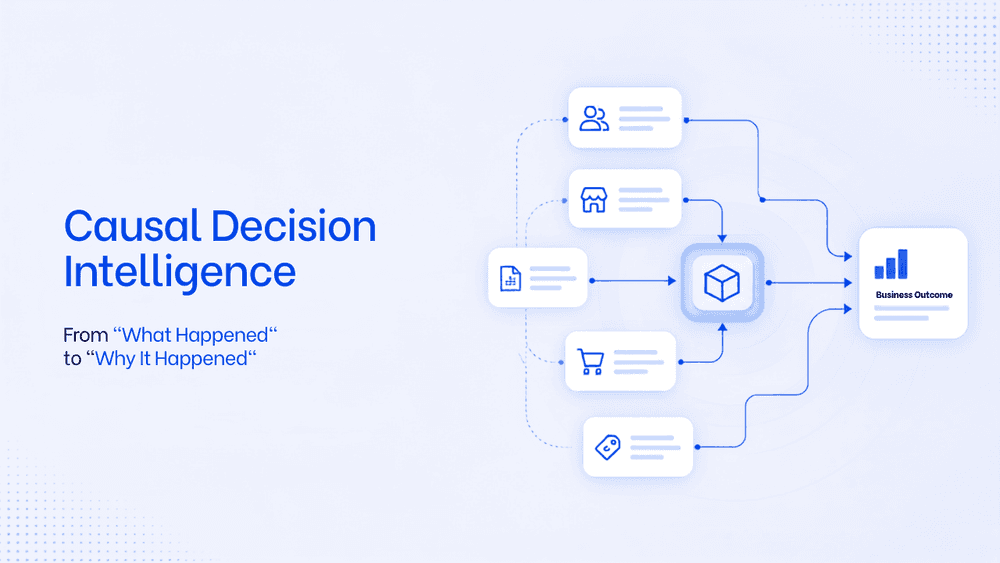
What Is Causal Decision Intelligence? A Framework To Move From "What Happened" to "Why It Happened"
Business intelligence tools are limited in their capability to find the root cause and the trigger behind it. Causal decision intelligence is the AI layer that helps business take faster, smarter decision with an auditable explanation. This will transform the way business analyse data and strategise on teh next actionable steps.