

All articles
What Is Causal Decision Intelligence? | FireAI
Learn how causal decision intelligence moves beyond reporting to explain why metrics change, reveal root causes and support faster business decisions.
G
Gurpreet Singh
Sep 3, 2026 · 6 min read
Most business intelligence tools report what changed.
Very few can explain why, or what to do about it.
This is a guide to close that gap.
In brief:
- Traditional business intelligence and predictive analytics are pattern-detection tools: they show what happened and forecast what's likely next, but neither identifies cause.
- Causal decision intelligence applies causal inference, not correlation, to trace the actual driver behind a change in business data, distinguishing genuine cause from coincidence.
- The urgency behind this shift is structural: as AI systems move from summarizing data to recommending action, unexplained or unfaithful reasoning becomes a governance risk, not just an analytics gap.
The Limits of Traditional Business Intelligence
Dashboards are built to answer one question well: what changed.
Revenue dipped 12%. Churn ticked up. A region underperformed.
Modern business intelligence platforms surface these shifts clearly, often in real time.
What they don't do is explain why. That task is typically handed to an analyst, who cross-references multiple systems and reconstructs the sequence of events manually, a process that can take days for a single anomaly. The dashboard has done its job. The harder analytical work, root cause analysis , still depends on human investigation.
Causal decision intelligence is the layer designed to close that gap: it automates the trace from a metric movement back to its actual origin, across every connected data source, rather than leaving that reconstruction to manual effort.
Correlation Is Not Causation- the Difference Has a Cost
The gap between correlation and causation is well understood in principle and routinely ignored in practice, largely because most analytics tools have no mechanism to distinguish between them.
Consider a common scenario: a business observes that months with higher marketing spend also show higher revenue, and concludes that increasing the marketing budget will drive further growth. A correlation-based tool will confirm this relationship without qualification.
A causal analysis may find a different explanation: both marketing spend and revenue are being driven independently by seasonality. The business increases spend in Q4 because Q4 is historically strong, not because the spend itself is generating the strength. As one analysis in Communications of the ACM notes, in cases like this the true incremental return on the additional spend can be close to zero, despite a compelling correlation.
This is a confounding variable: a hidden factor influencing both sides of a relationship that appears causal, but isn't. Confounders are common in business data, and correlation-based analytics has no way to detect them. Causal analysis is built specifically to isolate them.
The Analytical Foundation
Causal decision intelligence is not a new theoretical framework, it builds on causal inference methods formalized over the past two decades, most notably by computer scientist Judea Pearl. Pearl's central distinction is between observing an outcome and intervening to produce it, formalized through what he termed the do-operator.
The distinction matters directly in business contexts. Observing that a top-performing store also has the newest layout does not establish that replicating the layout elsewhere will replicate the result. Causal models, built using tools such as directed acyclic graphs, which map relationships between variables, are designed to test that intervention explicitly, accounting for the confounders that simple observation cannot separate out.
This is also the point at which causal decision intelligence departs from predictive analytics. Predictive analytics forecasts what is likely to happen based on historical patterns , a genuinely useful capability, but not a decision. Decision-making requires evaluating trade-offs and estimating outcomes under alternative actions: the counterfactual question predictive models are not built to answer.
Why the Stakes Have Changed
Causal inference remained largely academic for years, theoretically sound, but difficult to productionize without specialized expertise. That is changing quickly, driven by the shift from AI systems that summarize data to AI systems expected to recommend and take action. That shift raises the cost of unexplained reasoning considerably. A widely cited Carnegie Mellon University study on AI reasoning pipelines identified a 74% "faithfulness gap", instances where a model's stated explanation did not reflect what actually drove its output. A plausible-sounding explanation is not the same as a defensible, auditable one, and the distinction becomes material as more decisions are delegated to automated systems. Industry research suggests the shift is already underway: one 2026 survey of enterprise AI leaders found a majority now planning to move beyond simple automation toward genuine decision intelligence within 18 months.
From Reactive Reporting to Proactive Action
Traditional dashboards function retrospectively, accurately documenting what went wrong after the outcome is already fixed. Causal decision intelligence is built to intervene earlier, identifying the driver behind an emerging anomaly while there is still time to act on it.
This is the throughline connecting root cause analysis, anomaly detection, and causal chain analysis into a single discipline, rather than three disconnected capabilities. In practice, this looks like three specific functions:
- Automated root cause analysis. When a KPI shifts, revenue, margin, churn, conversion, the system traces backward across every connected data source to identify the actual driver, rather than the first correlated signal encountered.
- Causal chain analysis across functions. Business problems rarely originate in a single department. A revenue decline may trace through sales into inventory, back to a supplier delay weeks earlier. Causal decision intelligence follows that chain across departmental boundaries rather than stopping at a single team's dashboard.
- Decision-ready output. The objective is not a more detailed chart, but a specific, defensible answer, delivered while the finding is still actionable.
Causal Decision Intelligence vs. Business Intelligence vs. Predictive Analytics
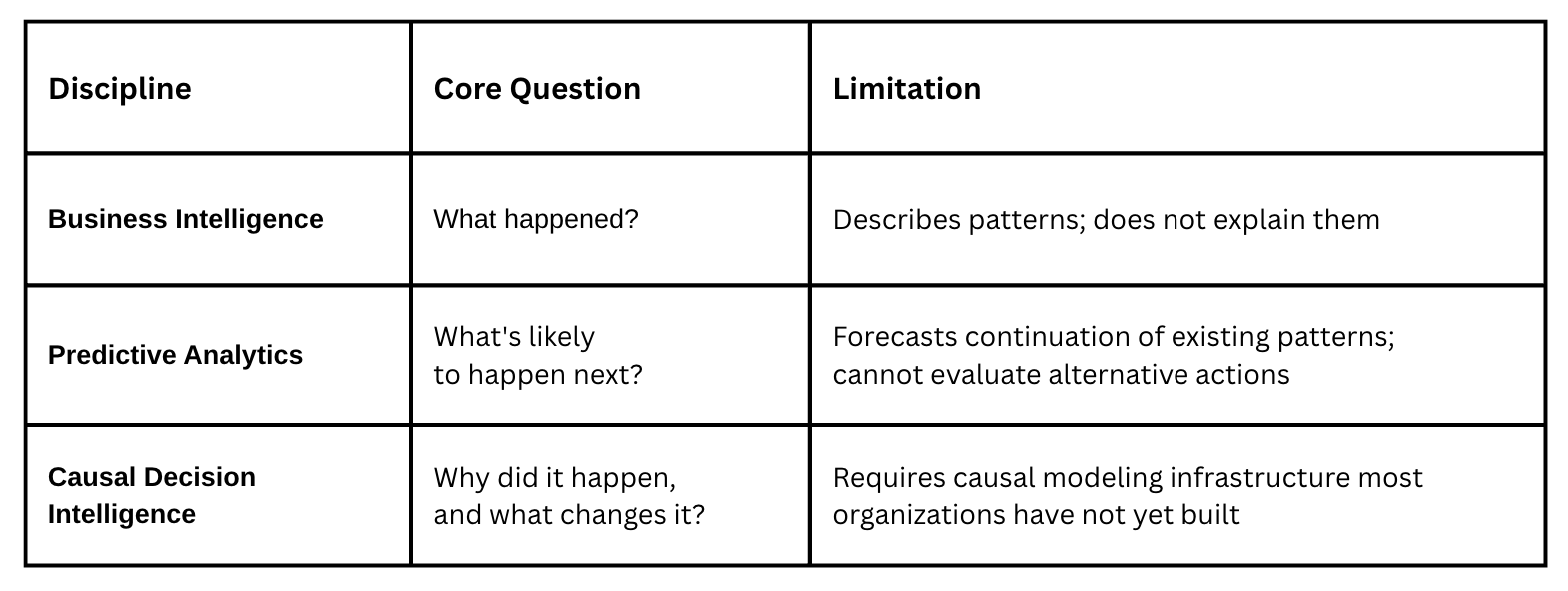
Each discipline serves a distinct function, and none replaces the others. But only causal analysis can indicate, with defensible confidence, whether a specific intervention will produce the intended outcome.
The Bottom Line
Most organizations are not short on dashboards. They are short on the time required to manually determine why a number moved, a bottleneck that scales poorly as data volume and decision speed both increase. Causal decision intelligence exists because "what changed" was never the difficult question in business decision-making. "Why" was, and it remains the question that determines what happens next.
Source: The Cube Research, Communications of the ACM, CausalDecisionIntelligence (UK)
Keep reading
More from the blog
See FireAI on your data.
Book a walkthrough to see how FireAI turns your business data into AI-driven decisions.