

Quick answer
No — AI cannot fully replace business analysts, but it does automate many of their routine tasks. AI excels at data retrieval, report generation, anomaly detection, and pattern recognition. Business analysts provide the strategic thinking, domain expertise, stakeholder communication, and contextual judgment that AI cannot replicate. The future is AI-augmented analysts, not AI-replaced analysts.
AI is transforming the business analyst role — automating many tasks, but not eliminating the need for human analytical judgment.
The question isn't really "will AI replace analysts?" The more useful question is: "Which parts of the analyst role will AI change, and what will analysts do with the time freed up?"
What AI Can Do That Business Analysts Currently Do
Routine Data Retrieval
Analysts currently spend 40–60% of their time on data extraction — writing SQL queries, pulling from systems, cleaning data, and formatting outputs. AI-powered tools like natural language querying and automated analytics handle this automatically.
Standard Report Preparation
Monthly sales reports, weekly KPI summaries, finance dashboards — these follow the same structure every cycle. AI handles the compilation, calculation, formatting, and delivery automatically. See can AI generate business reports.
Anomaly Detection
Identifying unusual patterns in large datasets — the work that took analysts hours of investigation — is handled by AI anomaly detection algorithms in real time.
Basic trend analysis
Describing what happened over time and identifying top contributors to changes. This is the most basic form of descriptive analytics and is fully automatable.
Dashboard Maintenance
Building and updating recurring dashboards. AI-powered BI tools like FireAI build and maintain dashboards automatically as data is refreshed.
What AI Cannot Replace in Business Analysts
Strategic Problem Framing
Before any analysis starts, a business analyst must define what question is actually being asked. This requires business context, stakeholder management, and problem-solving judgment that AI cannot replicate.
AI answers questions. Analysts ask the right questions.
Domain-Specific Interpretation
Knowing that a 15% drop in sales this week in the Northern region is likely related to a local competitor promotion — not a systemic problem — requires domain knowledge and business context that AI doesn't have.
Numbers need interpretation. Interpretation requires experience.
Stakeholder Communication
Translating analytical findings into compelling business recommendations, presenting to executives, managing expectations, and driving decision-making through organisational dynamics — this requires human communication and political intelligence.
Hypothesis Generation
The best analytical insights come from humans who know the business well enough to generate non-obvious hypotheses and design analysis to test them. AI can test hypotheses efficiently; generating the right hypotheses is a human skill.
Cross-Functional Synthesis
Combining insights from finance, operations, sales, and customer data into a coherent strategic recommendation requires the ability to hold multiple complex models in mind simultaneously — a distinctly human cognitive capability.
Ethical and Governance Judgment
Deciding what data should be used, how privacy considerations apply, and whether an analytical conclusion should drive a particular decision involves ethical reasoning that AI systems don't currently possess.
The Emerging Role: AI-Augmented Business Analyst
The most productive analysts will be those who leverage AI to multiply their output:
- AI handles data extraction, report generation, and routine dashboards
- Analysts focus on hypothesis generation, strategic framing, and stakeholder advisory
- AI surfaces anomalies; analysts determine which are strategically significant
- AI generates first-draft insights; analysts refine and contextualise them
This "AI-augmented analyst" can do the analytical work of 3–5 traditional analysts — not because AI replaces the thinking, but because it eliminates the data drudgery.
Impact on Analyst Job Market in India
India has a large and growing business analytics workforce. The likely evolution:
- Junior/entry-level analyst roles will be most impacted — routine data prep and reporting are the most automatable tasks
- Senior analysts and analytics leads who focus on strategy and stakeholder management will remain in high demand
- New roles will emerge — AI analytics managers, data quality and governance specialists, and AI output reviewers
The net result is unlikely to be mass unemployment, but a significant shift in what analysts are expected to do and the skills required to remain valuable.
Ready to act on your data?
See how teams use FireAI to ask in plain language and get analytics they can trust.
Explore FireAI workflows
Go from this topic into product features and solution paths that match what you read here.
Topic hub
AI Analytics
Guides on natural language querying, AI-powered analytics, forecasting, anomaly detection, and automated insights.
Explore hubFrequently asked questions
Will AI replace business analysts in India?
AI will automate many routine analyst tasks (data extraction, report preparation, anomaly detection) but will not replace analysts who provide strategic thinking, domain expertise, and stakeholder management. The outlook for analysts who embrace AI tools is positive — they become significantly more productive and focus on higher-value work.
Which analyst tasks are most at risk from AI automation?
The tasks most at risk are: routine report preparation, data extraction and cleaning, building standard dashboards, writing SQL for common business queries, and basic trend analysis. These are highly automatable with current AI technology.
What skills should business analysts develop to work with AI?
Analysts who thrive alongside AI will develop: strong problem framing and hypothesis generation skills, ability to evaluate and validate AI-generated insights, stakeholder communication and storytelling with data, data governance and AI ethics literacy, and proficiency in AI-powered BI tools.
Can AI do everything a business analyst does?
No. AI cannot replicate strategic problem framing, domain-specific business interpretation, cross-functional synthesis, stakeholder communication, or ethical judgment. These distinctly human capabilities remain essential. AI and analysts work best together — AI handling scale and speed, analysts providing judgment and strategy.
Related in this topic
What is Agentic Analytics? AI Agents for BI
Agentic analytics uses autonomous AI agents to proactively analyze data, surface insights, trigger alerts, and take actions without human prompting. Learn how agentic AI differs from traditional BI, and what it means for business decision-making.
What is Generative BI? AI-Powered BI Explained
Generative BI uses large language models (LLMs) to automatically generate reports, insights, visualizations, and natural language summaries from business data. Learn what generative BI is, how it works, and how it differs from traditional BI tools.
What is Automated Analytics? Definition and Benefits
Automated analytics uses AI and machine learning to automatically generate insights, detect anomalies, and deliver reports without manual intervention. Learn how automated analytics works and how it reduces the reporting burden on business teams.
What is Self-Service BI? Benefits and Tools
Self-service BI empowers business users to analyze data independently without IT assistance. Learn how self-service BI works, which tools enable it, and how to implement it to democratize data access and accelerate decision-making.
From the blog
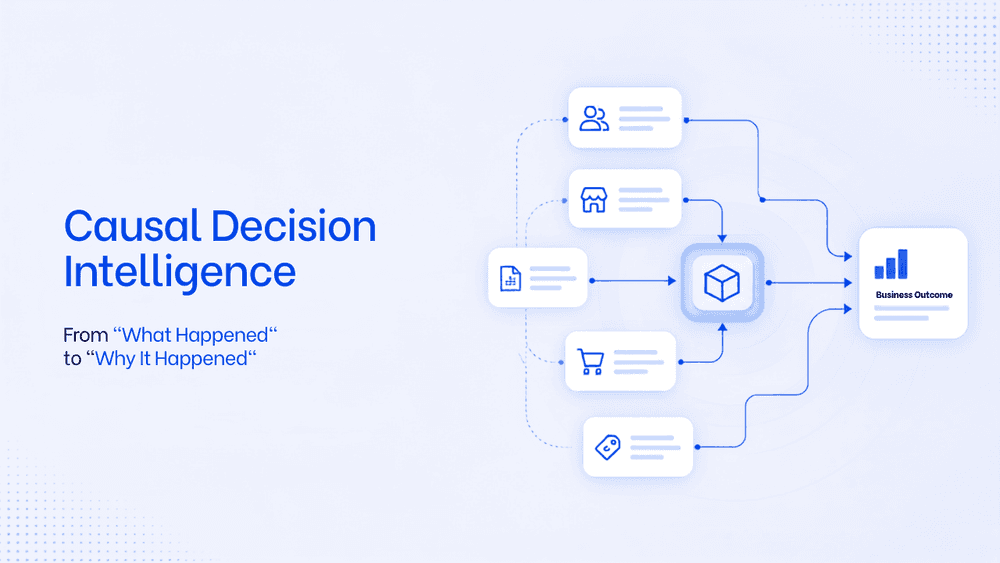
What Is Causal Decision Intelligence? A Framework To Move From "What Happened" to "Why It Happened"
Business intelligence tools are limited in their capability to find the root cause and the trigger behind it. Causal decision intelligence is the AI layer that helps business take faster, smarter decision with an auditable explanation. This will transform the way business analyse data and strategise on teh next actionable steps.

How a Modern Analytics Platform Transforms Business Intelligence
Why faster decision-making, real-time analytics, and AI-driven intelligence separate market leaders from laggards—and how Fire AI closes the gap between data and action.
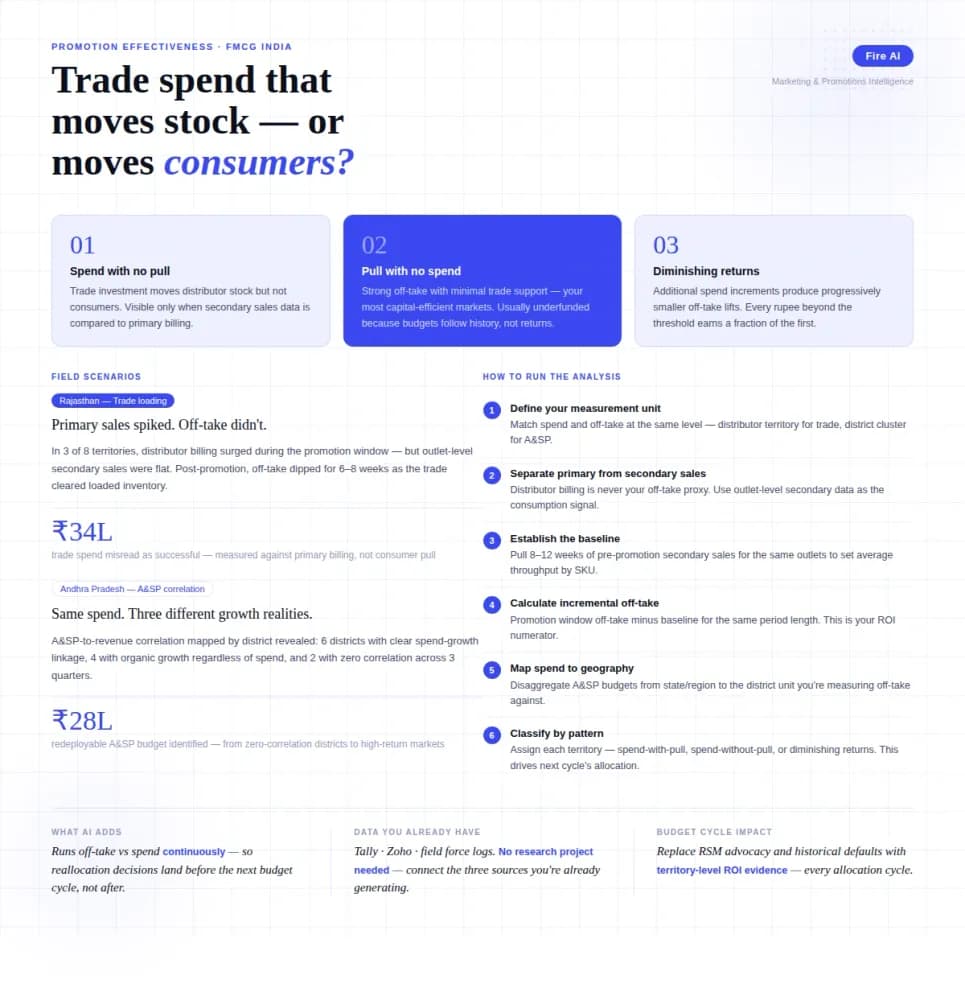
Measuring Promotion Effectiveness: A Data-Driven Guide for FMCG Marketers
FMCG brands in India spend 15–25% of gross revenue on trade promotions and A&SP (advertising and sales promotion) every year. Most can tell you how much they spent. Very few can tell you what it returned. The problem isn't a lack of data — it's that the data lives in disconnected places. Trade spend sits in finance. Off-take data lives with the distributor or field team. A&SP budgets are tracked in a marketing spreadsheet. No single view ties promotional investment to consumer pull at the outlet level. The result is a budget cycle where last year's spend allocation becomes next year's default, because no one has the numbers to argue for something different. This guide walks through how FMCG marketing and trade teams can build a promotion effectiveness framework that actually connects spend to outcome — not just channel-level assumptions.