

Quick answer
Logistics companies should invest in BI when operations need unified trip, fuel, and billing views, not late spreadsheets. The cost of no analytics is unprofitable lanes, SLA penalties, and idle assets. ROI compares cost to time saved and margin protected; many fleets see payback within months. Invest when you run multiple lanes, face SLAs, or need metrics for tenders.
Most logistics and transport companies should invest in BI once they have enough lanes, customers, and systems that weekly decisions cannot wait for reconciled Excel. This page is a decision guide: the hidden cost of not having analytics, how to think about ROI, what a reasonable rollout looks like, and when waiting is rational. For the problem case itself, start with why logistics companies need analytics. For the product view, see cargo and logistics solutions and logistics finance use cases.
The cost of no analytics in logistics
Without consolidated analytics, the same data exists (TMS, GPS, fuel, ERP or Tally), but no one sees margin, utilization, and service quality in one place until the month closes or a customer complains.
What you pay for in practice:
- Unprofitable lanes and customers stay on the network because blended averages look acceptable.
- SLA and penalty risk is discovered after breaches, not when trends drift.
- Fuel and maintenance variance is argued without liter-per-km or vehicle-level baselines.
- Freight billing and subcon disputes take finance and operations days to resolve from PDFs and screenshots.
That cost is not just software avoided; it is margin and credibility given away. Indian operators bidding for e-commerce, pharma, and manufacturing contracts increasingly need on-time, utilization, and cost proof, not assurances.
A practical ROI view for logistics BI
A useful ROI for logistics starts with a simple equation: one-time and annual platform cost, plus internal time to connect sources and own dashboards, versus benefits you can plausibly measure in 6 to 12 months.
| Benefit bucket | What to measure | Example levers |
|---|---|---|
| Lane and customer P&L | Margin by lane, client, or hub | Drop bad mix, reprice, change allocation |
| Asset utilization | Loaded km, dwell, trips per vehicle | Backhaul, shift planning, branch targets |
| OTD and SLA | On-time %, delay reason codes, hub variance | Fix hubs before penalties and churn |
| Fuel and maintenance | Liter per km, variance to benchmark | Route change, driver coaching, theft flags |
| Reconciliation | Time to match freight, fuel, and tolls | Fewer FTE hours, faster invoicing, fewer write-offs |
You do not need a perfect model on day one. Most teams get value when they can answer a short list in minutes: Which lanes were negative last week? Which five vehicles drove fuel cost per km? Which customers missed OTD target two weeks in a row? Measure analytics ROI explains how to frame benefit capture more broadly.
FireAI fits teams that want Tally, operational feeds, and natural-language questions in one place so operations and finance share one set of numbers without a full analytics department.
Implementation timeline: what to expect
Timelines depend on data readiness, not the PDF the vendor sent.
- 0 to 4 weeks: Connect core sources (billing from Tally or ERP, basic trip or TMS export, optional GPS or fuel). Stand up first dashboards: OTD, utilization, top lanes by margin if allocation exists.
- 1 to 3 months: Add branch or hub cut, customer-level SLA scorecards, fuel benchmarks, and freight reconciliation views that finance can trust. Tune alerts and owner roles.
- Ongoing: New lanes, new clients, and new integrations (e-wallets, e-way, additional hubs) are normal; treat BI as infrastructure, not a one-off project.
If the organization cannot assign an owner (ops, finance, or commercial) for 4 to 6 hours a week, even a good tool will under-deliver. In that case, fix ownership first or start with a narrower scope, for example OTD and fuel only.
When investing in logistics BI makes sense (and when to wait)
Prioritize investment when:
- You operate multiple branches, lanes, or hubs and P&L is still read at aggregate level.
- Customers measure you with SLAs, scorecards, or penalties.
- You bid for tenders that ask for history on utilization, on-time, or cost per ton-km.
- Reconciliation between operations and finance consumes more than a few person-days a month.
- You have outgrown static MIS but leadership still asks for ad hoc files before every review.
It can wait when:
- You are very small, single-lane, single-customer, and the founder still knows every number by heart.
- You have not stabilized master data (vehicles, drivers, cost centers) enough to match trips to P&L.
- You are in a one-time crisis where hiring a short-term analyst is enough for the next 90 days.
Next steps: compare options and a practical build
If you are ready to shortlist tools, use best BI tools for logistics in India and then how to build a logistics analytics dashboard for a concrete structure and data sources. Together with logistics finance use cases and the cargo and logistics solution, you can align investment to the metrics that protect margin first.
Ready to act on your data?
See how teams use FireAI to ask in plain language and get analytics they can trust.
Explore FireAI workflows
Go from this topic into product features and solution paths that match what you read here.
Topic hub
Industry Analytics In India
Comparison pages and implementation guidance for industry-specific BI, dashboards, and analytics use cases in India.
Explore hubFrequently asked questions
Should all logistics companies invest in BI?
Not on day one. One-vehicle or single-customer operations may not justify full BI. Most multi-lane, multi-hub, or SLA-driven operators benefit once spreadsheet delays or billing disputes get expensive. The decision is about scale, complexity, and how often you lose margin to invisible lanes or service.
What is the main ROI of logistics BI?
Usually a mix of better lane and customer margin visibility, higher asset utilization, fewer SLA penalties, lower fuel and maintenance variance, and less time on freight and toll reconciliation. The exact order depends on whether your biggest leak is service, cost, or cash.
How long does logistics BI take to show value?
Many teams get first dashboards in a few weeks if trip and billing data are available. Deeper P&L by lane, trusted reconciliation, and branch scorecards often take one to three months as mappings and data quality improve.
Can small logistics companies in India use BI without a data team?
Yes, if the platform connects to Tally, TMS, and GPS and supports plain-language questions. The constraint is more often ownership and clean master data than headcount. Modern tools are built so operations and finance leads can run the views they need with minimal IT support.
Related in this topic
Why Logistics Companies Need Analytics in 2026
Learn why transport and logistics operators need analytics: margin pressure, fleet underutilization, delivery SLA risk, and fuel waste. See how dashboards and AI-driven insights from trip, fuel, and ERP data improve profitability.
Best BI Tools for Logistics Companies in India (2026)
Compare the best BI and analytics platforms for Indian logistics and transport companies. See how tools stack up on fleet management, lane profitability, delivery SLA tracking, and Tally-friendly finance dashboards.
How to Build a Logistics Analytics Dashboard: KPIs, Data & Layout
Practical steps to build a transport and logistics analytics dashboard: pick the right KPIs, connect GPS, TMS, and ERP, design executive and hub views, and see how FireAI auto-builds logistics dashboards for teams in India.
How to Measure Analytics ROI: A Practical Framework
Learn how to calculate the return on investment (ROI) from your business intelligence and analytics implementation. Use this framework to quantify time saved, decisions improved, and revenue impact from analytics.
From the blog

Democratizing Data: How AI Analytics Levels the Playing Field for Small Businesses and Freelancers
For decades, data-driven decision making was a luxury that only enterprises could afford. Big companies hired data scientists, purchased expensive BI tools, and built complex data warehouses. In exchange, they received precise insights that guided budgets, strategy, and growth.
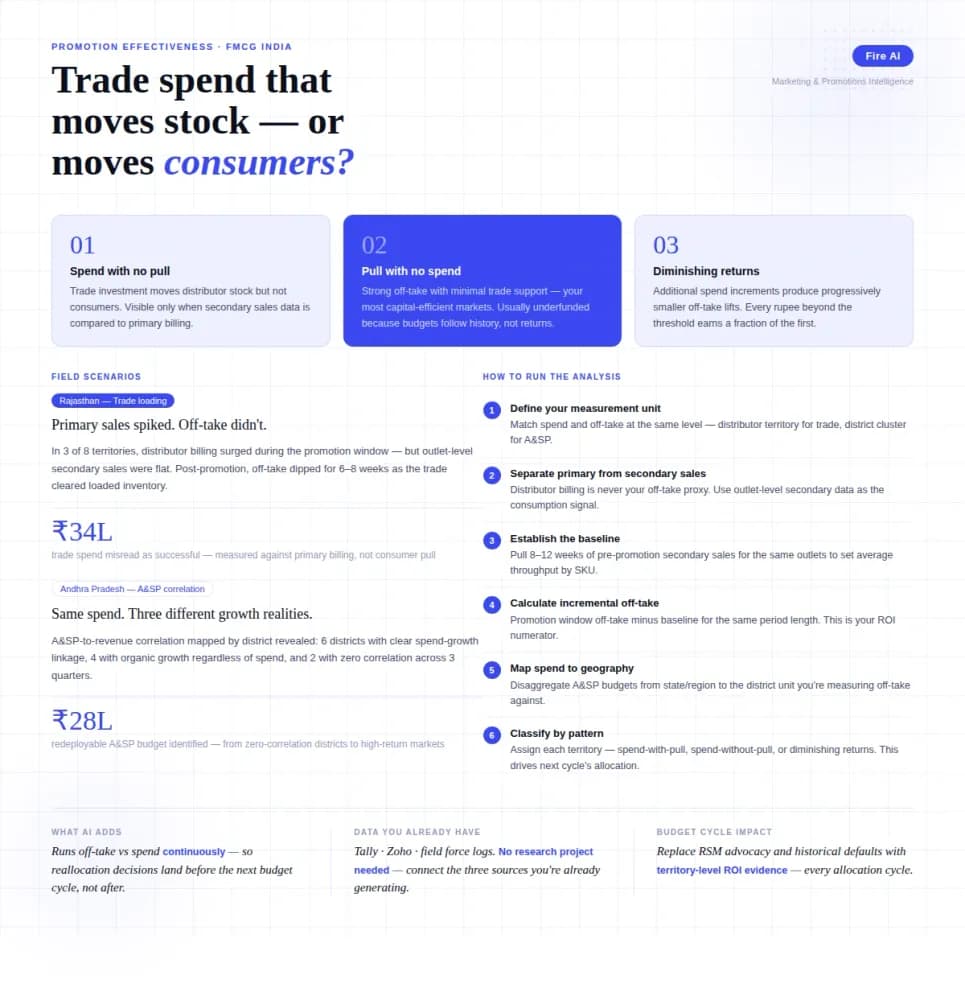
Measuring Promotion Effectiveness: A Data-Driven Guide for FMCG Marketers
FMCG brands in India spend 15–25% of gross revenue on trade promotions and A&SP (advertising and sales promotion) every year. Most can tell you how much they spent. Very few can tell you what it returned. The problem isn't a lack of data — it's that the data lives in disconnected places. Trade spend sits in finance. Off-take data lives with the distributor or field team. A&SP budgets are tracked in a marketing spreadsheet. No single view ties promotional investment to consumer pull at the outlet level. The result is a budget cycle where last year's spend allocation becomes next year's default, because no one has the numbers to argue for something different. This guide walks through how FMCG marketing and trade teams can build a promotion effectiveness framework that actually connects spend to outcome — not just channel-level assumptions.

How a Modern Analytics Platform Transforms Business Intelligence
Why faster decision-making, real-time analytics, and AI-driven intelligence separate market leaders from laggards—and how Fire AI closes the gap between data and action.