

Quick answer
AI analytics works by: (1) connecting to your business data sources, (2) using machine learning algorithms to identify patterns and anomalies automatically, (3) using natural language processing (NLP) to understand questions in plain language and generate narrative summaries, and (4) using large language models (LLMs) to produce human-readable explanations of what the data shows. The result: business users get instant answers and automatic insights without writing SQL or knowing data analysis techniques.
Understanding how AI analytics works helps you evaluate what any given tool is actually capable of — separating genuine AI capabilities from marketing hype.
The Five Layers of AI Analytics
Layer 1: Data Connection and Ingestion
AI analytics starts with data. The system connects to your business data sources — Tally, ERP, CRM, databases, APIs — and ingests relevant data into its analytical engine.
What happens here: Data is extracted, standardised (dates normalised, currencies converted, categories mapped), and loaded into the AI system's queryable store.
AI's role: Minimal. This is primarily engineering work. The AI comes later.
Layer 2: Semantic Understanding (The Business Model)
Raw data tables need to be mapped to business concepts. "What is revenue?" — is it net revenue, gross? Which Tally ledger? Excluding returns?
What happens here: A semantic layer (or business model) defines how raw data maps to business terms. This is typically configured once during setup.
AI's role: Some AI systems can auto-suggest semantic models from database schema patterns — but human review is still needed.
Layer 3: Pattern Detection (Machine Learning)
This is where AI adds its first major value. Machine learning algorithms continuously scan all data for:
- Trend detection: Is metric X trending up, down, or stable over recent periods?
- Anomaly detection: Does today's value deviate significantly from the expected range (based on historical patterns)?
- Correlation discovery: Do changes in metric A consistently precede changes in metric B?
- Segmentation: Do data points naturally cluster into distinct groups?
Key point: ML algorithms scan all metrics simultaneously — covering patterns that no human analyst would have time to check manually.
Layer 4: Natural Language Processing (Query Understanding)
When a user asks a question ("What were the top 5 products by revenue last quarter in South India?"), NLP:
- Parses the question to identify intent (ranking), metrics (revenue), dimensions (product, region), and time period (last quarter)
- Translates the parsed intent into a database query
- Executes the query against the business data
- Returns structured results
Modern NLP systems handle complex questions, follow-up questions ("What about the same period last year?"), and questions in multiple languages including Hindi.
Layer 5: Generative AI (Narrative Generation)
The newest AI layer — using large language models (LLMs) to:
- Narrate what the data shows in plain language: "Revenue in South India declined 12% last quarter, driven primarily by a 28% decline in Tamil Nadu..."
- Explain anomalies: "The Thursday spike in orders coincides with the weekly distribution day for your top distributor"
- Recommend: "Based on current trajectory and historical seasonal patterns, Q4 is projected at ₹8.2Cr — consider increasing inventory now"
This is generative BI — the most advanced current frontier of AI analytics.
What AI Analytics Cannot Do (Yet)
Cannot verify context: AI sees the data patterns but not the business context. "Sales declined in Maharashtra" — AI can identify this, but knowing it's because your key distributor had a personal emergency requires human knowledge.
Cannot replace strategy: AI identifies what's happening and what's likely to happen. Deciding what to do about it requires human judgment, values, and accountability.
Cannot work with bad data: AI analytics amplifies whatever the underlying data says — including errors. Good AI analytics requires good data quality foundations.
See what is AI data analytics for the broader conceptual overview, and what is generative BI for the latest frontier.
Ready to act on your data?
See how teams use FireAI to ask in plain language and get analytics they can trust.
Explore FireAI workflows
Go from this topic into product features and solution paths that match what you read here.
Topic hub
AI Analytics
Guides on natural language querying, AI-powered analytics, forecasting, anomaly detection, and automated insights.
Explore hubFrequently asked questions
How is AI analytics different from traditional analytics?
Traditional analytics requires humans to define what to look for, write queries, and interpret results. AI analytics automates pattern detection (ML continuously monitors all metrics), query interpretation (NLP understands plain language questions), and insight generation (generative AI produces narrative explanations). Traditional analytics answers questions humans think to ask; AI analytics surfaces patterns humans might never have thought to look for.
What AI technology powers modern BI tools?
Modern AI BI tools combine: machine learning for anomaly detection and forecasting, NLP (natural language processing) for query understanding, large language models (LLMs like GPT or Llama) for narrative generation, and statistical models for trend analysis and confidence intervals. Different tools use different AI approaches — FireAI uses a combination of these for its natural language querying, automated insights, and Tally data analysis capabilities.
Do I need technical knowledge to use AI analytics?
No — the purpose of AI analytics is to make data analysis accessible to non-technical business users. You ask questions in plain language (or Hindi), and the AI system translates, queries, and answers automatically. The technical complexity is handled by the AI layer. Business users interact with a conversational interface, not SQL or code. Initial setup (connecting data sources, defining business metrics) may require some technical work, but day-to-day use is fully accessible to non-technical users.
Related in this topic
Can AI Do Data Analytics? Examples, Capabilities and Limits
Yes, AI can perform sophisticated data analytics including pattern recognition, predictive modeling, and automated insights generation. Learn how AI does data analytics, which capabilities it provides, and see examples of AI-powered business intelligence.
What is AI-Powered Business Intelligence?
AI-powered business intelligence integrates AI and machine learning with traditional BI to automate insights, enable natural language queries, and provide predictive analytics. Learn how AI BI works, which features matter, and how businesses use it.
What is Generative BI? AI-Powered BI Explained
Generative BI uses large language models (LLMs) to automatically generate reports, insights, visualizations, and natural language summaries from business data. Learn what generative BI is, how it works, and how it differs from traditional BI tools.
What is Agentic Analytics? AI Agents for BI
Agentic analytics uses autonomous AI agents to proactively analyze data, surface insights, trigger alerts, and take actions without human prompting. Learn how agentic AI differs from traditional BI, and what it means for business decision-making.
From the blog

How a Modern Analytics Platform Transforms Business Intelligence
Why faster decision-making, real-time analytics, and AI-driven intelligence separate market leaders from laggards—and how Fire AI closes the gap between data and action.
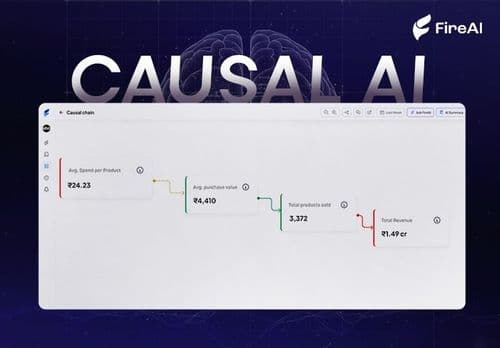
Causal AI Explained: Uncovering the “Why” in Data with Machine Learning
Causal AI reveals not just what will happen, but why — and exactly what changes if you act differently. It turns predictions into high-ROI decisions by uncovering true cause-and-effect in your data.
Democratizing Data: How AI Analytics Levels the Playing Field for Small Businesses and Freelancers
For decades, data-driven decision making was a luxury that only enterprises could afford. Big companies hired data scientists, purchased expensive BI tools, and built complex data warehouses. In exchange, they received precise insights that guided budgets, strategy, and growth.