

Quick answer
To automate GST reconciliation from Tally, sync or export B2B vouchers with GSTIN, invoice number, and tax split. Build keys to join Tally to GSTR-2B and align GSTR-1 with GSTR-3B, then auto-flag missing lines and variances. FireAI connects Tally to this path so you resolve exceptions, not re-key rows.
One-off invoice check? Use the free GST Calculator for quick CGST/SGST/IGST math before you reconcile. Need to match a GSTR-2B file against your purchase register right now? Run the free GSTR-2B reconciliation tool in your browser.
Automating GST reconciliation from Tally means your books and GSTN data stay aligned with minimal copy-paste, and you spend time on exceptions, not on line-by-line comparison. The steps below are the same workflow finance teams use manually; software and AI remove the heavy lifting. If you first need a clear yes or no on whether AI can do this, see can AI automate GST reconciliation from Tally data?. For SKU-level credit nuances in complex purchasing, also read GST credit reconciliation by SKU.
Step 1: Export or sync Tally data with full GST details
Start from vouchers that already carry the fields GSTN matching needs.
- Purchase and sales registers for the tax period, including B2B, B2C large, and credit or debit notes linked to original invoices.
- On each line, capture party GSTIN, invoice number, invoice date, place of supply, taxable value, and CGST, SGST, and IGST (or the integrated rate where applicable) plus HSN where you use it for validation.
- Decide your grain (usually one row per invoice per party) and remove duplicates from reversals, advances, and adjustments that would double-count the same document.
- Prefer a live connector to Tally Prime so exports are not three weeks old when you reconcile; manual Excel pulls work but repeat every return cycle.
Inconsistent party masters (wrong or missing GSTIN) break matching before you even open the portal, so clean masters first.
Step 2: Map a stable match key (GSTIN × invoice and more)
GST reconciliation is essentially joining two tables on business keys.
- Primary key for B2B is usually
supplier or customer GSTIN+invoice number+invoice date(some teams add taxable value to break ties on duplicate series). - Normalise invoice numbers: trim spaces, upper-case alphabets, and align with how the counterparty files on the GST portal.
- Map credit and debit notes to the original invoice or document so ITC and liability stay in the same family.
- Tag document type (original, amendment, note) so you do not expect the same GSTR-2B line to match two different Tally rows without reason.
This mapping step is what turns "two piles of data" into a join your automation can run every month.
Step 3: Auto-match books to GSTR-2B and align GSTR-1 with GSTR-3B
Split the problem into purchase-side and return-side checks.
- Purchases and ITC: download or fetch GSTR-2B and match each eligible line to your Tally purchase register. Missing in GSTR-2B means ITC is not in your books from the portal view; missing in Tally but present in GSTR-2B means an unbooked or mis-keyed purchase.
- Outward supply: use GSTR-1 (or books derived from the same source) and reconcile taxable values and tax amounts to GSTR-3B tables for outward supply and tax payable. Mismatches here are a common source of department queries.
- Apply tolerances for rounding (rupee-level) where your policy allows, but flag material tax differences.
- Reconcile ITC claimed in GSTR-3B with available credit from GSTR-2B after the above purchase match, so you do not over-claim or leave credit idle without explanation.
Automation here is repeated matching and variance rules, not a one-off VLOOKUP.
Step 4: Flag mismatches with clear categories
Categorise exceptions so accountants fix root causes, not random rows.
- Not in books, in GSTR-2B (or the reverse) for the same key.
- Amount or tax rate differences on what looks like the same document.
- GSTIN errors (wrong party, branch, or UIN) that stop reconciliation even when amounts look close.
- Period issues (invoice booked in a different month than the counterparty filed).
- Priority list for vendors or customers that drive the largest tax or commercial exposure.
A short exception report beats a 5,000-row dump.
Step 5: Reconcile with FireAI (ongoing, not one spreadsheet)
FireAI is built for Tally-first finance workflows: sync data, apply matching, and keep GST views on a dashboard.
- Connect Tally so purchase and sales vouchers flow in with GST fields without re-exporting everything by hand.
- Ingest GSTR-2B (and the return views you use) to run the same join logic on every return period.
- Surface mismatch dashboards and natural-language questions (for example, which vendors have repeat amount differences) so the team chases the right parties before filing.
- Track trends by GSTIN and by month to see whether problems are one-off data entry or systematic master issues.
This closes the loop from data to action: automate detection, keep humans for judgement and follow-up. For a broader view, see Tally GST analytics and how to build a GST dashboard from Tally.
Ready to act on your data?
See how teams use FireAI to ask in plain language and get analytics they can trust.
Explore FireAI workflows
Go from this topic into product features and solution paths that match what you read here.
Topic hub
Tally Analytics
Analytics for Tally Prime and Tally ERP — one of 700+ data sources FireAI connects to — including dashboards, reporting, GST, and finance workflows.
Explore hubFrequently asked questions
What is the minimum data I need in Tally before automating GST reconciliation?
You need B2B purchase and sales vouchers with correct party GSTIN, invoice number, date, taxable value, and split of CGST, SGST, and IGST (or integrated tax). Credit and debit notes should link to the right original invoice. Clean party masters and consistent invoice numbering on both sides of the transaction make automated matching reliable.
How is GSTR-1 versus GSTR-3B different from GSTR-2B matching with Tally?
GSTR-2B matching compares your Tally purchase register to what suppliers filed (input tax credit and purchase visibility). GSTR-1 versus GSTR-3B checks that your outward supply and tax liability in the monthly return are consistent with the summary you file. Both are required for a full reconciliation; automation can run all three in parallel.
Can small businesses automate GST reconciliation without a large IT project?
Yes. A connector-led stack with pre-built matching and dashboards avoids custom ETL. If you use Tally Prime, prioritise a tool that syncs vouchers with GST details and ingests GSTR-2B so you are not maintaining fragile CSV links every month.
How does this page differ from asking whether AI can automate GST reconciliation?
The "can" question explains feasibility and benefits of AI for GST. This page is a how-to: export and map data, match returns, flag exceptions, and use a platform like FireAI for ongoing automated reconciliation. Use both together if you are deciding first, then implementing.
Related in this topic
Can AI Automate GST Reconciliation from Tally Data?
Yes — AI can automate GST reconciliation by matching your Tally purchase register against GSTR-2B data, flagging mismatches, and tracking ITC discrepancies in real time.
Tally GST Analytics: Compliance, Returns & ITC Tracking
Use Tally GST analytics to track GSTR-1, GSTR-3B filings, ITC reconciliation, and compliance status from your Tally Prime data. Dashboards for Indian GST compliance.
How to Build a GST Dashboard from Tally Data
Learn how to build a real-time GST dashboard from Tally Prime data — track GSTR-1, GSTR-3B, input tax credit, and GST liability with visual analytics and automated alerts.
GST Return Analytics: GSTR-1, GSTR-3B & ITC Tracking
GST return analytics helps Indian businesses track GSTR-1, GSTR-3B filings, ITC reconciliation, and compliance status. Dashboards for GST data from Tally, ERP, or accounting software.
From the blog
Tally Analytics Dashboards for Indian Businesses
80% of Indian SMBs use Tally. Fewer than 5% have dashboards. Learn how to build real-time P&L, cash flow, and receivables analytics from your Tally Prime data.
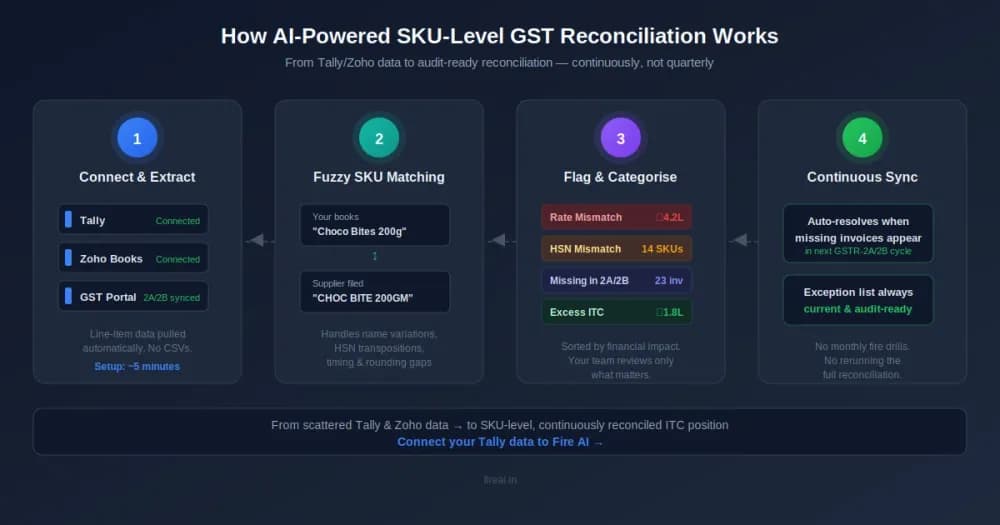
GST Credit Reconciliation by SKU: An AI-Powered Approach for FMCG
Your invoice totals match. Your GSTR-2A looks clean. But buried three levels down, at the SKU level, there's ₹14 lakh in ITC you either shouldn't have claimed — or haven't claimed at all. Here's how AI surfaces what spreadsheets can't.

Why Tally + ERP + Excel Will Never Agree With Each Other
Data fragmentation happens when Tally, your ERP, and Excel each hold a different version of the truth. Here's why reconciliation doesn't fix it and what does.